Charts like this, from your own numbers.
Connect a spreadsheet or the tools you run on, and Parity builds the dashboard and writes the report, with every number checked.
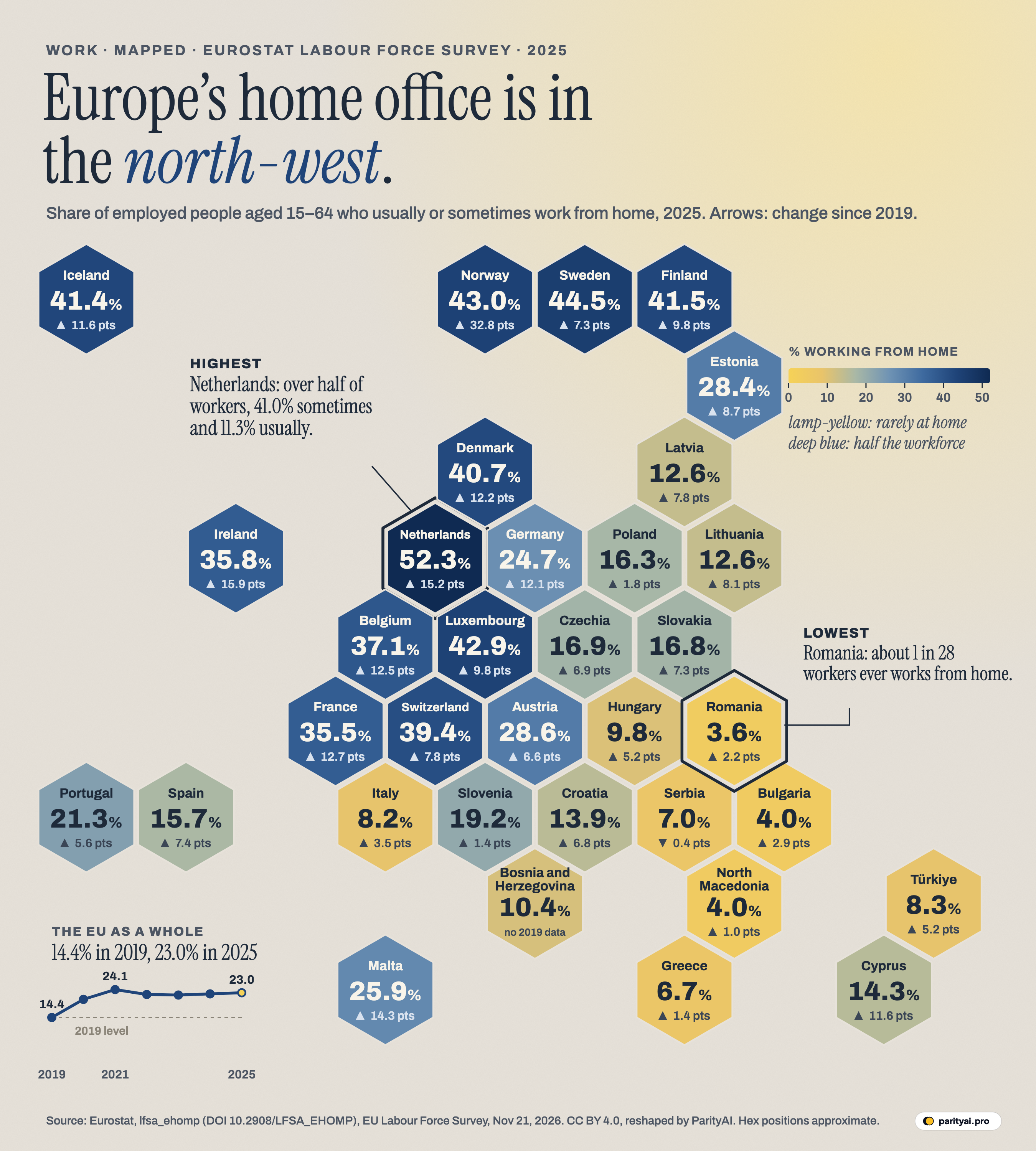
Try Parity freePick any working week in 2025 and line up the employed people of the Netherlands. 52.3% of them worked from home at least some of the time. Do the same in Romania and the figure is 3.6%. That's roughly one person in two against about one in 28, inside the same single market and counted by the same survey.
The map above sets that gap out across 34 countries. It uses Eurostat's lfsa_ehomp table, which comes from the EU Labour Force Survey. For each country it gives the share of employed people aged 15 to 64 who say they work from home "usually" or "sometimes". The EU as a whole sat at 23.0% in 2025. In 2019, before the pandemic, it was 14.4%.
Reading the hexagons
Every country gets one hexagon of the same size, whatever its population. Germany's hexagon is no bigger than Malta's. The layout follows the map roughly: Iceland is out on its own at top left, the Nordic countries run along the top, Iberia sits bottom left and Cyprus bottom right. Positions are approximate, and the United Kingdom isn't shown (more on that at the end).
Colour carries the 2025 share. Lamp yellow means almost nobody works from home; deep blue means around half the workforce does. The big number in each hexagon is that share. The small line underneath is the change since 2019 in percentage points. An up-arrow of 10 points means the share is 10 points higher than in 2019, not 10% higher. The two outlined hexagons are the extremes. The small line chart at bottom left shows the EU as a whole: up sharply in 2020 and 2021, then flat at its new level.
The rest of this piece follows the working week. Each day takes one question about who works from home, and the numbers for it.
Monday: who stays home
Start with the deep-blue block. 7 countries passed 40% in 2025: Netherlands, Sweden, Norway, Luxembourg, Finland, Iceland, Denmark. Behind them come Switzerland (39.4%), Belgium (37.1%), Ireland (35.8%) and France (35.5%). The north-western corner of the map is one dark patch.
The Netherlands is first by a clear margin, at 52.3%. Sweden is second at 44.5%, Norway third at 43.0% and Luxembourg fourth at 42.9%. Finland is close behind at 41.5%, and it leads a different list: the share who usually work from home. On that measure Finland is first in Europe, at 20.5%, and Ireland is next at 19.2%.
The north-west was ahead before COVID-19 too. Eurostat's 2020 news release on 2019 data said the Netherlands and Finland "topped the list of EU Member States for remote-working, with 14.1%" usually working from home. In 2019 the Dutch total, usually plus sometimes, was already 37.1%. That is higher than the EU's 2025 figure of 23.0%. The pandemic didn't put the north-west in front. It raised a lead the region already had.
Why the region leads is a harder question, and the survey doesn't answer it. When Euronews asked economists in June 2026, an economist at the EBRD linked the high rates to economies built on desk work in ICT, finance and professional services. A Eurofound researcher in the same article pointed to internet speeds and to right-to-request rules, naming France, Ireland and the Netherlands. Take those as explanations offered by experts, not things the data proves.
| # | Country | Usually + sometimes | Usually | Sometimes | Change since 2019 (pts) | 2019–2025 |
|---|---|---|---|---|---|---|
| 1 | Netherlands | 11.3 | 41.0 | ▲ 15.2 | ||
| 2 | Sweden | 12.4 | 32.1 | ▲ 7.3 | ||
| 3 | Norway | 5.4 | 37.6 | ▲ 32.8 | ||
| 4 | Luxembourg | 11.2 | 31.7 | ▲ 9.8 | ||
| 5 | Finland | 20.5 | 21.0 | ▲ 9.8 | ||
| 6 | Iceland | 8.0 | 33.4 | ▲ 11.6 | ||
| 7 | Denmark | 7.6 | 33.1 | ▲ 12.2 | ||
| 8 | Switzerland | 7.2 | 32.2 | ▲ 7.8 | ||
| 9 | Belgium | 13.2 | 23.9 | ▲ 12.5 | ||
| 10 | Ireland | 19.2 | 16.6 | ▲ 15.9 | ||
| 11 | France | 11.1 | 24.4 | ▲ 12.7 | ||
| 12 | Austria | 10.8 | 17.8 | ▲ 6.6 | ||
| 13 | Estonia | 11.6 | 16.8 | ▲ 8.7 | ||
| 14 | Malta | 12.5 | 13.4 | ▲ 14.3 | ||
| 15 | Germany | 13.0 | 11.7 | ▲ 12.1 | ||
| 16 | Portugal | 8.9 | 12.4 | ▲ 5.6 | ||
| 17 | Slovenia | 7.3 | 11.9 | ▲ 1.4 | ||
| 18 | Czechia | 6.6 | 10.3 | ▲ 6.9 | ||
| 19 | Slovakia | 7.3 | 9.5 | ▲ 7.3 | ||
| 20 | Poland | 6.1 | 10.2 | ▲ 1.8 | ||
| 21 | Spain | 7.9 | 7.8 | ▲ 7.4 | ||
| 22 | Cyprus | 4.2 | 10.1 | ▲ 11.6 | ||
| 23 | Croatia | 4.7 | 9.2 | ▲ 6.8 | ||
| 24 | Latvia | 8.5 | 4.1 | ▲ 7.8 | ||
| 25 | Lithuania | 5.1 | 7.5 | ▲ 8.1 | ||
| 26 | Bosnia and Herzegovina | 4.9 | 5.5 | – | ||
| 27 | Hungary | 4.1 | 5.7 | ▲ 5.2 | ||
| 28 | Türkiye | 4.1 | 4.2 | ▲ 5.2 | ||
| 29 | Italy | 2.7 | 5.5 | ▲ 3.5 | ||
| 30 | Serbia | 3.6 | 3.4 | ▼ 0.4 | ||
| 31 | Greece | 2.3 | 4.4 | ▲ 1.4 | ||
| 32 | Bulgaria | 1.4 | 2.6 | ▲ 2.9 | ||
| 33 | North Macedonia | 1.9 | 2.1 | ▲ 1.0 | ||
| 34 | Romania | 1.3 | 2.3 | ▲ 2.2 |
Share of employed people aged 15–64 who usually or sometimes worked from home (Eurostat, EU Labour Force Survey). EU-27: 23.0% (usually 8.8, sometimes 14.2), up from 14.4% in 2019. Bosnia and Herzegovina has no 2019 figure. Break in series in 2021.
Tuesday: the commuters
Now the yellow end. 8 countries were below 10% in 2025: Hungary, Türkiye, Italy, Serbia, Greece, Bulgaria, North Macedonia, Romania. Romania is last at 3.6%, with 1.3% usually and 2.3% sometimes working from home. Bulgaria and North Macedonia are level at 4.0%. The top-to-bottom ratio is about 15 to one.
The south-east was also at the bottom in 2019. That year Eurostat named Bulgaria (0.5%) and Romania (0.8%) as the lowest EU countries for usually working from home. Both have moved since, but only a little: Bulgaria is up 2.9 points on 2019 and Romania 2.2. Both were at their highest in 2021, Bulgaria at 6.5% and Romania at 6.6%, and both have fallen back since.
Italy and Greece fell furthest from their pandemic highs. Both were close to 15% in 2021 (Italy 14.8%, Greece 14.9%) and both have dropped a long way since, to 8.2% and 6.7%. Spain went the other way. At 15.7% it is at its highest since 2019. It is one of 7 countries where that is true in 2025: Norway, France, Czechia, Slovakia, Spain, Cyprus, Türkiye.
One country is now below its 2019 level. Serbia's total fell from 7.4% to 7.0%. Every other country with a 2019 figure is higher. Bosnia and Herzegovina has no figure that far back.
It helps to know how many jobs could be done from home at all. The European Commission's Joint Research Centre estimates that "around 37% of EU-27 employees are in occupations that can technically be carried out from home". It also finds that this is more common in better-paid jobs and in larger firms. A country with more factory, farm and hotel jobs has fewer jobs that can go home, however willing the employer.
Wednesday: hybrid
Midweek is when the two answers in the survey start to matter. Eurostat counts someone as usually working from home if they did productive work at home on "at least half of the days worked in a reference period of four weeks" (Eurostat, 2021). Sometimes is the lighter answer: some home working, but less than that. Eurostat's news releases do not spell out the threshold for "sometimes".
The EU's path since 2019 is really two paths. "Usually" more than doubled in the first pandemic year, from 5.4% in 2019 to 12.1% in 2020. It peaked at 13.3% in 2021 and has fallen back to 8.8%. "Sometimes" did the opposite. It barely moved in 2020 (8.6%), then rose every year, to 14.2% in 2025. Mostly-at-home working shrank after the crisis and occasional home working grew. Together they have stayed close to their 2021 level: 22.4% in 2022, 22.2% in 2023, 22.6% in 2024 and 23.0% in 2025.
| Year | Usually (%) | Sometimes (%) | Either (%) |
|---|---|---|---|
| 2019 | 14.4 | ||
| 2020 | 20.7 | ||
| 2021 | 24.1 | ||
| 2022 | 22.4 | ||
| 2023 | 22.2 | ||
| 2024 | 22.6 | ||
| 2025 | 23.0 |
EU-27, employed people aged 15–64. Highlighted: the year "usually" peaked. Eurostat flags a break in series in 2021.
That swap explains some of the map's oddities. Norway's 43.0% is almost all part-time: only 5.4% usually work from home and 37.6% sometimes. Denmark looks the same, at 7.6% usually and 33.1% sometimes. The Netherlands has the highest "sometimes" share in Europe, 41.0%, next to 11.3% usually. In these countries, home working mostly means a day or two a week.
Only 5 countries had more people working from home usually than sometimes in 2025: Ireland, Germany, Spain, Latvia, Serbia. Ireland splits 19.2% usually and 16.6% sometimes. Germany is close to even, at 13.0% and 11.7%. If you ranked countries on "usually" alone, Finland would come first and Norway would drop into the bottom half of the table. The distance between first and last would also be far smaller: 20.5 points from Finland down to Romania's 1.3%, against 52.3 and 3.6 on the combined measure.
Thursday: who signs off on it
Whether you can work from home depends a lot on who you work for. For the self-employed, home is often the workplace already: a consultant's spare room, a farmhouse office, a translator's kitchen table. Eurostat publishes the survey separately for employees and for the self-employed, and the gap between them is large everywhere.
Across the EU in 2025, 38.4% of the self-employed worked from home usually or sometimes, compared with 20.7% of employees. On "usually" alone the gap is 18.9% against 7.3%. The self-employed were already well ahead in 2019 (35.8% against 11.1%). The pandemic mostly changed the employees' figure, which is now almost double what it was. Eurostat's 2021 release showed the same shift at the time: employees who usually worked from home rose "from 3.2% in 2019 to 10.8%" in 2020, while the self-employed moved much less.
In none of the 34 countries do employees work from home more than the self-employed. The widest gap is in Czechia, where the self-employed lead by 33.6 points (45.4% against 11.8%). In the Netherlands 77.1% of the self-employed work from home at least sometimes, the highest in the table. Even so, Dutch employees, at 48.0%, are well above the self-employed of many southern and eastern countries.
| Country | Employees (%) | Self-employed (%) | Self-employed minus employees (pts) |
|---|---|---|---|
| Czechia | +33.6 | ||
| Belgium | +32.4 | ||
| France | +31.3 | ||
| Iceland | +31.2 | ||
| Denmark | +30.4 | ||
| Austria | +30.1 | ||
| Netherlands | +29.1 | ||
| Sweden | +28.7 | ||
| Finland | +28.1 | ||
| Bosnia and Herzegovina | +27.6 | ||
| Estonia | +24.6 | ||
| Norway | +24.3 | ||
| Slovenia | +23.7 | ||
| Germany | +23.0 | ||
| Poland | +22.5 | ||
| Switzerland | +21.2 | ||
| Ireland | +20.8 | ||
| Spain | +20.0 | ||
| Croatia | +19.1 | ||
| Slovakia | +17.1 | ||
| Lithuania | +17.1 | ||
| Latvia | +16.7 | ||
| Hungary | +14.1 | ||
| Portugal | +14.0 | ||
| Bulgaria | +9.0 | ||
| Serbia | +8.0 | ||
| North Macedonia | +6.5 | ||
| Italy | +6.0 | ||
| Türkiye | +5.4 | ||
| Cyprus | +5.2 | ||
| Greece | +4.2 | ||
| Luxembourg | +3.6 | ||
| Romania | +2.9 | ||
| Malta | +1.8 |
Usually or sometimes working from home, as a share of each group's employment. Highlighted: countries where employees work from home more than the self-employed. Some small-country self-employed figures carry Eurostat's low-reliability flag (see CSV).
This matters for the map. A country with many self-employed people gets a lift on the headline number without any office changing its rules. The employee columns are the cleaner guide to how employers have adapted, and they show the same pattern from north-west to south-east: 33.5% of Irish employees work from home at least sometimes, against 3.4% in Romania and 2.9% in Bulgaria.
Friday: what stuck
By the end of the week the question is whether any of this lasted. On the map's arrows, mostly yes. 33 countries have a 2019 figure, and every one of them except Serbia is higher in 2025. Across the EU the share is up 8.6 points. The share who never work from home fell from 85.5% in 2019 to 77.0%.
The biggest rise is in Norway, up 32.8 points, from 10.2% in 2019 to 43.0% in 2025. Be careful with that one. Most of the jump came in a single year: Norway was at 11.5% in 2020 and 42.1% in 2021. That is the year Eurostat flags a break in every country's series. Ireland (up 15.9) and the Netherlands (up 15.2) come next, and both had already risen in 2020, before the break.
Most countries are now somewhat below their pandemic peaks: 26 of 34 were below their highest figure since 2019. Ireland is down from 39.5% in 2021 to 35.8%, Luxembourg from 47.5% in 2020 to 42.9%. But the drop is small next to the rise before it. Nobody went back to 2019.
Laws have pulled in different directions. Ireland's Work Life Balance and Miscellaneous Provisions Act 2023 created "the right to request remote working for all employees". It came into force once the Workplace Relations Commission approved a code of practice in March 2024. In the Netherlands, a bill that would have treated a request to work from home like a request to change working hours, the "Work Where You Want" Act, was rejected by the Senate on 26 September 2023. The Dutch rate stayed the highest in Europe anyway. Further back, the EU social partners' 2002 framework agreement on telework set out that telework is voluntary and that workers keep a right to return to the employer's premises.
The small print
A few things to know before quoting these numbers.
"Usually" plus "sometimes" is our choice. We add the two categories so that hybrid workers count. Ranked on "usually" alone, the map changes a lot (see Wednesday). Each category is rounded by Eurostat to one decimal before we add them, so a total can be 0.1 off from 100 minus the "never" share.
The 2021 break. Since 1 January 2021 the survey has run under Regulation (EU) 2019/1700. Eurostat says results "obtained before and after 1 January 2021 are consequently not fully comparable". Every country's series carries a break flag in 2021, and some have others: Bulgaria and Poland in 2019, Germany and Iceland in 2020, Denmark in 2023, France and Bulgaria in 2024. Spain and France also carry a "definition differs" flag from 2021. The change arrows cross that break, so read them as broad direction, not exact size.
Employed people only, aged 15 to 64. The base is everyone in work, including people whose jobs could never be done from home. Some older Eurostat releases use ages 20 to 64, so their numbers differ slightly from these.
Small samples. Some figures for small countries and small groups, mainly the self-employed, carry Eurostat's low-reliability flag. The downloadable CSV keeps every flag.
Who is left out. Eurostat's licence allows commercial reuse of its data only for EU, EFTA and candidate countries, so the United Kingdom isn't included. Montenegro has no figure after 2020, so it appears only in the CSV. Bosnia and Herzegovina's series starts in 2021, so its hexagon shows no change since 2019.
Back to Monday
So, back to that working week. In the Dutch, Nordic and Luxembourg hexagons, working from home is ordinary, mostly for a day or two a week and fitted around the office. In Romania, Bulgaria and North Macedonia it is still rare, under one worker in twenty. The EU average of 23.0% sits between the two and describes almost nobody. The pandemic lifted nearly every country, and then most of them settled at a new level instead of falling back. Where people already worked from home some of the time, it became normal. Where they rarely did, it stayed rare.
Sources and method
- Eurostat, Employed persons working from home by professional status – % of total employment (lfsa_ehomp), DOI 10.2908/LFSA_EHOMP. Source: 10.2908/LFSA_EHOMP, accessed November 21, 2026 (data updated October 30, 2026). Reused under CC BY 4.0 per the Eurostat copyright notice; reshaped by ParityAI, and Eurostat is not responsible for this reuse.
- Eurostat news: How usual is it to work from home? (2020)
- Eurostat news: Working from home across EU regions in 2021
Eurostat's EU Labour Force Survey asks employed people whether they work from home usually (at least half of the days worked in a four-week reference period), sometimes, or never. The headline figure here is usually plus sometimes, each as Eurostat publishes it to one decimal, for employed people aged 15 to 64 in 2025. Change is the same sum in 2025 minus 2019, in percentage points. The map shows the 27 EU members, Iceland, Norway, Switzerland, Bosnia and Herzegovina (no 2019 figure), North Macedonia, Serbia and Türkiye; Montenegro has no figure after 2020 and appears only in the CSV. The United Kingdom, last reported for 2019, is left out under the Eurostat licence's exception for countries outside the EU, EFTA and candidate countries. Eurostat flags a break in series in 2021 for every country (and some others in other years), and a differing definition for Spain and France from 2021; changes across 2021 are therefore not fully like-for-like. The EU figure is Eurostat's own EU-27 aggregate. Hexagon positions are approximate and not to scale. Data reshaped by ParityAI (one row per country, status, frequency and year); Eurostat bears no responsibility for this reuse.
Charts like this, from your own numbers.
Connect a spreadsheet or the tools you run on, and Parity builds the dashboard and writes the report, with every number checked.
Try Parity free