Calder & Wynne, an example five-lawyer firm we'll use in this guide, recorded 1,660 billable hours between July and September. At the lawyers' standard rates, that's $527,000 of work. The money that actually reached the bank for that work was $429,750. Nobody had stolen anything, and no client had gone bust. The other $97,250 had leaked out in small, ordinary ways: an hour written off here, a discount there, an invoice still unpaid.
Billable hours are the raw material of most law firms, accountancies and consultancies, but recorded hours are not revenue. This guide explains how billable hours work, what a billable-hour target really asks of a person, and how to track the three rates (utilization, realization and collection) that show where the hours go. It also covers the ethics rules that shape how lawyers record and bill time, with the caveat that those rules vary by state and you should check yours.
How billable hours work
A billable hour is time spent on a client's matter that the firm can charge the client for under the engagement agreement: drafting, research, calls, court time, reviewing documents. Non-billable time is everything else that keeps the firm running: admin, marketing, training, supervising juniors, internal meetings.
The mechanics are simple:
- Time is recorded in small increments, most commonly tenths of an hour (six minutes), against a client and matter, with a short description of the work.
- Each timekeeper has a standard rate. At Calder & Wynne, the partners charge $400 and $425 an hour and the associates $250 to $275.
- Before invoicing, a partner reviews the time ("pre-bill review") and may write some of it down: time spent learning an area of law, duplicated effort, or work the client won't accept.
- The invoice goes out, and the client pays, or pays part, or pays late.
For lawyers, the fee arrangement itself is regulated. ABA Model Rule 1.5 says a lawyer shall not charge or collect an unreasonable fee, lists the factors used to judge reasonableness (time and labour among them), and says the scope and basis of the fee should be communicated to the client, preferably in writing, usually before or soon after the work starts. You can read the text of Rule 1.5 on the ABA's site. The Model Rules are a template: each state adopts its own version, so check your state's rules and ethics opinions, or ask your bar's ethics counsel, before relying on any general summary, including this one.
What a billable hours target really asks for
Firms often set annual billable-hour targets per lawyer. The number sounds abstract until you turn it into a working week.
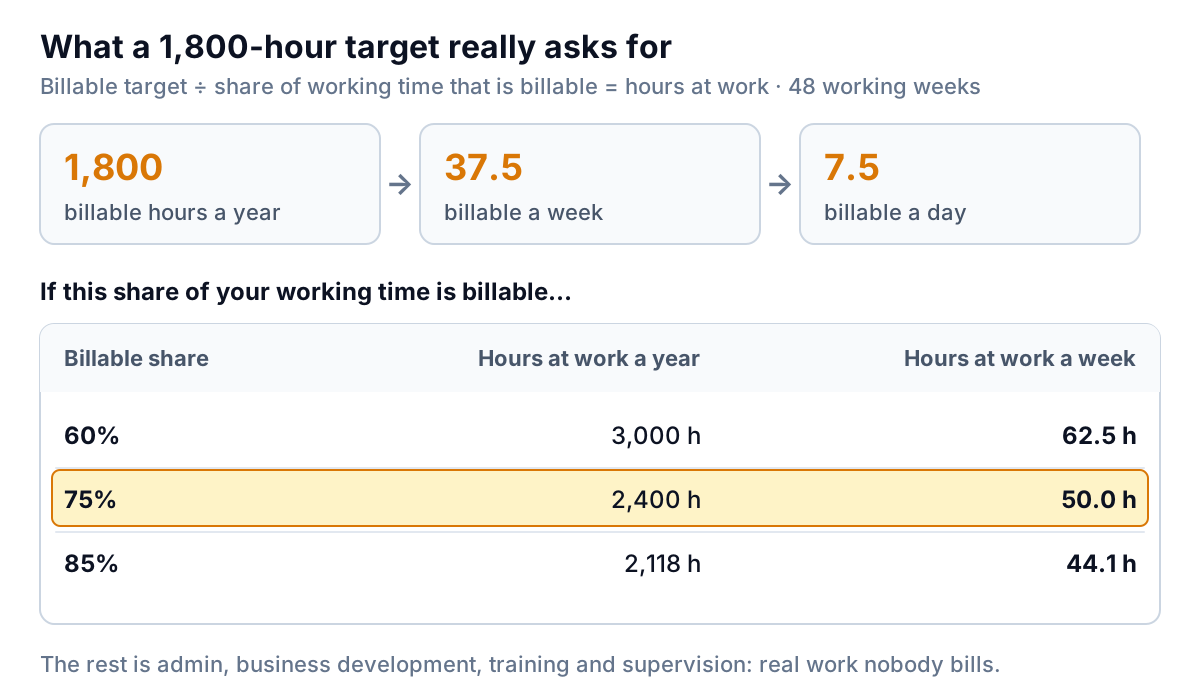
Take 1,800 billable hours a year. Over 48 working weeks (allowing for holidays and leave), that's 37.5 billable hours a week, or 7.5 a day. Nobody bills every hour they work. If three quarters of a lawyer's working time is billable, 1,800 billable hours means 2,400 hours at work: 50 hours a week, every week. If only 60% is billable, because the lawyer also manages staff, brings in clients and trains juniors, the same target means 62.5 hours a week.
Two practical consequences for a small firm:
- Set targets by role. A partner who runs the firm and brings in the work can't bill like an associate who doesn't. Calder & Wynne's partners recorded 300 and 330 hours in the quarter; the senior associates 380 and 400.
- Set targets for non-billable work too. If business development and supervision matter, give them hours on the plan. Otherwise the target quietly tells everyone they don't.
Utilization, realization and collection
Three rates show where billable hours go between the timesheet and the bank account. Each uses the previous stage as its denominator.
- Utilization rate = billable hours recorded ÷ available hours. How much of the working day goes on client work.
- Realization rate = hours billed ÷ hours recorded. How much recorded time survives pre-bill review and discounts to reach an invoice.
- Collection rate = hours (or dollars) collected ÷ hours (or dollars) billed. How much of what's invoiced is paid.
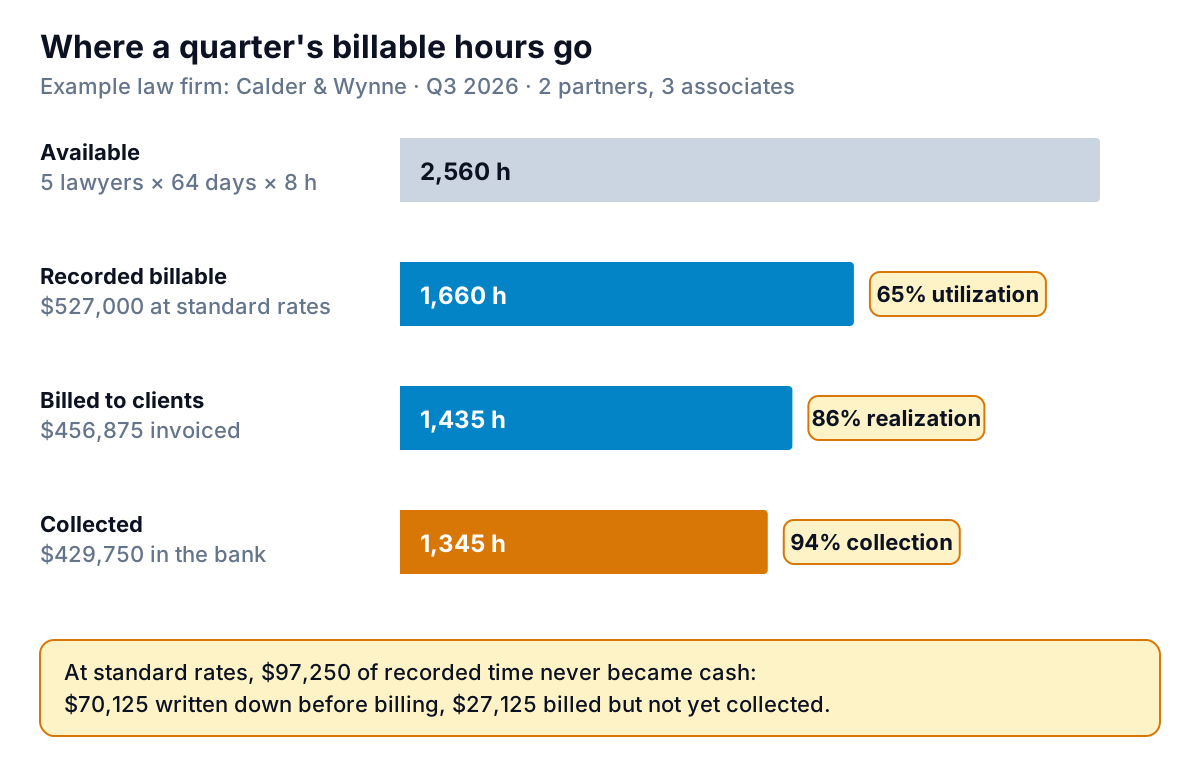
Calder & Wynne's quarter: five lawyers × 64 working days × 8 hours = 2,560 available hours. They recorded 1,660 billable hours (65% utilization), billed 1,435 (86% realization) and collected payment for 1,345 (94% collection). In dollars at standard rates, $70,125 was written down before billing and $27,125 was billed but not collected by the end of the quarter.
For comparison, Clio's Legal Trends benchmarks, based on its own data, put the 2025 averages at 38% utilization (about 3.0 billable hours captured in an 8-hour day), 88% realization and 93% collection. Calder & Wynne's utilization is well above that average, its realization slightly below, its collection about level. Treat any benchmark loosely: firms define "available hours" differently, and a practice area with flat fees will look nothing like a litigation boutique.
Reading billable hours lawyer by lawyer
The firm-wide funnel tells you how much leaks. The per-lawyer view tells you where.
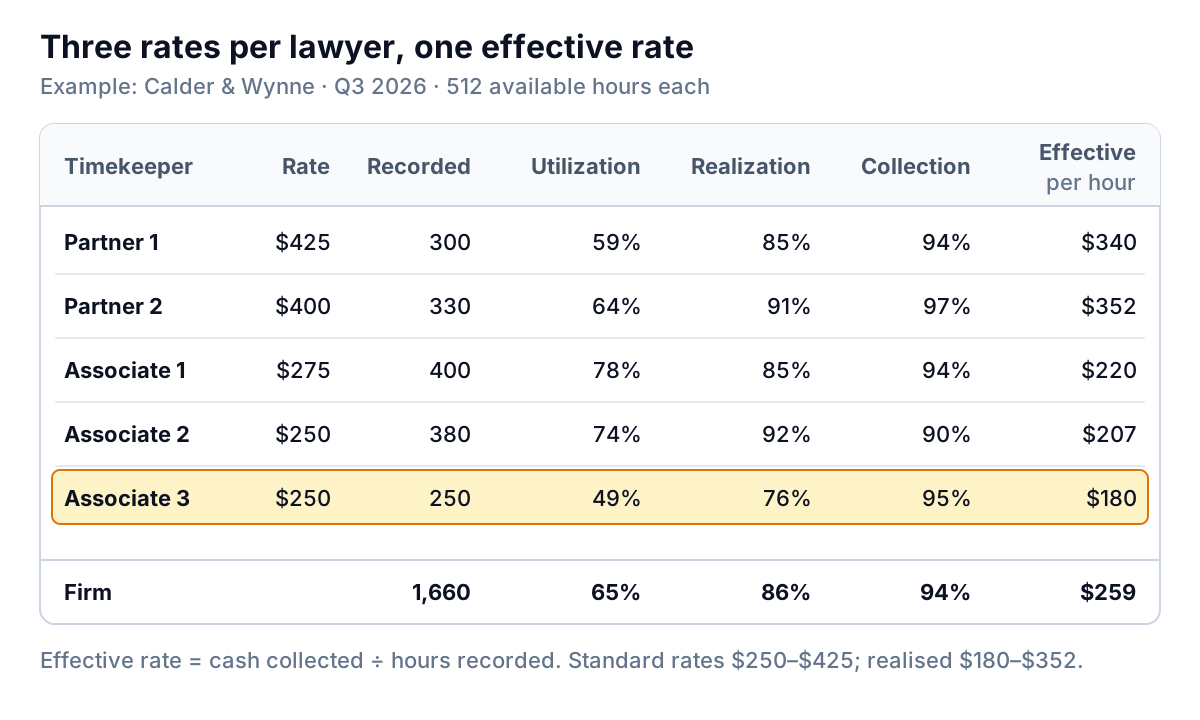
The useful single number is the effective rate: cash collected ÷ hours recorded. Associate 3 has a standard rate of $250 but an effective rate of $180. Associate 3 joined in June, so low utilization (49%) is expected while the caseload builds, and the 76% realization reflects partners writing down time a more experienced lawyer would have spent less of. That's normal for a new lawyer, and the right response is supervision and training, not pressure to record more time.
Two other patterns are worth a look. Partner 1's realization is 85%: on reviewing the write-downs, most came from one fixed-budget matter that ran over. And Associate 2 has the firm's best realization (92%) but its lowest collection (90%), because one client is slow to pay. That's a receivables issue, not a timekeeping one. An accounts receivable aging report shows which invoices are late and by how much.
Tracking billable hours accurately and ethically
Good numbers start with good time entries. For lawyers, several ABA ethics opinions shape what counts as a proper entry. These are summaries, not legal advice; your state's rules and opinions govern.
- Bill only time actually spent. ABA Formal Opinion 93-379 addresses billing for professional fees and expenses. It says that where a client has agreed to hourly billing, a lawyer may not bill more time than actually spent, apart from rounding up to the agreed minimum increment, and that billing two clients for the same hour is improper. It also says general office overhead shouldn't be billed as a separate charge unless the client agreed in advance.
- Time saved by AI tools belongs to the client. ABA Formal Opinion 512 (July 2024), on generative AI, says lawyers who bill hourly must bill for the time actually spent, even when a tool makes the work faster. If a first draft takes 20 minutes with a tool and 30 minutes to check, that's the time recorded, not the three hours it used to take.
- Record time when you do the work. Entries reconstructed at the end of the week are less accurate, and they tend to come out lower: people forget short calls and emails. Daily entry is the habit most firms aim for.
- Write descriptions a client can understand. "Review file" invites a dispute; "Review lease and draft list of 6 issues for client call" doesn't.
- Record write-downs with a reason. A short list (inexperience, over budget, client relationship, duplicated work, disputed) turns the realization rate from a number into a diagnosis.
Time entries also carry confidential client information. ABA Model Rule 1.6(c) asks lawyers to make reasonable efforts to prevent unauthorized disclosure of, or access to, information relating to a representation; see the ABA's comment on Rule 1.6. Before you export time data to analyse it in a spreadsheet or any other tool, strip the narrative descriptions and replace client names with matter numbers. The numbers in this guide need only timekeeper, matter number, date, hours recorded, hours billed, amounts and payments. Check your own state's rules and your firm's policies on using outside software.
What to do when the numbers move
| Symptom | Common causes | What to try |
|---|---|---|
| Utilization falling | Not enough work, or time not being recorded | Compare recorded hours with calendars; check the pipeline of new matters before blaming the timesheet |
| Realization falling | Write-downs on fixed-budget matters, inexperienced staffing, client pushback | Read the write-down reasons; quote budgets more realistically; staff matters at the right level |
| Collection falling | Slow-paying clients, invoices disputed or sent late | Invoice monthly and promptly; follow up at 30 days; consider advance fee deposits where your rules allow |
| Effective rate well below standard | A mix of the three | Find which stage leaks most for that person or practice area, and fix that one first |
Review the three rates monthly, and the per-lawyer view quarterly, since a single month is too noisy for five people. If you present the firm's numbers to partners, a short monthly report with the funnel, the per-lawyer table and the write-down reasons covers most of what they need to discuss. For a broader view of the firm alongside cash and receivables, see our guide to the KPI dashboard.
Building the dashboard from your time and billing export
Most practice management systems can export time entries and invoices as CSV or Excel. Parity builds a dashboard from that upload: utilization, realization, collection and effective rate by lawyer and practice area, with charts, what explains the changes, and a table of what needs attention. Every number is checked against queries on the full dataset before you see it. Upload the export with narratives removed and matters identified by number, as above. You can refine the view by chat, share it with your partners through a read-only link with an optional password and end date, and update it with next month's export.
Upload a time and billing export and get utilization, realization and collection by lawyer, checked against your full data. Build a report from your data free
The billable hour will keep its critics, and many firms are moving some work to flat or capped fees. But as long as time is how you price and staff the work, the question for each quarter is the same one Calder & Wynne asked: of the hours we worked, how many did we bill, and how many did we get paid for? Once you can answer it per lawyer, the fixes are usually obvious.