Charts like this, from your own numbers.
Connect a spreadsheet or the tools you run on, and Parity builds the dashboard and writes the report, with every number checked.
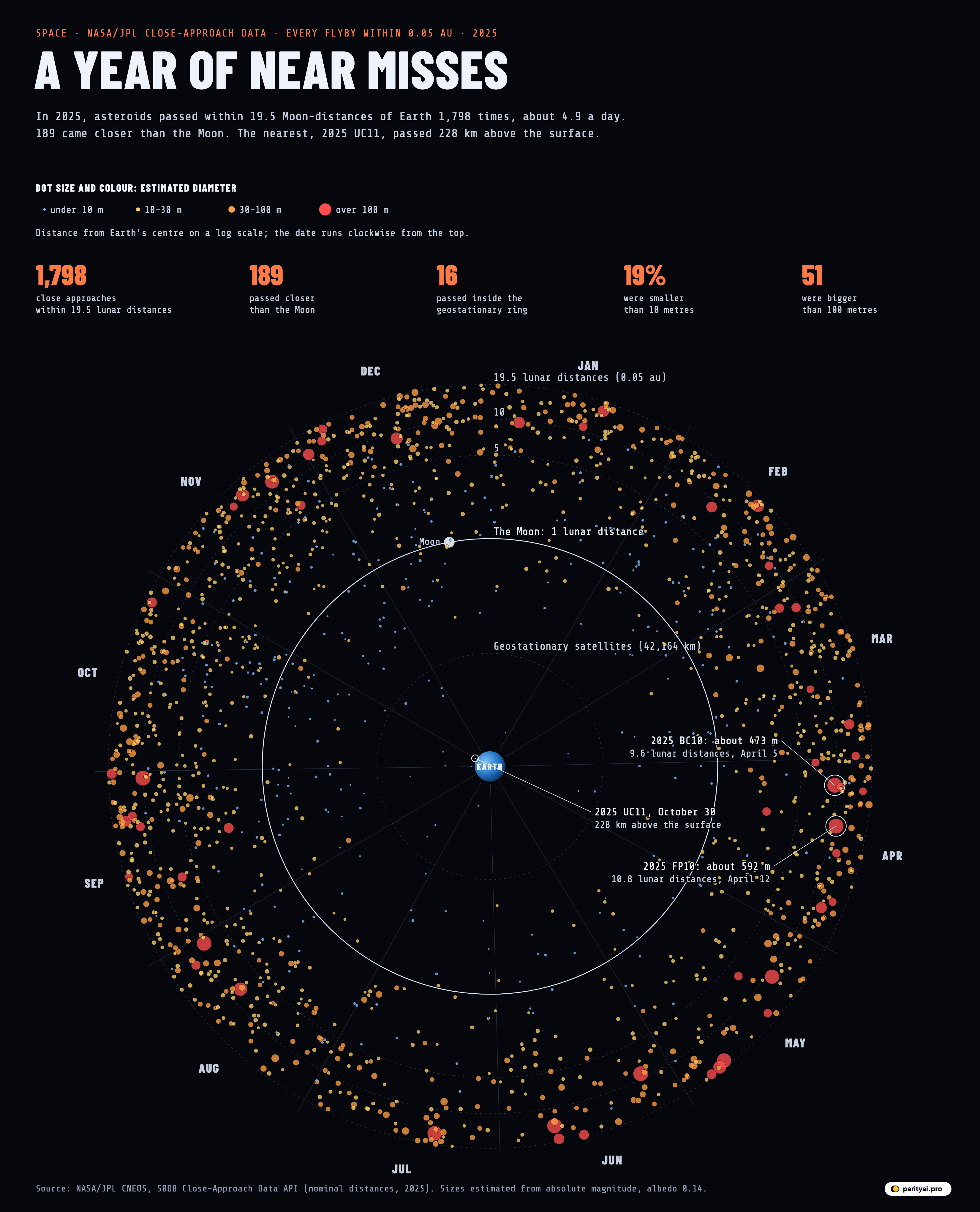
Try Parity freeOn the morning of October 30, 2025, a rock about the size of a kitchen table passed 228 kilometres above the Earth's surface. That is lower than the International Space Station flies. Its name is 2025 UC11, and it was the closest of 1,798 asteroid flybys that NASA's Jet Propulsion Laboratory logged for 2025 within 0.05 astronomical units of Earth, about 7.5 million kilometres. That is just under 20 times the distance to the Moon.
The chart above puts all 1,798 on a single dial. Earth is at the centre. Each dot is one flyby, set at its distance from Earth on a stretched (logarithmic) scale, so the inner rings get as much room as the outer ones. The angle around the dial is the date, starting at the top on January 1 and running clockwise through the year. A dot's size and colour show how big the object is estimated to be. The rings mark the height of geostationary satellites, the Moon's orbit, and 5, 10 and 19.5 times the distance to the Moon.
A year of near misses raises a lot of questions. This piece takes them one at a time.
Key takeaways
- NASA/JPL's close-approach database lists 1,798 asteroid flybys within 0.05 au of Earth in 2025, about 4.9 a day.
- 189 of them came closer than the Moon, and 16 passed inside the ring of geostationary satellites.
- The closest, 2025 UC11 on October 30, passed about 228 km above the surface. It was roughly 1 metre across.
- 74% of the objects were less than 30 metres wide on our size estimate. Only 51 were 100 metres or more.
- 89% of the objects that flew by in 2025 had been discovered that same year.
Is 1,798 a lot?
It is a count of what was seen, not of what was there. The database behind the chart is JPL's Small-Body Database close-approach table, which lists every known asteroid or comet whose computed path brings it within a chosen distance of Earth. We asked for every approach in 2025 within 0.05 au. The query returned a count of 1,798, one approach per object.
The 0.05 au line is not arbitrary. It is the same distance that NASA's Center for Near-Earth Object Studies uses to define a potentially hazardous asteroid: one whose orbit can come within 0.05 au or less of Earth's orbit and that is bright enough to be at least about 140 metres across. Most of the objects on this dial are far too small to meet the second half of that definition.
What makes the number grow is discovery. Of the objects on the chart, 1606, or 89%, carry a provisional designation starting "2025", which means they were first spotted that year. Many of them were found only days before their closest approach, or after it. Small asteroids are faint, and a survey telescope usually picks one up only when it is already close. The total of known near-Earth objects keeps rising for the same reason. CNEOS's running count reached 42,996 near-Earth objects on October 30, 2026, about 2,200 more than at the start of the year.
So 1,798 is better read as a measure of how good the surveys have become than as a measure of how crowded space near Earth is.
How close is close?
The dial is drawn on a logarithmic scale because the distances span more than three orders of magnitude. The median flyby in 2025 passed 6.8 lunar distances away, which is about 2.6 million kilometres. That is the dense band of dots in the outer half of the dial.
Moving inward, 709 flybys came within five lunar distances. 189 came closer than the Moon. Those are the dots inside the grey Moon ring, an average of about 16 a month.
Inside that ring is a smaller one, at 42,164 kilometres from Earth's centre: the height at which a satellite takes exactly one day to go round and so appears to hang still in the sky. Communication and weather satellites live there. In 2025, 16 asteroids passed inside it.
The closest five were:
- 2025 UC11, on October 30, about 228 km above the surface
- 2025 TF, on October 1, about 409 km
- 2025 BP6, on January 26, about 3,341 km
- 2025 OS, about 4,087 km
- 2025 TQ2, about 4,868 km
These heights are our own conversion: the database gives the distance from Earth's centre, and we subtract Earth's mean radius. For 2025 TF, the European Space Agency's figure is that it came as close as 428 ± 7 km to the surface over Antarctica. Our figure, 409 km, is lower because the Earth is flatter at the poles than its mean radius implies. Either way, the asteroid passed at about the height of the Space Station's orbit.
| # | Asteroid | Date (UTC) | Height above Earth's surface, km | Est. diameter, m | Speed, km/s |
|---|---|---|---|---|---|
| 1 | 2025 UC11 | 2025-Oct-30 12:11 | 228 | 1 | 11.4 |
| 2 | 2025 TF | 2025-Oct-01 00:49 | 409 | 2 | 20.9 |
| 3 | 2025 BP6 | 2025-Jan-26 01:10 | 3,341 | 2 | 21.0 |
| 4 | 2025 OS | 2025-Jul-19 03:21 | 4,087 | 4 | 12.7 |
| 5 | 2025 TQ2 | 2025-Oct-02 19:02 | 4,868 | 3 | 14.7 |
| 6 | 2025 UW107 | 2025-Oct-19 04:35 | 5,910 | 2 | 16.7 |
| 7 | 2025 FY6 | 2025-Mar-23 19:29 | 15,573 | 2 | 23.4 |
| 8 | 2025 PF2 | 2025-Aug-15 00:13 | 15,990 | 3 | 13.1 |
| 9 | 2025 SU4 | 2025-Sep-24 08:34 | 16,010 | 2 | 9.2 |
| 10 | 2025 WV13 | 2025-Nov-27 23:30 | 18,054 | 6 | 10.6 |
| 11 | 2025 HH | 2025-Apr-17 23:24 | 21,484 | 2 | 9.3 |
| 12 | 2025 WE14 | 2025-Nov-29 18:44 | 21,656 | 5 | 20.8 |
| 13 | 2025 PU1 | 2025-Aug-13 19:44 | 22,902 | 2 | 10.0 |
| 14 | 2025 VN | 2025-Nov-08 00:29 | 29,721 | 9 | 11.9 |
| 15 | 2025 WR7 | 2025-Nov-26 02:02 | 29,905 | 4 | 5.6 |
| 16 | 2025 GS1 | 2025-Apr-15 21:36 | 31,619 | 5 | 10.5 |
| 17 | 2025 UX18 | 2025-Oct-30 04:24 | 40,699 | 3 | 8.1 |
| 18 | 2025 PU | 2025-Aug-02 21:42 | 46,616 | 3 | 10.5 |
| 19 | 2025 SY1 | 2025-Sep-19 10:24 | 50,840 | 2 | 7.9 |
| 20 | 2025 UJ4 | 2025-Oct-21 21:30 | 55,310 | 3 | 7.1 |
Highlighted: passed inside the geostationary satellite ring (42,164 km from Earth's centre). Sizes estimated from brightness.
How big were they?
Mostly small. For all but 5 of the objects the database has no measured diameter, so we estimated size from brightness. CNEOS publishes the conversion: diameter depends on the object's absolute magnitude, H, and on how much light its surface reflects. Assuming a reflectivity of 14%, which is what CNEOS uses in its hazard definition, gives the sizes on the chart. A darker surface would mean a bigger rock for the same brightness, so treat every size here as an estimate that could be off by a factor of two either way.
On that estimate:
- 344 objects, 19% of the total, were under 10 metres across.
- 982 were between 10 and 30 metres.
- 421 were between 30 and 100 metres.
- 51 were 100 metres or more.
For a sense of scale, the meteor that exploded over Chelyabinsk in Russia on February 15, 2013, had an effective diameter of about 18 meters, by CNEOS's estimate. Objects of that size are in the second band, the most common one on the chart. None of them hit the Earth in 2025, and almost all of them passed far beyond the Moon.
The flybys that came closest were among the smallest. 2025 UC11 was about 1 metre across on our estimate; 2025 TF was about 2, in line with ESA's range of one to three metres. That is not a coincidence of 2025. A rock that small can be seen only when it is very close, so the inner rings of the dial are filled with tiny objects and the large ones appear only further out.
What were the biggest?
The biggest dots on the dial sit in the outer rings. The largest object to pass within 0.05 au in 2025 was 2025 FP10, estimated at 592 metres across, at 10.8 lunar distances on April 12. Next were 2025 BC10, about 473 metres, at 9.6 lunar distances on April 5, and 424482 (2008 DG5), about 431 metres, at 9.1 lunar distances on June 5.
One of the few objects with a measured size and a long history is 3361 Orpheus, discovered in 1982. The database lists it at 300 metres, and it passed at 14.8 lunar distances on November 19.
| Asteroid | Date (UTC) | Est. diameter, m | Distance, lunar distances |
|---|---|---|---|
| 2025 FP10 | 2025-Apr-12 03:55 | 10.80 | |
| 2025 BC10 | 2025-Apr-05 10:12 | 9.64 | |
| 424482 (2008 DG5) | 2025-Jun-05 23:59 | 9.09 | |
| 152664 (1998 FW4) | 2025-Sep-29 18:59 | 10.02 | |
| 793349 (2003 AY2) | 2025-Jun-22 04:09 | 14.13 | |
| 875163 (1998 SH2) | 2025-Aug-30 13:23 | 8.09 | |
| 812769 (2005 VO5) | 2025-Jul-11 04:46 | 15.83 | |
| 387746 (2003 MH4) | 2025-May-24 10:37 | 17.37 | |
| 612356 (2002 JX8) | 2025-May-09 11:02 | 10.94 | |
| 516155 (2016 DP) | 2025-Nov-24 00:56 | 12.45 | |
| 1997 QK1 | 2025-Aug-20 10:25 | 7.83 | |
| 3361 Orpheus (1982 HR) | 2025-Nov-19 01:27 | 14.76 |
The difference between the large and small objects shows up in their names. Only 17 of the objects on the chart have a permanent number, the label an asteroid gets once its orbit is known well enough. Those are mostly the larger, older finds. The rest still carry provisional designations.
When did they come?
The angle around the dial is the date, and the dots are spread around the whole year. The busiest month was October, with 220 flybys; the quietest was June, with 76. That variation is likely to say more about when telescopes could see than about the asteroids themselves: survey telescopes lose time to the Moon, weather and the seasons, and the data cannot separate those effects. The average was 4.9 flybys a day.
The two closest flybys of the year came a month apart: 2025 TF on October 1 and 2025 UC11 on October 30. Both sit in the upper-left part of the dial, among the autumn months.
How fast were they going?
The median speed relative to Earth was 9.8 kilometres per second, or about 35,000 kilometres an hour. The fastest was 2025 DF4, at 34.9 km/s. The slowest was 2024 PT5, which drifted past on January 9 at 1.0 km/s, on an orbit so similar to Earth's that it barely moved relative to us.
Did any of them threaten the Earth?
Not on these passes. Every object on the dial missed. The asteroid that caused the most concern in 2025 was not a close flyby at all. 2024 YR4, which Webb images show is about the size of a 15-story building, was briefly given a chance of hitting the Earth in December 2032. ESA's estimate of that chance peaked at 2.8% on February 18, 2025, before further observations brought it down to 0.001%. A remaining chance of it hitting the Moon was later ruled out: NASA reported in March 2026 that lunar impact is no longer a possibility.
The pattern is typical. A newly found object has an uncertain orbit, so the range of possible paths can include the Earth. As more observations come in, the range narrows and the Earth usually falls outside it.
There is also a precedent for doing something about one that doesn't. In 2022 NASA's DART spacecraft hit the small asteroid Dimorphos and altered its orbit by 32 minutes.
What happens next?
The dial is likely to get more crowded. The Vera C. Rubin Observatory in Chile released its first images in June 2025, and about 10 hours of test observations turned up 2,104 never-before-seen asteroids, seven of them near-Earth asteroids. For comparison, Rubin says that about 20,000 asteroids a year are found by all other observatories combined. NASA's NEO Surveyor, an infrared space telescope built to hunt hazardous asteroids, is scheduled for launch no earlier than September 2027.
Better surveys will mean more small flybys found, more of them found before they pass rather than after, and more objects on the inner rings of a chart like this one. That will not mean more asteroids are coming. It will mean fewer are passing unseen.
The next big date is already known. On April 13, 2029, the asteroid Apophis will pass about 32,000 kilometres from the Earth's surface, which is inside the geostationary ring. On this dial it would sit among the innermost dots, and be far larger than any of them.
Where does the data come from?
Every dot comes from the JPL Small-Body Database close-approach API, queried for January 1 to December 31, 2025, at distances up to 0.05 au. Distances are nominal closest approach from Earth's centre. A lunar distance is taken as 384,400 km and Earth's mean radius as 6,371 km. Sizes are estimated from absolute magnitude assuming a 14% albedo, except for the few objects with a measured diameter. Dates and times are UTC.
Sources and method
- NASA/JPL Center for Near-Earth Object Studies, SBDB Close-Approach Data API. All approaches within 0.05 au in calendar 2025, retrieved November 1, 2026
- NASA/JPL CNEOS, Discovery statistics and close approach tables
Each dot is one close approach of an asteroid to Earth between January 1 and December 31, 2025, within 0.05 astronomical units (7.5 million km), as listed by JPL. Distance is the nominal centre-to-centre distance at closest approach, converted to lunar distances (384,400 km); the inner disc is Earth itself (6,371 km radius). The angle is the date. For the few objects with a measured diameter we use it; for the rest the size is estimated from absolute magnitude H assuming an albedo of 0.14, so actual sizes could be roughly half or double. Many of the smallest objects were found only days before, or after, their closest approach. The list will grow slightly as older images are searched and orbits are refined.
Charts like this, from your own numbers.
Connect a spreadsheet or the tools you run on, and Parity builds the dashboard and writes the report, with every number checked.
Try Parity free