Key takeaways
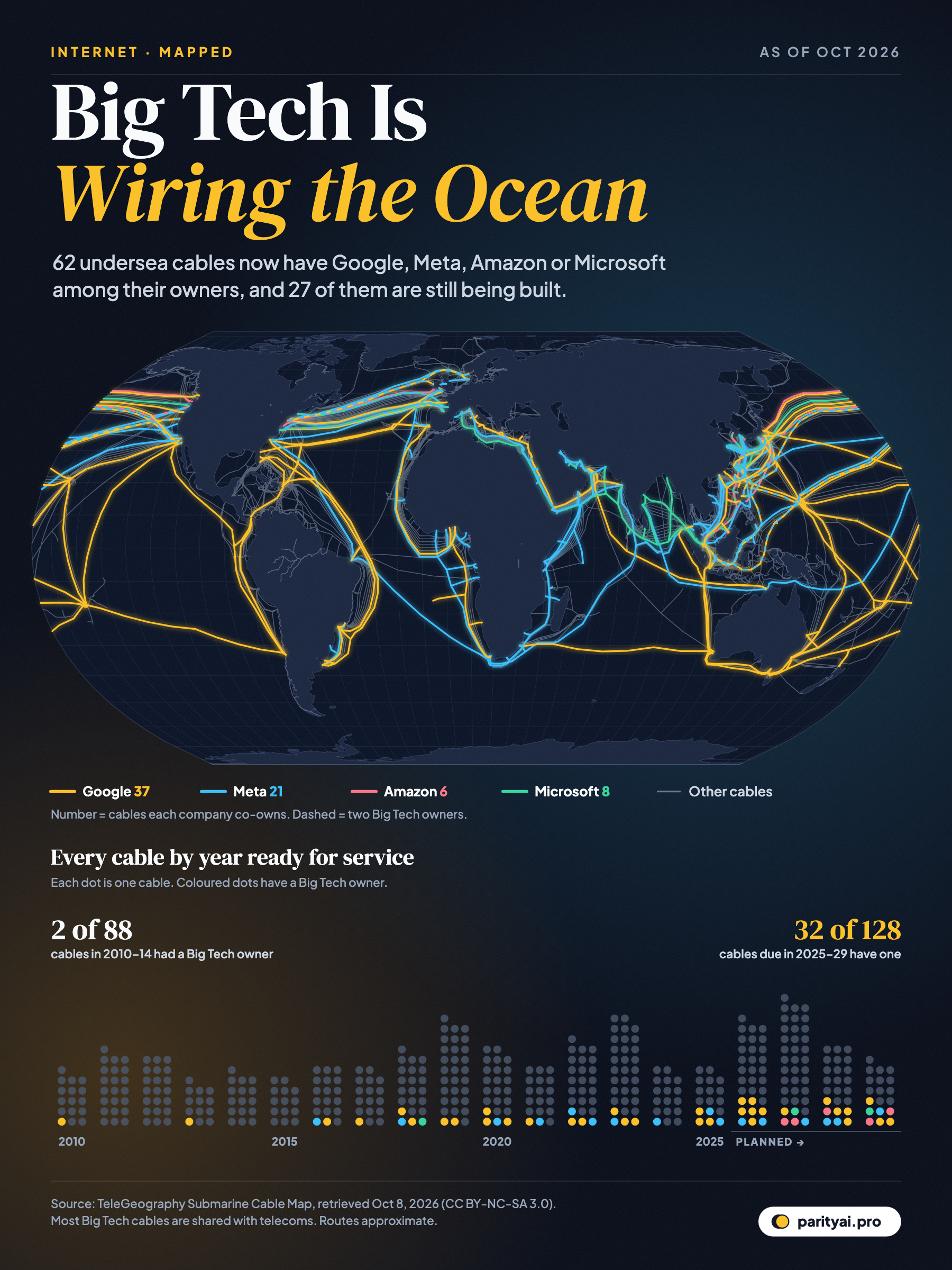
- 62 of the 712 submarine cables in TeleGeography's database list Google, Meta, Amazon or Microsoft among their owners. Google alone co-owns 37, and it is the only listed owner of 23 of them.
- Only 2 of the 88 cables that entered service from 2010 to 2014 had one of these companies as an owner. Of the 128 cables due from 2025 to 2029, 32 do, about one in four.
- 27 Big Tech cables are planned or under construction, from Amazon's Fastnet across the Atlantic to Google's Umoja between Africa and Australia.
The internet looks wireless from a phone, but between continents it travels almost entirely through glass fibres laid on the sea floor. TeleGeography, the research firm that maps them, confirms the often-quoted claim that submarine cables carry more than 99% of intercontinental data traffic. For most of the internet's history those cables were built and owned by telecom carriers, usually in large consortiums. That is changing fast.
The map above shows every cable in TeleGeography's public Submarine Cable Map database. Most are drawn as faint grey lines. The ones that list Google, Meta, Amazon or Microsoft among their owners glow in each company's colour, and dashed lines mark cables with two of them as co-owners. The dot chart below the map counts every cable by the year it entered, or is due to enter, service. Coloured dots are the Big Tech cables.
From customers to owners
A decade ago, the big internet companies mostly bought capacity on cables built by others. In our data, only 2 of the 88 cables that entered service between 2010 and 2014 had one of the four as an owner. That rose to 9 of 102 in 2015 to 2019 and 15 of 115 in 2020 to 2024. Of the 128 cables due between 2025 and 2029, 32 do: 25%.
The reason is simple: they became the biggest users. TeleGeography estimates that content and cloud providers accounted for almost three-quarters of all international bandwidth demand in 2024, and at least 80% on major transoceanic routes. When a company needs that much capacity, building its own cable is often cheaper than renting. It also gives the company control over routes, landing points and upgrades.
A new cable is expensive but not out of reach for these companies. TeleGeography puts the cost of a typical 7,000 km transatlantic cable at around $250 million, and trans-Pacific routes at up to $400 million. Against capital budgets measured in tens of billions of dollars a year, that is a modest line item.
What goes into a cable
A modern cable is thinner than a garden hose in deep water. It holds a few dozen hair-thin glass fibres wrapped in copper, insulation and, near the shore, steel armour against anchors. Every 50 to 100 km sits a repeater, a pressure-proof amplifier that boosts the light signal on its way across the ocean. TeleGeography estimates that the cable itself costs $6,000 to $20,000 per kilometre and each repeater another $200,000 or so. Survey work, permits, landing stations and the specialist ships that lay the cable add the rest.
What the money buys has grown enormously. A single new cable can now carry hundreds of terabits per second, more than the entire internet's international traffic a decade or two ago. TeleGeography put total used international bandwidth at more than 6.4 petabits per second in 2025. The cloud companies' appetite for that capacity, to move data between their own data centers, is what turned them from customers into builders. Training and serving AI models across regions only adds to that appetite.
Google: the biggest builder
Google is the clear leader, with 37 cables on the map and roughly 267,000 km of cable by TeleGeography's listed lengths. More striking is how many it owns outright. TeleGeography lists Google as the only owner of 23 cables, while most cables, including most of the other companies' cables, are shared with telecom partners.
Its cables that entered service from 2025 on, or are planned, read like an atlas: Apricot (2025), Echo (2025), Firmina (2025), Bulikula (2026), Honomoana (2026), Nuvem (2026), Proa (2026), Tabua (2026), TPU (2026), Raman (2027), Dhivaru (2028), Sol (2028), TalayLink (2028), Umoja (2028), Bosun (2029), Halaihai (2029), Taihei (2029).
Several fill gaps the old network left. Nuvem links South Carolina, Bermuda and Portugal and is the first cable to connect Bermuda with Europe. Sol runs from Florida to Spain via Bermuda and the Azores. Umoja starts in Kenya, crosses Africa overland to South Africa and then runs under the Indian Ocean to Australia. A cluster of Pacific cables, including Bulikula and Tabua, which landed in Fiji in early 2025, and Bosun and TalayLink linking Australia to Southeast Asia, form what Google calls its Australia Connect and Pacific Connect initiatives. In February 2026, Google also announced an America-India Connect initiative as part of a $15 billion, five-year investment in India.
Meta: the longest bets
Meta co-owns 21 cables in the database. Its recent and planned ones are: Apricot (2025), Bifrost (2025), Echo (2025), Southeast Asia-Japan Cable 2 (SJC2) (2025), Anjana (2026), Daraja (2026), ORCA (2027), Aurora (2028), Candle (2028), Petal (2029).
Meta's signature project is not fully on the map yet. In February 2025 it announced Project Waterworth, a cable of more than 50,000 km, longer than the Earth's circumference. It is designed to connect the United States, India, Brazil, South Africa and other regions across five continents, and Meta called it its "most ambitious subsea cable endeavor yet". It explicitly linked the project to AI. Meta was also a lead partner in 2Africa, the 45,000 km cable that loops around the African continent, visible as the blue ring around Africa on the map.
Amazon and Microsoft: late but accelerating
Amazon and Microsoft were slower to own cables, and the map reflects it. Amazon co-owns 6 cables and Microsoft 8. Many are joint projects, sometimes with each other: Beaufort, JAKO and Asia United Gateway East all list both companies.
Amazon's cables since 2020: JUPITER (2020), Beaufort (2027), JAKO (2027), Fastnet (2028), Asia United Gateway East (AUG East) (2029), Sta’O’Nuk (2029). The most notable is Fastnet, announced in November 2025. It will run from Maryland to County Cork, Ireland, with more than 320 terabits per second of capacity when it starts operating in 2028.
Microsoft's cables since 2020: Amitie (2023), Beaufort (2027), JAKO (2027), SeaMeWe-6 (2027), Asia United Gateway East (AUG East) (2029), I-2SEA (2029). Microsoft knows the cost of depending on others' cables. In September 2025, its Azure cloud warned customers of higher latency after cables were cut in the Red Sea, forcing traffic between Asia and Europe onto longer routes.
Why ownership matters
Cables break regularly, most often because of fishing gear and ship anchors, and a repair ship can take days or weeks to arrive. Some breaks draw more attention. In February 2024, several cables in the Red Sea were cut, affecting about a quarter of the traffic through the region, according to one operator. In the Baltic, a series of cuts in late 2024 led Finland to charge the officers of a tanker that dragged its anchor for about 90 kilometres across the sea floor.
For a cloud provider, every cut is a reliability problem, and the answer is more routes. Owning cables lets a company decide where they go, often avoiding chokepoints like the Red Sea and the Strait of Malacca. Several new routes, such as Google's Umoja between Africa and Australia, add paths that bypass the most crowded corridors.
Ownership also raises questions. When the companies that run the biggest cloud and social platforms also own the physical links between continents, they gain more control over how the internet works. Supporters say the investment brings capacity to places carriers neglected, from Pacific islands to East Africa. Critics worry about concentration, and governments increasingly treat cables as strategic infrastructure, screening who may land them on their shores.
A map still being drawn
Two caveats about this map:
- It includes the future. 27 of the 62 Big Tech cables are due in 2026 or later. Dates often slip, and routes can change before a cable ship sets out. Some announced projects, including much of Waterworth, have no route drawn yet.
- Co-ownership varies. A cable with Google as its only owner and a 20-member consortium where Microsoft holds one fibre pair both count once. Ownership shares are rarely public.
The database includes 712 cables in total, including some planned and retired systems. That is more than TeleGeography's own headline count of "more than 600 active and planned" cables. Their listed lengths add up to about 1,973,000 km, of which Big Tech cables account for about 529,000 km. TeleGeography reports about 1.5 million km of cable in service in early 2026.
| Cable | Ready | Status | Big Tech owner(s) | Length |
|---|---|---|---|---|
| Amitie | 2023 | In service | Meta, Microsoft | |
| Blue | 2023 | In service | ||
| Equiano | 2023 | In service | ||
| Topaz | 2023 | In service | ||
| 2Africa | 2024 | In service | Meta | |
| Apricot | 2025 | In service | Google, Meta | |
| Bifrost | 2025 | In service | Meta | |
| Echo | 2025 | In service | Google, Meta | |
| Firmina | 2025 | In service | ||
| Southeast Asia-Japan Cable 2 (SJC2) | 2025 | In service | Meta | |
| Anjana | 2026 | Planned | Meta | |
| Bulikula | 2026 | Planned | ||
| Daraja | 2026 | Planned | Meta | |
| Honomoana | 2026 | Planned | ||
| Nuvem | 2026 | Planned | ||
| Proa | 2026 | Planned | ||
| Tabua | 2026 | Planned | ||
| TPU | 2026 | Planned | ||
| Beaufort | 2027 | Planned | Amazon, Microsoft | |
| JAKO | 2027 | Planned | Amazon, Microsoft | |
| ORCA | 2027 | Planned | Meta | |
| Raman | 2027 | Planned | ||
| SeaMeWe-6 | 2027 | Planned | Microsoft | |
| Aurora | 2028 | Planned | Meta | |
| Candle | 2028 | Planned | Meta | |
| Dhivaru | 2028 | Planned | ||
| Fastnet | 2028 | Planned | Amazon | |
| Sol | 2028 | Planned | ||
| TalayLink | 2028 | Planned | ||
| Umoja | 2028 | Planned | ||
| Asia United Gateway East (AUG East) | 2029 | Planned | Amazon, Microsoft | |
| Bosun | 2029 | Planned | ||
| Halaihai | 2029 | Planned | ||
| I-2SEA | 2029 | Planned | Microsoft | |
| Petal | 2029 | Planned | Meta | |
| Sta’O’Nuk | 2029 | Planned | Amazon | |
| Taihei | 2029 | Planned |
Years from 2026 on are planned and may slip. Chip colour shows the first Big Tech owner. The CSV lists every cable with all of its owners.
Who owns the sea floor now
The open sea floor was once the domain of phone companies. Today it increasingly belongs to the companies whose apps people use. Of the cables now being laid, one in four carries a Big Tech name on the ownership papers. Given how much data those companies move, that share is likely to rise.
Sources and method
- TeleGeography, Submarine Cable Map (public API, v3). Cable routes, owners and ready-for-service years, retrieved October 8, 2026. Licensed CC BY-NC-SA 3.0
- Natural Earth land (via world-atlas)
A cable counts as Big Tech-owned when TeleGeography lists Google, Meta (or Facebook), Amazon or Microsoft among its owners, alone or in a consortium; many such cables have telecom co-owners. Years are TeleGeography's ready-for-service (RFS) year; cables from 2026 on are planned or under construction and their dates can slip. The map includes 712 active, planned and some retired systems in TeleGeography's database, which counts 'more than 600 active and planned' cables. Routes are approximate, and a few planned routes are not yet drawn.
Charts like this, from your own numbers.
Connect a spreadsheet or the tools you run on, and Parity builds the dashboard and writes the report, with every number checked.
Try Parity free