For 105 minutes of the World Cup final at MetLife Stadium, nobody could score. Then, in the first half of extra time, Ferran Torres, who had started on the bench, put the ball past Emiliano Martínez, and Spain beat Argentina 1–0 to win their second world title. Argentina, a man down since Enzo Fernández was sent off in stoppage time, could not find a reply.
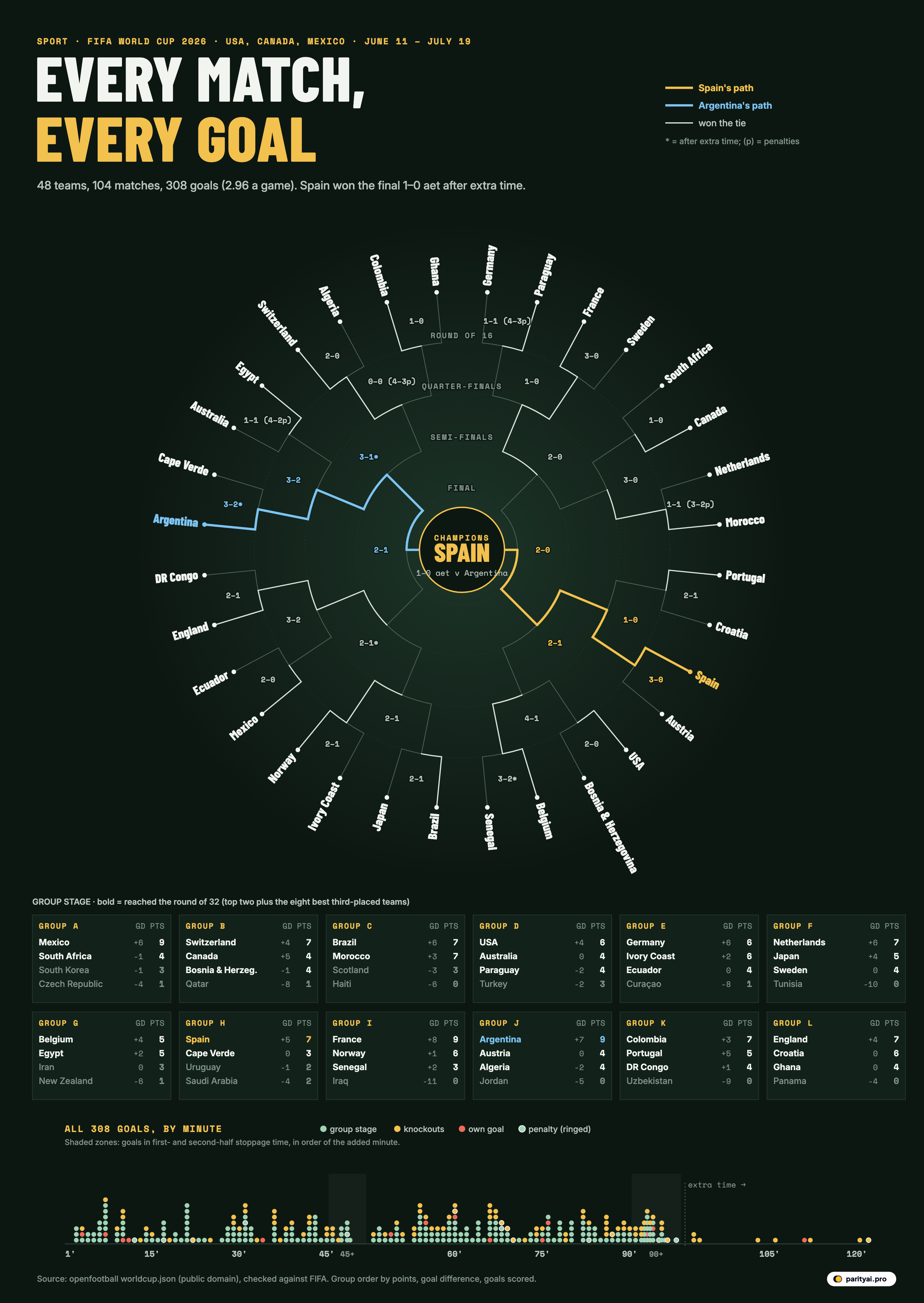
It was the 104th match of the first 48-team World Cup, played across the United States, Canada and Mexico from June 11 to July 19, 2026. The chart above tries to hold the whole tournament on one page: every knockout match in the circle, every group in the boxes below it, and every one of its 308 goals at the bottom.
How to read the circle
The 32 teams that reached the knockout rounds sit around the rim. Lines step inward one ring at a time: round of 32, round of 16, quarter-finals, semi-finals and the final, with the champion in the middle. Where two lines meet, the number shows the score of that match from the winner's side; an asterisk means it went to extra time, and a score in brackets with a "p" is a penalty shoot-out. Spain's path to the title is drawn in gold, and Argentina's in blue.
Because every match halves the field, the circle is also a family tree. Pick any team on the rim and you can follow its route inward until the line ends: that is where it went out.
Twelve boxes, 72 matches
The tournament began with 12 groups of four. For the first time, the top two in each group were joined in the knockout rounds by the eight best third-placed teams, so 32 of the 48 went through. In the boxes, those 32 are in bold.
That format made the group stage more forgiving than before. Several teams went through with just three or four points, and the group stage produced 20 draws in 72 matches. The four debutants, Cape Verde, Curaçao, Jordan and Uzbekistan, had very different tournaments. Cape Verde held Spain to a goalless draw, the only match the champions failed to win, and reached the round of 32. Curaçao, the smallest nation ever to qualify, lost Germany 7–1 Curaçao in the most one-sided result of the tournament, but earned its first World Cup point in a 0–0 draw with Ecuador. Jordan and Uzbekistan went home without a point.
Spain's road
Follow the gold line from the rim. Spain's route ran: R32: Austria 3–0; R16: Portugal 1–0; QF: Belgium 2–1; SF: France 2–0; Final: Argentina 1–0 aet.
What stands out is how little Spain conceded: one goal in the entire tournament, against Belgium in the quarter-final. Every other match, including the goalless draw with Cape Verde, was a clean sheet. The semi-final against France, the 2018 champions and 2022 finalists, ended 2–0.
Spain also dominated the individual awards. Rodri was named the tournament's best player, Unai Simón its best goalkeeper and Pau Cubarsí its best young player.
Argentina's road
The blue line tells a more frantic story: R32: Cape Verde 3–2 aet; R16: Egypt 3–2; QF: Switzerland 3–1 aet; SF: England 2–1; Final: Spain 0–1 aet.
The holders needed extra time to get past Cape Verde in the round of 32, and again against Switzerland in the quarter-final. Lionel Messi scored 8 goals, the second-highest total of the tournament. In the final, Martínez made a record 11 saves to keep Argentina in it. Then Fernández's dismissal left them to play extra time with ten men, and Torres's goal ended their defence of the title.
| Round | Match | Date | Venue |
|---|---|---|---|
| Final | Spain 1–0 aet Argentina | 2026-07-19 | New York/New Jersey (East Rutherford) |
| Match for third place | France 4–6 England | 2026-07-18 | Miami (Miami Gardens) |
| Semi-final | England 1–2 Argentina | 2026-07-15 | Atlanta |
| Semi-final | France 0–2 Spain | 2026-07-14 | Dallas (Arlington) |
| Quarter-final | Argentina 3–1 aet Switzerland | 2026-07-11 | Kansas City |
| Quarter-final | Norway 1–2 aet England | 2026-07-11 | Miami (Miami Gardens) |
| Quarter-final | Spain 2–1 Belgium | 2026-07-10 | Los Angeles (Inglewood) |
| Quarter-final | France 2–0 Morocco | 2026-07-09 | Boston (Foxborough) |
| Round of 16 | Switzerland 0–0 (4–3p) Colombia | 2026-07-07 | Vancouver |
| Round of 16 | Argentina 3–2 Egypt | 2026-07-07 | Atlanta |
| Round of 16 | USA 1–4 Belgium | 2026-07-06 | Seattle |
| Round of 16 | Portugal 0–1 Spain | 2026-07-06 | Dallas (Arlington) |
| Round of 16 | Mexico 2–3 England | 2026-07-05 | Mexico City |
| Round of 16 | Brazil 1–2 Norway | 2026-07-05 | New York/New Jersey (East Rutherford) |
| Round of 16 | Canada 0–3 Morocco | 2026-07-04 | Houston |
| Round of 16 | Paraguay 0–1 France | 2026-07-04 | Philadelphia |
| Round of 32 | Australia 1–1 (2–4p) Egypt | 2026-07-03 | Dallas (Arlington) |
| Round of 32 | Colombia 1–0 Ghana | 2026-07-03 | Kansas City |
| Round of 32 | Argentina 3–2 aet Cape Verde | 2026-07-03 | Miami (Miami Gardens) |
| Round of 32 | Switzerland 2–0 Algeria | 2026-07-02 | Vancouver |
| Round of 32 | Spain 3–0 Austria | 2026-07-02 | Los Angeles (Inglewood) |
| Round of 32 | Portugal 2–1 Croatia | 2026-07-02 | Toronto |
| Round of 32 | Belgium 3–2 aet Senegal | 2026-07-01 | Seattle |
| Round of 32 | USA 2–0 Bosnia & Herzegovina | 2026-07-01 | San Francisco Bay Area (Santa Clara) |
| Round of 32 | England 2–1 DR Congo | 2026-07-01 | Atlanta |
| Round of 32 | Mexico 2–0 Ecuador | 2026-06-30 | Mexico City |
| Round of 32 | Ivory Coast 1–2 Norway | 2026-06-30 | Dallas (Arlington) |
| Round of 32 | France 3–0 Sweden | 2026-06-30 | New York/New Jersey (East Rutherford) |
| Round of 32 | Brazil 2–1 Japan | 2026-06-29 | Houston |
| Round of 32 | Netherlands 1–1 (2–3p) Morocco | 2026-06-29 | Monterrey (Guadalupe) |
| Round of 32 | Germany 1–1 (3–4p) Paraguay | 2026-06-29 | Boston (Foxborough) |
| Round of 32 | South Africa 0–1 Canada | 2026-06-28 | Los Angeles (Inglewood) |
Upsets in the outer ring
The outer ring is where most of the surprises are. The biggest came in the round of 32, when Paraguay eliminated Germany on penalties after a 1–1 draw, Germany's first-ever defeat in a World Cup shoot-out. Morocco, semi-finalists in 2022, also went through on penalties, against the Netherlands, and then beat Canada before losing to France in the quarter-finals.
The tournament produced 9 matches that needed extra time and 4 penalty shoot-outs, all in the knockout rounds. A bigger format meant more teams, more mismatches in the group stage and, once the knockouts began, more close games between sides that had rarely met.
When the goals came
The strip at the bottom of the chart stacks all 308 goals by the minute they were scored. That is 2.96 goals a game, up from 2.69 at the 2022 World Cup in Qatar.
The goals are spread surprisingly evenly through each half. 41% came before half-time. The shaded zones hold the goals scored in stoppage time, sorted by the added minute, and they show how much the extra minutes at the end of each half now matter: 45 goals, 15% of the total, came in the 90th minute or later. Longer stoppage time, introduced at the 2022 World Cup to make up for time lost during matches, is a big reason.
Of the 308 goals, 16 were penalties and 14 were own goals. Gold dots are knockout goals; there are only a few after the dotted line, in extra time, where most of the games were tense and low-scoring.
The highest-scoring match of the tournament, though, came at the very end: in the third-place match, France 4–6 England, the most goals ever in a third-place match. England led 4–0 at half-time before France pulled three back.
| # | Player | Team | Goals |
|---|---|---|---|
| 1 | Kylian Mbappé | France | |
| 2 | Lionel Messi | Argentina | |
| 3 | Erling Haaland | Norway | |
| 4 | Jude Bellingham | England | |
| 5 | Ousmane Dembélé | France | |
| 6 | Harry Kane | England | |
| 7 | Mikel Oyarzabal | Spain | |
| 8 | Julián Quiñones | Mexico | |
| 9 | Vinícius Júnior | Brazil | |
| 10 | Ismaïla Sarr | Senegal | |
| 11 | Raúl Jiménez | Mexico | |
| 12 | Johan Manzambi | Switzerland |
Own goals excluded. openfootball dataset; check FIFA's official list for tie-breaks such as assists.
Three hosts, one ceiling
For the first time, three countries shared a World Cup, and all three of them made it out of their groups. Mexico and the United States both topped their groups, and Canada finished second in theirs. On the circle, though, their lines are short.
All three won their round-of-32 match and lost in the round of 16. The United States went R32: Bosnia & Herzegovina 2–0; R16: Belgium 1–4. Mexico went R32: Ecuador 2–0; R16: England 2–3. Canada went R32: South Africa 1–0; R16: Morocco 0–3. Each host managed one knockout win in front of home crowds, and none reached the quarter-finals, where the eight teams left were all from Europe and South America, except for Morocco.
Group stage versus knockouts
Splitting the 308 goals by stage shows how evenly the scoring held up. The 72 group matches produced 215 goals, 2.99 a game. The 32 knockout matches produced 93, 2.91 a game, almost exactly the same rate, even though knockout football is usually more cautious.
The difference is in how the knockout goals were shared. 14 of the 32 knockout matches ended with one side failing to score, while a handful of wild games, above all the 6–4 third-place match, pushed the average up. The decisive matches tended to be tight: the final, both semi-finals and every quarter-final were won by one or two goals.
The man who scored the most
Kylian Mbappé of France won the Golden Boot with 10 goals, ahead of Messi's 8 and Norway's Erling Haaland with 7. Mbappé is the first player to win the award at two World Cups, having also won it in 2022. France and England each scored 20 goals in the tournament, the most of any team; both played the maximum of eight matches.
A bigger tournament, in numbers
The 48-team format meant 40 more matches than in 2022 and one extra knockout round, so the champion had to win eight games rather than seven. It also produced the best-attended World Cup in history: more than 6.8 million spectators, nearly twice the previous record set at the 1994 tournament in the United States.
Critics had warned that a bigger World Cup would dilute the group stage, and the most lopsided scores, such as Germany 7–1 Curaçao, gave them some evidence. But the format also gave smaller countries a stage, and Cape Verde's draw with Spain was one of the moments of the summer.
A few notes on the chart
- Scores from the winner's side. Each score in the circle is written with the winning team's goals first.
- Extra time and penalties. An asterisk marks extra time; a penalty shoot-out is shown in brackets after the score.
- Group order. Teams are ranked by points, goal difference and goals scored. FIFA's further tie-breakers are not applied, so teams level on all three may appear in a slightly different order from the official tables.
- Goal minutes. Goals are plotted at the minute recorded in the match report, with stoppage-time goals placed by their added minute in the shaded zones.
The circle closes
In the middle of the chart, all of the lines converge on one name. Spain arrived at the tournament as one of the favourites and left without losing a match, conceding one goal in eight games. It took them until the 106th minute of the last one to get the goal that mattered most. The next World Cup, in 2030, will be spread across three continents, with opening matches in South America and the main tournament in Spain, Portugal and Morocco, so Spain will defend their title partly at home.
Sources and method
- openfootball, worldcup.json (2026 World Cup results, public domain). All 104 matches with scores and goal minutes, retrieved October 10, 2026
- FIFA World Cup 2026 official site
Match results and goal minutes come from the openfootball project's public-domain dataset, checked against FIFA and press reports for the final, the third-place match and the tournament's goal total. Group standings use three points for a win and one for a draw, then goal difference and goals scored; FIFA's further tie-breakers (such as fair play) are not applied, so a few teams level on all three may be listed in a different order from the official table. In the bracket, knockout matches decided on penalties show the score after extra time with the shoot-out in brackets. Stoppage-time goals are plotted at the minute of the half they were added to (a goal at 45+2 sits at 45).
Charts like this, from your own numbers.
Connect a spreadsheet or the tools you run on, and Parity builds the dashboard and writes the report, with every number checked.
Try Parity free