Charts like this, from your own numbers.
Connect a spreadsheet or the tools you run on, and Parity builds the dashboard and writes the report, with every number checked.
Try Parity freeChuck Grassley was born on September 17, 1933. Maxwell Frost was born on January 17, 1997. Between those two birthdays sit 64 years and every other person now serving in the 119th Congress. Grassley, a Republican senator from Iowa, is 93. Frost, a Democratic representative from Florida, is 29. One first walked onto the House floor in the mid-1970s; the other was sworn in on January 3, 2023.
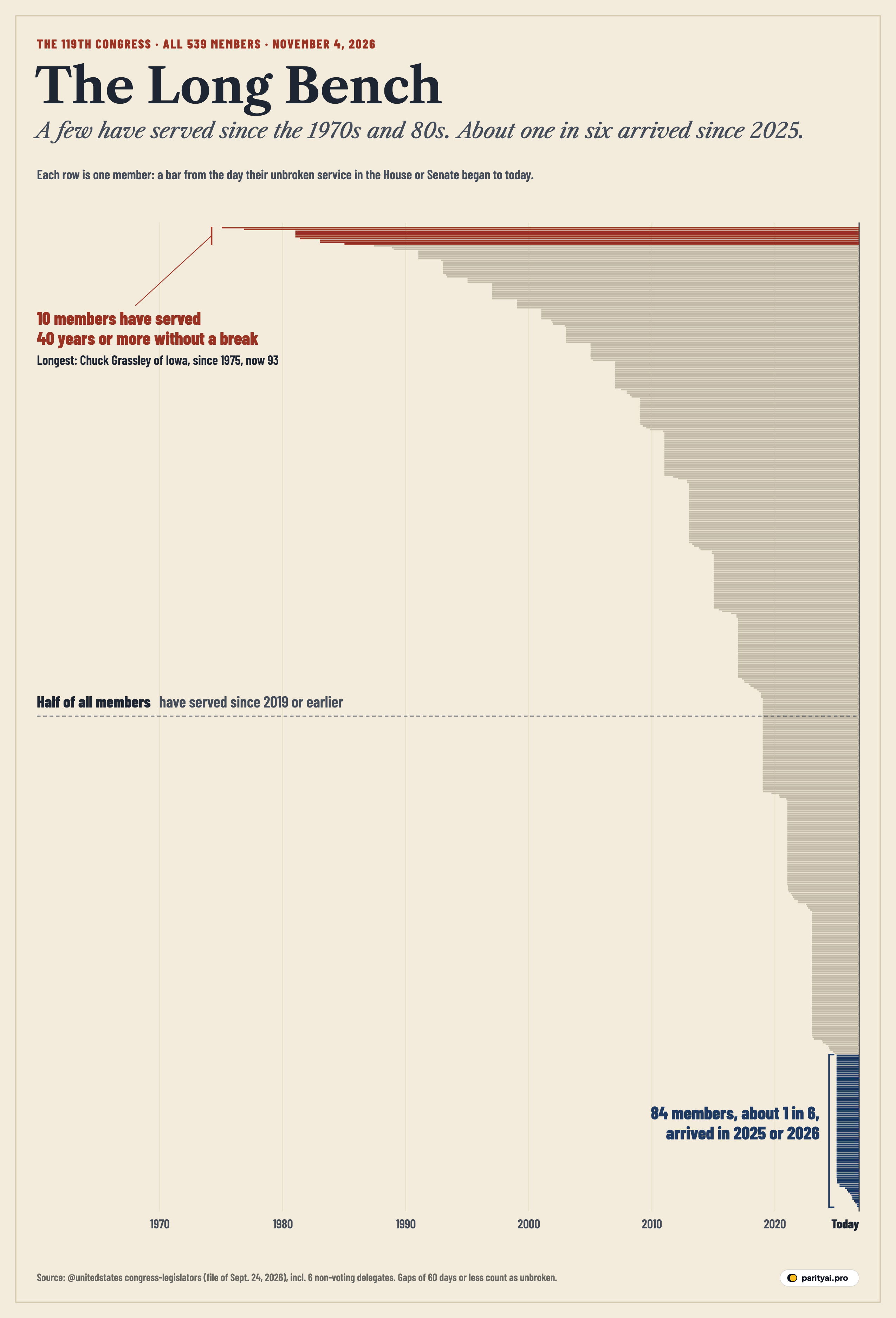
The chart above puts all 539 current members side by side, so that the span between those two is not just a pair of anecdotes but a shape. It is built from the @unitedstates congress-legislators project, a public-domain file that records every term every member has served, along with dates of birth. The file used here was last updated on September 24, 2026, and lists 100 senators and 439 House members, 6 of whom are the non-voting delegates and resident commissioner for the District of Columbia, Puerto Rico and four other territories. Ages and bars run to November 4, 2026.
Reading the staircase
Each of the 539 thin rows is one member, and each bar runs from the day that member's current, unbroken stretch in Congress began to today. Brick red marks the 10 members who have served for 40 years or more. Navy marks the 84 whose service began in 2025 or 2026. Everyone else is drawn in grey, so the two ends of the story stand out. The chart leaves out party, chamber and age to keep that one point clear; the sections and tables below fill them in.
Rows are sorted by the date each member's unbroken service began, longest at the top. "Unbroken" here means a chain of House and Senate terms with no gap longer than 60 days, so a move from one chamber to the other without leaving Congress still counts as one run; 43 of today's senators have a House stretch in their run. That leaves a staircase: a narrow top where a few rows reach back to the 1970s and 1980s, then wider and wider steps as each election brings in a new class, until the bottom rows are only a year or two long. The dashed line splits the rows in half: half of all members have served since January 3, 2019 or earlier.
Age is the other half of this story, and it is told here in numbers rather than on the chart. The sections below group members into generations, using the birth years the Pew Research Center uses: the Silent Generation (1928 to 1945), Baby Boomers (1946 to 1964), Generation X (1965 to 1980), Millennials (1981 to 1996) and Generation Z (born from 1997). The yardstick is the median age of the whole US population, 39.4 in July 2025, from the Census Bureau's Vintage 2025 estimates.
Almost every member is older than that. The median member of the current Congress is 60.5 years old, 21.1 years older than the median American. Only 24 of the 539 members (4%) are younger than the country's median resident. 135 are 70 or older, and 28 are 80 or older.
The widest steps are the biggest classes. The 2025 class, with 76 members whose unbroken run began that year, is the largest, followed by 2023 with 73.
The rest of this piece walks down the generations one at a time, from the oldest band to the youngest, and looks at where each one sits on the chart.
The Silent Generation: 23 members holding the top of the chart
Born between 1928 and 1945, the Silent Generation is the oldest cohort in Congress and the one that dominates the upper rows. There are 23 Silent Generation members in the 119th Congress, 4% of the total: 6 senators and 17 House members. By party they split 14 Democrats, 7 Republicans and 2 independents. Their median age is 84.0.
Their rows are long. The median Silent Generation member has served without a break for 29.8 years, and 17 of the 23 (74%) have served at least two decades. Of the 20 longest unbroken runs in Congress, 11 belong to this generation, although it accounts for only 4% of members.
The oldest and longest-serving member of all belongs here. Chuck Grassley of Iowa has served without a break since 1975, first in the House and, since 1981, in the Senate. On the first day of this Congress the Senate elected him its president pro tempore. Two rows below him on the House side is Hal Rogers of Kentucky, who has represented the same Kentucky district since 1981 and became Dean of the House, its longest-serving member, in March 2022. Further down this band sit Steny Hoyer, Richard Durbin, Mitch McConnell, Nancy Pelosi, Maxine Waters and Delegate Eleanor Holmes Norton of the District of Columbia.
Not every Silent Generation row is long, though. The cohort's youngest member, James Baird of Indiana, is 81 and began his current run in 2019. Six of the cohort are senators (Chuck Grassley, Richard Durbin, Mitch McConnell, Bernie Sanders, James Risch and Angus King Jr.), and none of the 23 began serving in 2025 or 2026.
The Silent Generation also arrived later than one might guess. Their median age when first sworn in to Congress was 54.6, almost exactly the same as the Boomers' (54.7). What sets their rows apart is not an early start but how long they have stayed.
| # | Member | State or territory | Chamber now | Unbroken since | Years | Age | Generation |
|---|---|---|---|---|---|---|---|
| 1 | Chuck Grassley (R) | Iowa | Senate (House first) | January 14, 1975 | 93 | Silent | |
| 2 | Ed Markey (D) | Massachusetts | Senate (House first) | November 2, 1976 | 80 | Boomers | |
| 3 | Hal Rogers (R) | Kentucky | House | January 5, 1981 | 88 | Silent | |
| 4 | Ron Wyden (D) | Oregon | Senate (House first) | January 5, 1981 | 77 | Boomers | |
| 5 | Chuck Schumer (D) | New York | Senate (House first) | January 5, 1981 | 75 | Boomers | |
| 6 | Chris Smith (R) | New Jersey | House | January 5, 1981 | 73 | Boomers | |
| 7 | Steny Hoyer (D) | Maryland | House | May 19, 1981 | 87 | Silent | |
| 8 | Richard Durbin (D) | Illinois | Senate (House first) | January 3, 1983 | 81 | Silent | |
| 9 | Marcy Kaptur (D) | Ohio | House | January 3, 1983 | 80 | Boomers | |
| 10 | Mitch McConnell (R) | Kentucky | Senate | January 3, 1985 | 84 | Silent | |
| 11 | Nancy Pelosi (D) | California | House | June 2, 1987 | 86 | Silent | |
| 12 | Frank Pallone Jr. (D) | New Jersey | House | November 8, 1988 | 75 | Boomers | |
| 13 | Richard Neal (D) | Massachusetts | House | January 3, 1989 | 77 | Boomers | |
| 14 | Eleanor Norton (D) | District of Columbia (delegate) | House | January 3, 1991 | 89 | Silent | |
| 15 | Maxine Waters (D) | California | House | January 3, 1991 | 88 | Silent | |
| 16 | Bernie Sanders (I) | Vermont | Senate (House first) | January 3, 1991 | 85 | Silent | |
| 17 | Rosa DeLauro (D) | Connecticut | House | January 3, 1991 | 83 | Silent | |
| 18 | Jack Reed (D) | Rhode Island | Senate (House first) | January 3, 1991 | 76 | Boomers | |
| 19 | Jerrold Nadler (D) | New York | House | November 3, 1992 | 79 | Boomers | |
| 20 | Jim Clyburn (D) | South Carolina | House | January 5, 1993 | 86 | Silent |
Years of unbroken House and Senate service to November 4, 2026. Highlighted rows: members of the Silent Generation (born 1928–45). D = Democrat, R = Republican, I = independent; the chip shows party and chamber as on the chart.
Baby Boomers: 228 members and the widest band
Born from 1946 to 1964, Boomers are the largest generation in Congress: 228 members, or 42%. They hold 62 of the 100 Senate seats and 166 House seats, and split 107 Democrats to 121 Republicans. Their median age is 69.8, and the median Boomer has served without a break for 13.8 years.
On the chart the Boomers are everywhere, from the brick-red rows at the top to the navy rows at the bottom, because Boomers have kept arriving in every class. The longest Boomer run belongs to Ed Markey of Massachusetts, second only to Grassley's: Markey won a special election on November 2, 1976 that doubled as a regular election, took his House seat that night, and moved to the Senate in 2013. 52 Boomers have served at least 20 years without a break, and 9 of the 20 longest runs are theirs.
Five Boomers born in 1946 have already turned 80: Richard Blumenthal, the generation's oldest member, among them. At the other end, Michael Bennet of Colorado, born in 1964, is the youngest Boomer at 61. Boomers also still join: 9 of them began their current service in 2025 or 2026.
The Senate is where Boomers are most concentrated. With 62 of 100 seats, they form a clear majority of the chamber, and the median senator is 66.5 while the median House member is 58.8. The Constitution sets a lower floor for the Senate too: senators must have attained the age of thirty, against twenty-five for representatives, and serve six-year terms instead of two.
Generation X: 209 members, mostly recent
Generation X, born from 1965 to 1980, is almost as large as the Boomer cohort in Congress: 209 members, 39%. Gen X members split 99 Democrats and 110 Republicans, and their median age is 54.7. Most of them are in the House: 181, against 28 senators.
Their rows look very different. The median Gen Xer has served without a break for 5.8 years, and only 5 have reached 20 years. None of the 20 longest runs belongs to Gen X; the 20th-longest began in 1993. The longest Gen X runs belong to Adam Smith of Washington and Robert Aderholt of Alabama, both of whom began in 1997, 29.8 years ago.
Gen X is the generation that is arriving now. 47 of the 84 members whose unbroken service began in 2025 or 2026 are Gen Xers, more than any other cohort. That includes five senators in their first terms: David McCormick, Bernie Moreno, Angela Alsobrooks, Jon Husted and Ashley Moody. They also entered Congress younger than the generations before them, at a median age of 46.8.
Gen X sits on both sides of the age where Congress is centred. Their oldest member, Terri Sewell of Alabama, is 61; their youngest, Derek Tran of California, is 45. Every Gen X member is older than the US median of 39.4.
| Generation (Pew birth years) | Members | Share | D / R / I | Senate / House | Median age | Median years unbroken | Median age when first sworn in |
|---|---|---|---|---|---|---|---|
| Silent Generation (1928–1945) | 4% | 14 / 7 / 2 | 6 / 17 | 84.0 | 29.8 | 54.6 | |
| Baby Boomers (1946–1964) | 42% | 107 / 121 / 0 | 62 / 166 | 69.8 | 13.8 | 54.7 | |
| Generation X (1965–1980) | 39% | 99 / 110 / 0 | 28 / 181 | 54.7 | 5.8 | 46.8 | |
| Millennials (1981–1996) | 14% | 41 / 36 / 1 | 4 / 74 | 41.5 | 3.8 | 37.5 | |
| Generation Z (1997–2012) | <1% | 1 / 0 / 0 | 0 / 1 | 29.8 | 3.8 | 26.0 |
All 539 members, including the six non-voting delegates and resident commissioner, counted in the House column. Ages as of November 4, 2026.
Millennials: 78 members in the bottom third
Millennials, born from 1981 to 1996, are 78 members of the 119th Congress, 14%: 41 Democrats, 36 Republicans and 1 independent, Kevin Kiley of California, who served his earlier House terms as a Republican. Their median age is 41.5, and their median unbroken service is 3.8 years.
On the chart the Millennials are almost all in the lower third, where rows are short. The longest Millennial run belongs to Elise Stefanik of New York, who began in 2015 and has served 11.8 years; nobody else in the generation has passed eight. 28 Millennials began in 2025 or 2026.
Only 4 Millennials sit in the Senate: Andy Kim, Jon Ossoff, Katie Britt and Tim Sheehy. Jon Ossoff of Georgia, at 39, is the youngest senator and the only one under 40. The rest are in the House, where the youngest Millennial is Brandon Gill of Texas, at 32.
This is the generation that pulls the chamber's age down. Every one of the 27 members under 40 is a Millennial except Frost, and the same is true of the 24 members who are younger than the median American. Their median age at first swearing-in, 37.5, is more than a decade below the Silent Generation's and the Boomers'. That is partly arithmetic: a generation still in its thirties and early forties can only have entered young. It will take several more elections to see whether Millennials stay as long as the generations above them.
Generation Z: a single row
Generation Z, born from 1997, has one member: Maxwell Frost of Florida. He became the first Gen Z member of Congress when he won his seat in November 2022, and the Pew Research Center's count for the 119th Congress also found exactly one. He is 29 and has served since January 3, 2023. His row is one of the short grey bars near the bottom, in the 2023 class.
No one from Generation Z is old enough for the Senate yet: the minimum is 30, and the oldest Gen Zers, born in 1997, turn 30 in 2027. In the House, anyone born by late 2001 already meets the age floor of 25.
Older than it used to be
How unusual is this Congress? The same project publishes a historical file of every member since 1789, which makes it possible to take the median age of voting members on January 31 of the first year of every Congress since 1949. On that basis the House median was 50.8 in 1949 and the Senate median 56.4. Both fell into the early 1980s: the Senate's low was 51.8 in 1981 (the 97th Congress) and the House's was 48.5 in 1983 (the 98th). In January 2025 they were 57.6 for the House and 65.1 for the Senate. The highest House median in the series came in 2021, and the highest Senate median in 2023.
Those figures sit close to independent counts. Pew put the median age of voting House members at 57.5 and of the Senate at 64.7 on January 3, 2025, and the Congressional Research Service's profile of the 119th Congress gives average ages of 57.9 for representatives and 63.9 for senators at its start. The small differences come from the day counted, from medians versus averages, and from which seats were filled on that day.
Today's figures are higher than those, partly because almost two years have passed: across all 539 members, including delegates, the median age on November 4, 2026 is 60.5, with 66.5 in the Senate and 58.8 in the House.
| Congress | Date counted | House median age | House change | Senate median age | Senate change |
|---|---|---|---|---|---|
| 119th | Jan. 31, 2025 | ▼ 0.4 | ▼ 0.3 | ||
| 118th | Jan. 31, 2023 | ▼ 0.9 | ▲ 0.6 | ||
| 117th | Jan. 31, 2021 | ▲ 0.8 | ▲ 1.1 | ||
| 116th | Jan. 31, 2019 | ▼ 0.4 | ▲ 1.2 | ||
| 115th | Jan. 31, 2017 | ▲ 0.8 | ▲ 1.1 | ||
| 114th | Jan. 31, 2015 | ▼ 0.0 | ▼ 0.5 | ||
| 113th | Jan. 31, 2013 | ▲ 0.4 | ▲ 0.3 | ||
| 112th | Jan. 31, 2011 | ▼ 0.1 | ▼ 0.8 | ||
| 111th | Jan. 31, 2009 | ▲ 0.5 | ▼ 0.6 | ||
| 110th | Jan. 31, 2007 | ▲ 0.5 | ▲ 1.8 | ||
| 109th | Jan. 31, 2005 | ▲ 1.2 | ▲ 1.6 | ||
| 108th | Jan. 31, 2003 | ▲ 1.1 | ▲ 0.9 | ||
| 107th | Jan. 31, 2001 | ▲ 1.4 | ▲ 1.3 | ||
| 106th | Jan. 31, 1999 | ▲ 1.0 | ▲ 1.0 | ||
| 105th | Jan. 31, 1997 | ▲ 0.7 | ▼ 1.3 | ||
| 104th | Jan. 31, 1995 | 0.0 | ▼ 0.1 | ||
| 103rd | Jan. 31, 1993 | ▼ 0.9 | ▲ 1.5 | ||
| 102nd | Jan. 31, 1991 | ▲ 1.2 | ▲ 1.6 | ||
| 101st | Jan. 31, 1989 | ▲ 0.8 | ▲ 0.7 | ||
| 100th | Jan. 31, 1987 | ▲ 0.7 | ▲ 0.2 | ||
| 99th | Jan. 31, 1985 | ▲ 0.6 | ▲ 0.8 | ||
| 98th | Jan. 31, 1983 | ▼ 0.1 | ▲ 1.1 | ||
| 97th | Jan. 31, 1981 | ▼ 0.8 | ▼ 1.2 | ||
| 96th | Jan. 31, 1979 | ▼ 0.2 | ▼ 1.5 | ||
| 95th | Jan. 31, 1977 | ▼ 0.2 | ▼ 0.6 | ||
| 94th | Jan. 31, 1975 | ▼ 1.1 | ▼ 1.1 | ||
| 93rd | Jan. 31, 1973 | ▼ 0.8 | ▲ 0.2 | ||
| 92nd | Jan. 31, 1971 | ▼ 0.0 | ▼ 0.3 | ||
| 91st | Jan. 31, 1969 | ▲ 1.1 | ▼ 3.3 | ||
| 90th | Jan. 31, 1967 | ▲ 0.6 | ▼ 0.2 | ||
| 89th | Jan. 31, 1965 | ▼ 1.0 | ▲ 1.8 | ||
| 88th | Jan. 31, 1963 | ▼ 1.5 | ▼ 0.9 | ||
| 87th | Jan. 31, 1961 | ▲ 1.1 | ▲ 1.4 | ||
| 86th | Jan. 31, 1959 | ▼ 1.7 | ▼ 1.6 | ||
| 85th | Jan. 31, 1957 | ▲ 0.6 | ▲ 1.0 | ||
| 84th | Jan. 31, 1955 | ▲ 0.2 | ▲ 1.3 | ||
| 83rd | Jan. 31, 1953 | ▲ 0.4 | ▲ 0.9 | ||
| 82nd | Jan. 31, 1951 | ▲ 1.1 | ▼ 0.4 | ||
| 81st | Jan. 31, 1949 |
Voting members serving on January 31 of each Congress's first year, from the congress-legislators current and historical files (delegates excluded). Change is versus the previous Congress.
What a row leaves out
The chart is a snapshot of who holds a seat on one day, and that shapes it in a few ways.
- Members who have left are not on it. CBS News counted five members of the 119th Congress who died in office by April 2026, among them Sylvester Turner, Raúl Grijalva and Gerry Connolly in 2025. Their successors appear instead, usually in short rows at the bottom. Members who resigned are also absent.
- "Unbroken" is a rule, not an official measure. 19 current members have an earlier stretch of service separated by more than 60 days; the chart counts only their current run. The longest break belongs to Cleo Fields of Louisiana, who first served in 1993 and returned in 2025, 28.0 years later.
- Term dates come from the file, with four corrections. Most terms are recorded from the start of a Congress or from the day of a special election or appointment. For four members who joined mid-Congress the file uses the start of the Congress instead, so their first terms are redrawn from the special-election date: Ed Markey (November 2, 1976), Steny Hoyer (May 19, 1981), Nancy Pelosi (June 2, 1987) and Frank Pallone Jr. (November 8, 1988). Other rows were not checked one by one.
- Party is a label on a term. Independents are drawn in their own colour even though Sanders and King caucus with Democrats, and a member who changed party has segments in more than one colour.
- Generations are conventions. Pew's boundaries are one widely used set; a member born in late 1964 or early 1965 sits on a line someone drew, not a real break.
- The November 3, 2026 election is not in it. Two appointed senators, Jon Husted and Ashley Moody, have terms that the file ends on election day; they are drawn up to today. Results from that election will change the chart in January.
Two bars on the same day
Go back to the two members from the opening. Grassley's row is the longest on the chart, 51.8 years from his first House term. Frost's is a short stub a little under four years long. Both of them cast votes with the same weight. Sorted into generations, the balance is plain: 42% Boomers and 39% Gen Xers between them hold most of the seats, while the members born after 1980 hold 14% and a single seat.
The staircase will change shape. Each election removes some rows and adds a new step at the bottom; 163 members (30%) have arrived since the start of 2023 alone. Half of the current members began their unbroken service on or before January 3, 2019, and half after. The shape of the next chart, after the members elected on November 3 take their seats, will show how much of the top survives.
Sources and method
- @unitedstates project, congress-legislators: legislators-current.json and legislators-historical.json. Every current member's terms, party and date of birth; file last updated September 24, 2026; retrieved November 4, 2026. Public domain (CC0).
- US Census Bureau, Vintage 2025 population estimates (median age). US median age 39.4 in July 2025.
- Pew Research Center, generation birth-year definitions. Silent 1928–45, Boomers 1946–64, Generation X 1965–80, Millennials 1981–96, Generation Z 1997–2012.
All 539 people listed as current members in the congress-legislators file are included: 100 senators, the voting House members and the six non-voting House delegates and resident commissioner (District of Columbia, Puerto Rico, Guam, the U.S. Virgin Islands, American Samoa and the Northern Mariana Islands). Ages are as of November 4, 2026. Continuous service is the unbroken run of House and Senate terms ending in the member's current term; a gap of more than 60 days between terms starts a new run, so moving from the House to the Senate without a break counts as continuous. Earlier, separate stretches of service are drawn faded. Party and chamber are those of each term as recorded in the file; independents are shown as independents whatever caucus they sit with. Generations follow Pew Research Center birth-year ranges. The file dates the first House terms of Ed Markey, Steny Hoyer, Nancy Pelosi and Frank Pallone Jr. from the start of a Congress although each joined mid-Congress by special election; their first terms are drawn from the special-election dates instead (November 2, 1976; May 19, 1981; June 2, 1987; November 8, 1988). Historical median ages count members serving on January 31 of each odd year, excluding delegates.
Charts like this, from your own numbers.
Connect a spreadsheet or the tools you run on, and Parity builds the dashboard and writes the report, with every number checked.
Try Parity free