Charts like this, from your own numbers.
Connect a spreadsheet or the tools you run on, and Parity builds the dashboard and writes the report, with every number checked.
Try Parity freeIn 2015, fewer than one in a hundred new cars sold anywhere in the world ran on electricity: 0.7%, by the International Energy Agency's count. In 2020 the share was 4.4%. In 2025 it was 25%. The IEA's latest Global EV Outlook says electric car sales grew by 20% globally to exceed 20 million in 2025, and that one-quarter of all new cars sold were electric.
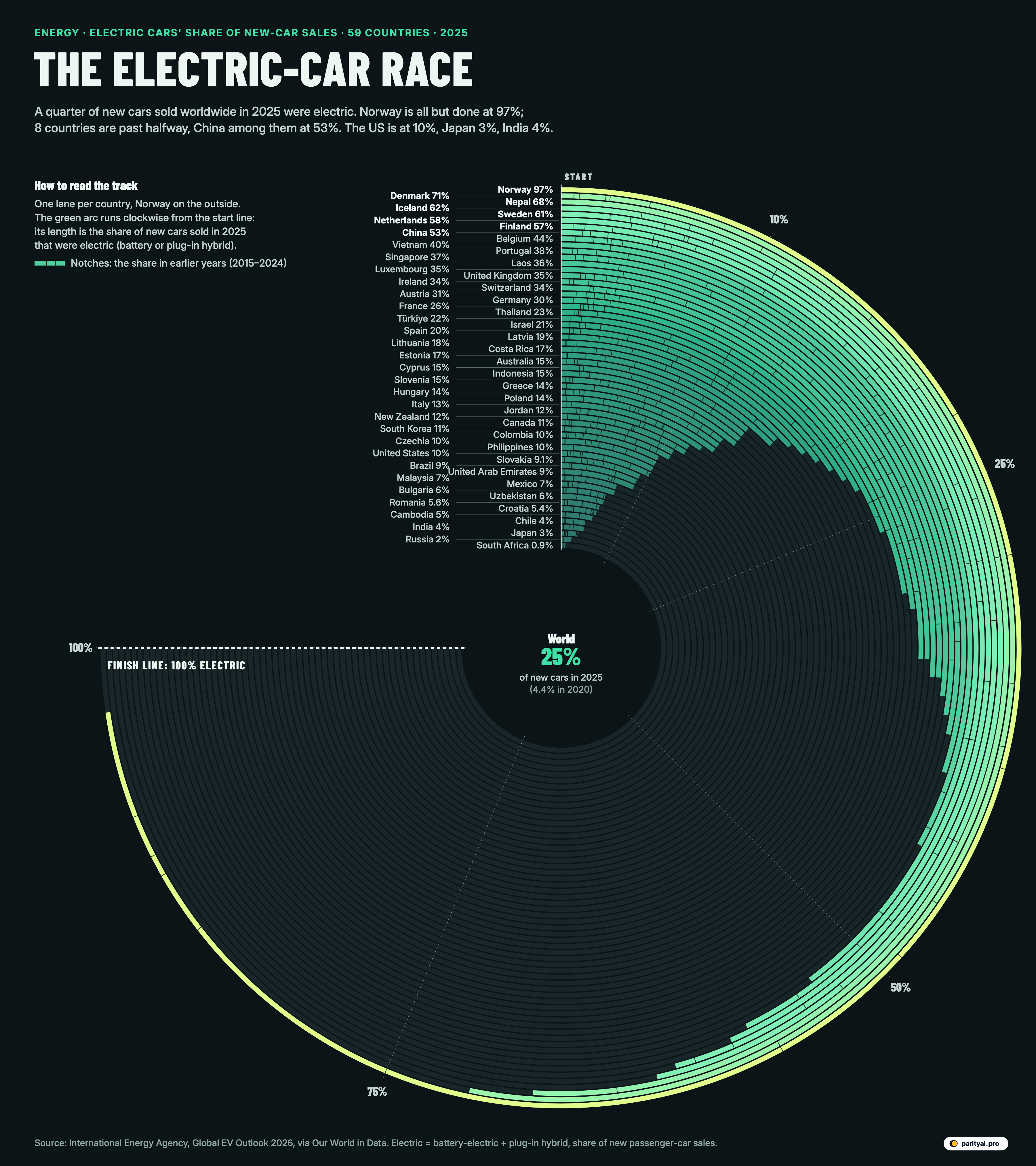
That global average describes a race in which the field is spread out over most of the course. The chart above draws it as a running track, with one lane for each of the 59 countries the IEA reports on, Norway on the outside and South Africa on the inside. Each lane fills clockwise from the start line at the top: the further round it reaches, the larger the share of new cars sold in 2025 that were electric. A full three-quarter lap would be 100%. The small notches in each lane mark where the country stood in earlier years, back to 2015, so a lane with notches spread far apart has been moving fast. Here "electric" means battery-electric cars plus plug-in hybrids, as in the IEA's figures.
What follows is the race commentary.
The leader: Norway, nearly home
One lane is almost at the finish. In 2025, 97% of new cars sold in Norway were electric on the IEA's measure. Norway's road traffic information council, OFV, which counts only fully battery-electric cars, put the figure at 95.9% of all new passenger car registrations, and its director said Norway had achieved its zero-emission target for new car sales.
Norway's notches tell the story of a long lead. Electric cars were 22% of its sales in 2015 and 75% in 2020, already further round than every other country is today.
The breakaway: the Nordics, the Netherlands, Nepal and China
Behind the leader, a group of 8 countries is past the halfway mark: Norway, Denmark, Nepal, Iceland, Sweden, Netherlands, Finland, China. Four of them are Nordic. Denmark is second at 71%, up from 56% in 2024 and 16% in 2020. Iceland reached 62%, Sweden 61%, the Netherlands 58% and Finland 57%.
The surprise in the group is Nepal, at 68%. Nepal is one of the few countries in the breakaway whose share actually slipped in 2025, from 74% the year before.
The biggest rider in the group is China. The IEA says electric cars accounted for nearly 55% of all car sales there in 2025; Our World in Data's figure is 53%. Five years earlier it was 5.7%. In absolute numbers China's lane dwarfs every other: the country's car industry association reported that sales of new-energy vehicles broke through the 16 million-unit threshold, and the IEA says Chinese carmakers supplied 60% of the world's electric car sales.
The chasing group: Western Europe and the fast risers of Asia
The next stretch of the track, between about a quarter and a half of the way round, is crowded with Western European countries and a few from Southeast Asia. Belgium is at 44%, Portugal 38%, the United Kingdom 35%, Germany 30% and France 26%. For the European Union as a whole the IEA puts the share at 27%; the industry body ACEA, counting battery-electric cars only, reported a 17.4% market share for them, with plug-in hybrids adding 9.4%.
Germany's lane shows a jump: from 20% in 2024 to 30% in 2025. Spain rose from 11% to 20%, Italy from 7.5% to 13%. The EU's car-emission rules were loosened in 2025 to let manufacturers comply with their obligations for the years 2025, 2026 and 2027 on a three-year average rather than year by year.
Asia supplies some of the fastest riders in this group. Vietnam is the race's biggest climber of the year: its share rose 21 points, from 19% to 40%. The Vietnamese carmaker VinFast delivered 175,099 electric vehicles in 2025, a record in the domestic market. Singapore is at 37%, Laos at 36%, Thailand at 23%, up from 13%.
| # | Country | EV share 2025 | 2024 | 2020 | 2015–2025 |
|---|---|---|---|---|---|
| 1 | Norway | 92% | 75% | ||
| 2 | Denmark | 56% | 16% | ||
| 3 | Nepal | 74% | n/a | ||
| 4 | Iceland | 43% | 52% | ||
| 5 | Sweden | 58% | 32% | ||
| 6 | Netherlands | 48% | 25% | ||
| 7 | Finland | 50% | 18% | ||
| 8 | China | 48% | 5.7% | ||
| 9 | Belgium | 43% | 11% | ||
| 10 | Vietnam | 19% | n/a | ||
| 11 | Portugal | 33% | 13% | ||
| 12 | Singapore | 34% | 2.6% | ||
| 13 | Laos | 25% | n/a | ||
| 14 | Luxembourg | 36% | 11% | ||
| 15 | United Kingdom | 27% | 11% | ||
| 16 | Ireland | 25% | 7.4% | ||
| 17 | Switzerland | 28% | 14% | ||
| 18 | Austria | 24% | 9.5% | ||
| 19 | Germany | 20% | 14% | ||
| 20 | France | 24% | 11% | ||
| 21 | Thailand | 13% | 1.1% | ||
| 22 | Türkiye | 11% | 0.2% | ||
| 23 | Israel | 19% | 2.6% | ||
| 24 | Spain | 11% | 4.5% | ||
| 25 | Latvia | 12% | 2.6% | ||
| 26 | Lithuania | 12% | 1.1% | ||
| 27 | Costa Rica | 15% | 2.5% | ||
| 28 | Estonia | 10% | 1.8% | ||
| 29 | Australia | 12% | 1% | ||
| 30 | Cyprus | 12% | 1.4% | ||
| 31 | Indonesia | 6.8% | 0.1% | ||
| 32 | Slovenia | 8.1% | 3.1% | ||
| 33 | Greece | 12% | 2.7% | ||
| 34 | Hungary | 12% | 4.7% | ||
| 35 | Poland | 6.7% | 1.9% | ||
| 36 | Italy | 7.5% | 4.2% | ||
| 37 | Jordan | 21% | 2.4% | ||
| 38 | New Zealand | 11% | 6.6% | ||
| 39 | Canada | 17% | 4.2% | ||
| 40 | South Korea | 7.4% | 2.5% | ||
| 41 | Colombia | 7.6% | 0.8% | ||
| 42 | Czechia | 6.8% | 2.5% | ||
| 43 | Philippines | 1.3% | 0.2% | ||
| 44 | United States | 10% | 2.3% | ||
| 45 | Slovakia | 4.8% | 2.3% | ||
| 46 | Brazil | 6.4% | 0.2% | ||
| 47 | United Arab Emirates | 6.5% | 0.4% | ||
| 48 | Malaysia | 3.1% | 0.1% | ||
| 49 | Mexico | 2.2% | 0.5% | ||
| 50 | Bulgaria | 5% | n/a | ||
| 51 | Uzbekistan | 5% | n/a | ||
| 52 | Romania | 6.5% | 3.1% | ||
| 53 | Croatia | 4.9% | 1.9% | ||
| 54 | Cambodia | 2.9% | n/a | ||
| 55 | Chile | 2.1% | 0.2% | ||
| 56 | India | 2.1% | 0.1% | ||
| 57 | Japan | 2.8% | 0.8% | ||
| 58 | Russia | 2.5% | 0.1% | ||
| 59 | South Africa | 0.5% | 0.1% |
Share of new passenger cars sold that are battery-electric or plug-in hybrid. IEA via Our World in Data.
The peloton: from Türkiye to the United States
The bulk of the field sits within the first quarter of the track. Türkiye has moved fast, to 22% from 11% a year earlier and 0.2% in 2020. Indonesia reached 15%, Australia 15%, Poland 14%, Costa Rica 17%.
The United States is in this group, at 10%, the same as in 2024; it ranks 44 of 59. The IEA says American electric car sales were slightly lower than in 2024, at around 1.5 million. Federal tax credits for buying an electric car ended for vehicles acquired after September 30, 2025, and the IEA reports that fourth-quarter sales were 45% lower than a year earlier. Canada's share fell from 17% to 11%. South Korea is at 11%, Brazil at 9%, the Philippines at 10%, up from 1.3%, and Mexico at 7%.
Off the back: Japan, India, Russia, South Africa
The innermost lanes have barely left the start line. India is at 4%, Japan at 3%, Russia at 2% and South Africa at 0.9%. Japan is the striking one: a car-making powerhouse whose domestic market is among the least electrified on the chart, ranking 57 of 59. India has doubled its share in a year, from 2.1%, but from a very low base.
Some countries are missing from the race entirely because the IEA does not report a 2025 figure for them. Ethiopia, for example, became in 2024 the first country in the world to ban the importation of non-electric private vehicles, according to the Associated Press, but it does not appear on the track.
Who moved most this year
Looking only at the gap between 2024 and 2025, the biggest gains were in Vietnam (21 percentage points), Iceland (19), Denmark (15), Laos and Türkiye (11 each) and the Netherlands (10). Only 5 countries saw their share fall: Romania, Luxembourg, Nepal, Canada, Jordan.
Outside China, the IEA counts the developing markets as a group, and there sales of electric cars increased by around 80% in 2025, to reach almost 1.2 million, a record. Many of those countries now sit in the middle of the track, well ahead of some richer car markets.
Lap times
The notches make it possible to time the leaders. Norway was already above 10% by 2015, the first year shown, and passed 50% in 2019. Sweden took from 2019 to 2022 to make the same climb, Finland from 2020 to 2023 and Denmark from 2020 to 2024: four years or less each. China first passed 10% in 2021 and crossed 50% in 2025. The Netherlands was the slowest of the breakaway: above 10% as early as 2016, it only passed 50% in 2025.
Across the whole field, the change in five years has been dramatic. In 2020, 13 of these 59 countries had an electric share of 10% or more; by 2022 the number was 20, and in 2025 it was 44. The number at 25% or more went from 4 to 20.
Among the leaders, the climb from 10% to 50% took between one year, in Nepal's case (2022 to 2023, on the IEA's figures), and nine, in the Netherlands'. Iceland made it in three, from 2017 to 2020. Whether the large markets now sitting at around 10%, the United States, Canada and South Korea among them, follow a similar curve is the main open question of the race. The American lane did not move at all between 2024 and 2025. Across all 59 countries, the median share in 2025 was 15%, still below the 22% Norway had reached a decade earlier.
Reading the track
A few notes on the rules of this race. The shares include plug-in hybrids, which have both a battery and a petrol engine, so they run higher than the battery-only figures many national agencies publish: Norway's OFV and the EU's ACEA both report battery-electric cars separately. They cover new passenger cars only, not the cars already on the road, which change far more slowly. Small markets, like Iceland or Laos, can swing sharply from one year to the next on a few thousand sales. And the field includes only the 59 countries with a 2025 IEA figure; the "rest of the world" outside them averaged 5.5%.
The race is also not a contest between companies, though one shows up in the numbers. Counting fully electric cars only, BYD sold 2,254,714 in 2025, against Tesla's 1,636,129 deliveries.
The next lap
The IEA expects the global share to keep rising, to close to 30% of cars sold in 2026, according to its latest outlook. On the track, that would move the world's marker from a quarter of the way round to just under a third. Norway will cross the line first. The more interesting question is how long the rest of the field takes, and whether the riders at the back, the United States, Japan and India among them, start to close the gap or fall further behind.
Sources and method
- IEA (2026), Global EV Data Explorer, processed by Our World in Data: Share of new cars sold that are electric. License: CC BY 4.0. 2010–2025, retrieved October 30, 2026. Electric = battery-electric plus plug-in hybrid
The share is electric cars as a percentage of all new passenger cars sold in each country in a calendar year, as estimated by the International Energy Agency and published by Our World in Data. 'Electric' combines battery-electric and plug-in hybrid cars, so figures are higher than national statistics that count only fully electric cars. Each lane is three-quarters of a circle long, and its length is proportional to the share: a full lane would mean every new car sold was electric. Notches show the share in each earlier year from 2015 where available. The 59 countries are all those with a 2025 figure; regional and world totals are shown separately.
Charts like this, from your own numbers.
Connect a spreadsheet or the tools you run on, and Parity builds the dashboard and writes the report, with every number checked.
Try Parity free