Charts like this, from your own numbers.
Connect a spreadsheet or the tools you run on, and Parity builds the dashboard and writes the report, with every number checked.
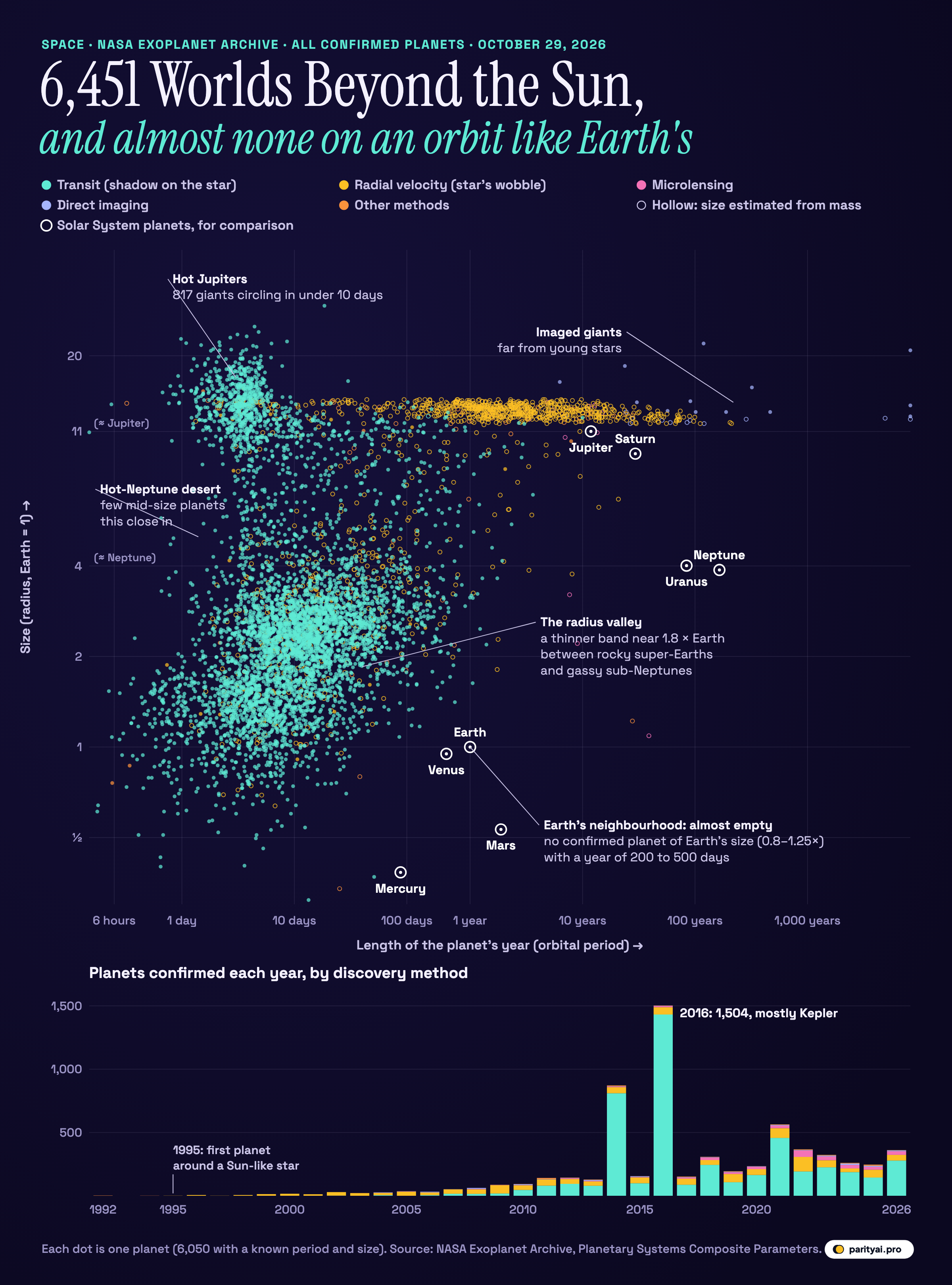
Try Parity freeEarth takes 365 days to go round the Sun and is, by definition, one Earth wide. Put that point on the chart above and draw a box around it, from planets four-fifths of Earth's size to a quarter bigger, with years between 200 and 500 days. Then count how many of the 6,451 planets confirmed beyond the Solar System fall inside the box, using sizes that were actually measured.
The answer is zero.
That empty box is not evidence that Earth is unusual. It is evidence of how planets get found. NASA's Exoplanet Archive, which keeps the official tally, lists 6,451 confirmed planets as of October 29, 2026. Each dot on the chart is one of the 6,050 that have both a known orbital period, the length of the planet's year, and a radius. Left to right is the year, on a logarithmic scale running from hours to millennia. Bottom to top is the size, from smaller than Earth to more than twice the width of Jupiter. The colour is the method that found it. The white rings are the eight planets of our own Solar System, placed by the same rules.
The sections below are a tour of that chart, one set of coordinates at a time.
Where most of the dots are: 3 to 30 days, 1 to 4 Earths
The dense teal cloud in the left half of the chart is the most common kind of known planet: worlds between Earth and Neptune in size, on orbits of a few days to a few weeks. Of the 4,834 planets with a measured radius, 3,049 (63%) are between 1.25 and 4 times Earth's width. Our Solar System has nothing of that size at all; it jumps from Earth to Neptune.
The cloud is teal because these planets were almost all found by transit, the method behind 4,785 discoveries, or 74% of the total. A transit survey stares at stars and waits for a planet to cross the face of its star, dimming it slightly. NASA's description of how the Kepler space telescope worked is plain: it was "waiting to catch tiny dips" in starlight caused by planets passing in front. Kepler launched in March 2009, and when NASA retired it in October 2018 it left "a legacy of more than 2,600 exoplanet discoveries". The archive today credits 2,787 planets to Kepler and 550 more to K2, its second mission; together, 52% of every known exoplanet.
Short orbits dominate partly for a simple reason: a planet with a 10-day year crosses its star 36 times in a year of observing, while an Earth twin would cross once, if its orbit happens to line up with our view at all. About 48% of the planets on the chart orbit in under 10 days.
A gap at 1.8 Earths
Look at the teal cloud closely and it is not one blob but two, one centred a little above Earth's size and one around twice to three times it, with a thinner band in between. That band is called the radius valley, or the Fulton gap, after the California-Kepler Survey team led by Benjamin Fulton, which reported in 2017 a deficit of at least a factor of two in how often planets 1.5 to 2.0 times Earth's radius occur.
You can see it in the raw counts too, even without the corrections for detection bias that the survey made. Among planets with measured radii and years shorter than 100 days, 328 are between 1.3 and 1.5 Earths across, 246 between 1.7 and 1.9, and 340 between 2.2 and 2.4. The middle bin is the valley. Planets below it are usually called super-Earths, rocky worlds a bit bigger than ours; those above it are sub-Neptunes, thought to carry thick envelopes of gas.
Under 3 days, Neptune-sized: almost nothing
Move to the far left, where years last less than three days, and look between 3 and 8 Earth radii. The chart thins out. Astronomers call this the hot-Neptune desert. A 2016 study by Tsevi Mazeh and colleagues described "a significant dearth of exoplanets with Neptune mass and radius" on orbits shorter than about two to four days.
The archive shows the same thing. Among planets with measured radii and years under two and a half days, 319 are between 1 and 3 Earths across and 159 are at least 8, but only 32 fall between 3 and 8. Small planets are harder to find than big ones, so the desert is not a detection effect: a Neptune that close in would be easier to spot than the super-Earths that outnumber it.
3 days, 13 Earths: the hot Jupiters
The cluster at the top left, giants circling their stars in a few days, was the first surprise of the exoplanet age. In 1995 Michel Mayor and Didier Queloz announced the first planet found orbiting a solar-type star, 51 Pegasi b, and shared half of the 2019 Nobel Prize in Physics for it. NASA's explainer describes how the planet "tugged so hard on its parent star as it raced around in a four-day orbit" that the wobble was obvious.
Nothing in our Solar System looks like that. Jupiter takes almost 12 years to go round the Sun. Yet hot Jupiters are among the easiest planets to find, by wobble or by transit, and the archive now lists 817 giants (at least 8 Earth radii, or about a third of Jupiter's mass where only the mass is known) with years shorter than 10 days.
1 to 100 years, Jupiter-sized: the yellow band
The yellow dots are planets found by radial velocity: astronomers measure a star's spectrum night after night and look for the tiny back-and-forth shift caused by a planet's pull. That method gives a planet's mass, or a minimum mass, but not its size. For 1,134 of the radial-velocity planets on the chart, the archive has estimated the radius from the mass with a standard relation, and those are drawn as hollow rings.
That is why so many yellow rings line up in a neat horizontal band, slightly above Jupiter's size. A gas giant's radius changes little with its mass, so the formula puts most of them at roughly the same width. The band is a product of the method, not a pile-up of identical planets. What is real is how far right it reaches: radial velocity, with surveys that now span decades, finds giants on orbits of years to decades, like Jupiter and Saturn.
| Year | Planets | Transit | Radial velocity | Microlensing | Imaging | Other |
|---|---|---|---|---|---|---|
| 2026 | 278 | 45 | 29 | 7 | 2 | |
| 2025 | 144 | 62 | 23 | 8 | 9 | |
| 2024 | 187 | 29 | 28 | 11 | 5 | |
| 2023 | 225 | 56 | 30 | 7 | 5 | |
| 2022 | 192 | 115 | 51 | 4 | 5 | |
| 2021 | 457 | 77 | 21 | 5 | 4 | |
| 2020 | 164 | 46 | 20 | 3 | 1 | |
| 2019 | 107 | 65 | 14 | 4 | 4 | |
| 2018 | 244 | 38 | 21 | 3 | 2 | |
| 2017 | 87 | 48 | 10 | 3 | 4 | |
| 2016 | 1432 | 58 | 10 | 2 | 2 | |
| 2015 | 99 | 46 | 4 | 5 | 1 | |
| 2014 | 810 | 48 | 6 | 2 | 6 | |
| 2013 | 79 | 34 | 5 | 7 | 3 | |
| 2012 | 94 | 39 | 7 | 2 | 2 | |
| 2011 | 80 | 49 | 1 | 2 | 9 | |
| 2010 | 46 | 37 | 2 | 6 | 2 | |
| 2009 | 18 | 66 | 2 | 0 | 1 | |
| 2008 | 15 | 36 | 4 | 7 | 0 | |
| 2007 | 16 | 34 | 0 | 1 | 1 | |
| 2006 | 5 | 21 | 1 | 5 | 0 | |
| 2005 | 0 | 33 | 2 | 1 | 0 | |
| 2004 | 5 | 18 | 1 | 3 | 0 | |
| 2003 | 0 | 21 | 0 | 0 | 1 | |
| 2002 | 1 | 28 | 0 | 0 | 0 | |
| 2001 | 0 | 12 | 0 | 0 | 0 | |
| 2000 | 0 | 16 | 0 | 0 | 0 | |
| 1999 | 0 | 13 | 0 | 0 | 0 | |
| 1998 | 0 | 6 | 0 | 0 | 0 | |
| 1997 | 0 | 1 | 0 | 0 | 0 | |
| 1996 | 0 | 6 | 0 | 0 | 0 | |
| 1995 | 0 | 1 | 0 | 0 | 0 |
Confirmed planets by the year the discovery was published, as listed in the NASA Exoplanet Archive on October 29, 2026. 3 planets found before 1995 are not shown.
Far right: the imaged and the lensed
The lavender and pink dots at the right edge come from the two methods that can see far from a star. Direct imaging, taking an actual picture of a planet by blocking its star's glare, has found 98 of the planets in the archive; NASA notes that "fewer than 100 exoplanets have been directly imaged". Imaging favours big, young, hot giants far from their stars, the only kind bright enough to spot. The longest year in the archive belongs to COCONUTS-2 b, at about 1,100,616 Earth years.
Microlensing, which catches a planet when its star briefly magnifies a more distant one, has found 292. It is sensitive to planets at Earth-to-Jupiter distances from their stars but rarely gives a period directly, so most microlensing planets cannot be placed on this chart at all. NASA's Nancy Grace Roman Space Telescope, which lifted off on a Falcon Heavy on August 30, 2026, has exoplanets among its main goals.
365 days, 1 Earth: the empty box
Back to the box we started with. The archive holds 479 planets with a measured radius between 0.8 and 1.25 Earths. The one with the longest year is Kepler-186 f, at about 130 days. Only 58 planets with measured radii have years between 200 and 500 days, and the smallest of them is Kepler-62 f, 1.41 times Earth's width, with a year of 267 days. Kepler-452 b, sometimes called Earth's cousin, is 1.63 Earths across with a 385-day year.
None of this means Earth-like planets on Earth-like orbits are rare. Kepler watched one patch of sky for a few years, so an Earth twin would have crossed its star only a handful of times, each time dimming it by a sliver. The next transit mission built for that search is the European Space Agency's PLATO, with 26 cameras, planned for April 2027.
How the count grew
The bars under the chart show the pace of discovery. The first confirmed planets, found in 1992 by Aleksander Wolszczan and Dale Frail, circled a pulsar, the dead core of an exploded star, and Nature reported that it was "orbited by two or more planet-sized bodies". By the end of 2000 the archive counts 46 planets in total.
Then Kepler's data arrived in bulk. In 2014 the archive records 872 discoveries, 784 of them from Kepler, and in 2016 a record 1,504, 1,276 from Kepler. Both spikes came from large batches of Kepler candidates confirmed together. Since then the count has grown by a few hundred a year, much of it from NASA's Transiting Exoplanet Survey Satellite, TESS, which launched in April 2018 and is credited with 1,012 planets; 273 of this year's 361 discoveries so far came from it. The total passed 1,000 in 2014, 5,000 in 2022 and 6,000 in 2025; NASA announced the 6,000 mark in September 2025 and said more than 8,000 further candidates were awaiting confirmation.
| # | Facility | Planets |
|---|---|---|
| 1 | Kepler | |
| 2 | Transiting Exoplanet Survey Satellite (TESS) | |
| 3 | K2 | |
| 4 | Multiple Observatories | |
| 5 | La Silla Observatory | |
| 6 | W. M. Keck Observatory | |
| 7 | KMTNet | |
| 8 | SuperWASP | |
| 9 | OGLE | |
| 10 | HATSouth |
Discovery facility as recorded by the archive. 'Multiple Observatories' means the discovery paper credits more than one.
Reading the chart with care
A few warnings before drawing conclusions. The chart shows what has been found, not what exists; the methods' blind spots shape it as much as nature does. "Confirmed" has a specific meaning: the archive requires that follow-up has made a false positive unlikely and that the mass is at most 30 times Jupiter's. Radii estimated from mass, the hollow rings, are only as good as the formula. A few values at the extremes come from single papers and may be revised: the archive lists Kepler-1979 b at 29.3 Earth radii, about 2.6 times Jupiter, and the smallest measured radius belongs to Kepler-37 b, at 0.31 Earths. And the count changes almost weekly, so the totals here describe one day.
Beyond counting, telescopes have started to read these worlds' air. In 2022 the James Webb Space Telescope captured "the first clear evidence for carbon dioxide" in an exoplanet's atmosphere, on the hot giant WASP-39 b. On K2-18 b, a sub-Neptune in its star's temperate zone, Webb found methane and carbon dioxide; a hint of dimethyl sulfide, a gas that on Earth comes from life, was reported too, but NASA said that "the inference of DMS is less robust and requires further validation".
The neighbours
A few more numbers from the archive put the 6,451 in perspective. The nearest known exoplanet is Proxima Cen b, about 4.2 light-years away. The fastest year belongs to PSR J1719-1438 b, which goes round its pulsar in about 2.2 hours. 1,069 stars are known to host more than one planet, and the biggest family so far is KOI-351 (8), as many as our own Sun.
Thirty-five years ago the number of known planets beyond the Solar System was zero. Today it fills a chart so densely that its patterns, a desert, a valley, a band of giants, have become subjects of study in their own right. The one corner still empty is the one that matters most to us.
Sources and method
- NASA Exoplanet Archive, Planetary Systems Composite Parameters (pscomppars). All confirmed planets, queried October 29, 2026 via the TAP service
- NASA Science, Exoplanets
The archive's composite table gives one row per confirmed planet, combining the best available values from different papers. Planets are placed by orbital period and radius, both on log scales. About a quarter of the radii are not measured but calculated by the archive from the planet's mass with a mass–radius relation (mostly planets found by radial velocity); those are drawn as hollow rings. Planets with no period or radius in the table are counted in the totals and the yearly bars but cannot be placed on the scatter. Discovery year and method are as listed by the archive. New planets are added most weeks, so the totals will have changed since publication.
Charts like this, from your own numbers.
Connect a spreadsheet or the tools you run on, and Parity builds the dashboard and writes the report, with every number checked.
Try Parity free