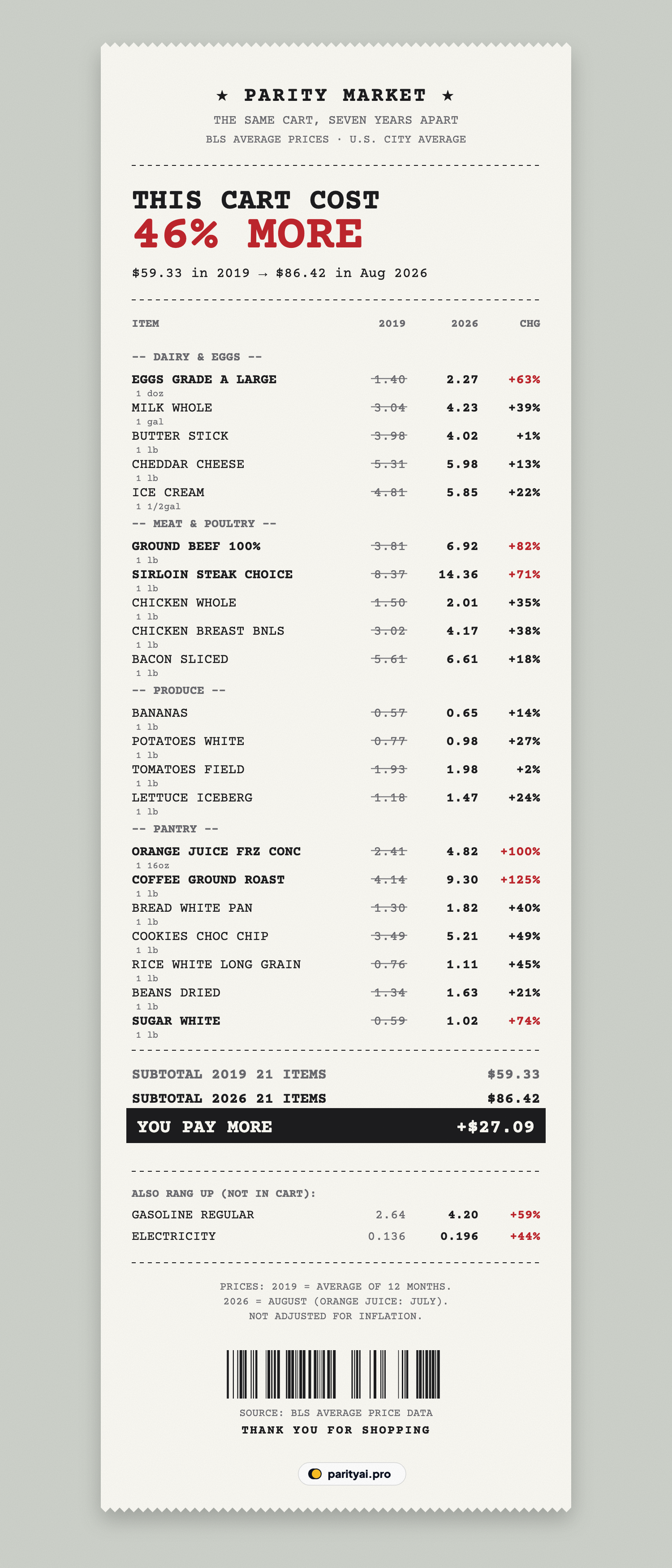
Push the same cart down the same aisles you shopped in 2019, put the same 21 things in it, and the register now asks for $86.42. In 2019 it asked for $59.33. That is $27.09 more, or 46%, for exactly the same food.
The receipt above was printed from the U.S. Bureau of Labor Statistics' average price data, the price collectors' own record of what everyday groceries cost across American cities. For each item we took its average price through all of 2019 and compared it with August 2026, the latest month published. The cart holds one unit of each, as BLS defines the unit: a pound of ground beef, a dozen eggs, a gallon of milk. Nobody buys exactly this basket, so treat the total as a way of adding up price changes, not as a household budget. The prices are not adjusted for inflation, which is the point: this is what the sticker says.
Let's walk the store.
Aisle 1: dairy and eggs
The first stop is the cheapest surprise. Eggs cost $1.40 a dozen on average in 2019 and $2.27 in August 2026, up 63%. But that endpoint hides a wild ride. In March 2025, eggs hit a record $6.23 a dozen. Bird flu had forced farmers to cull more than 30 million laying hens, the AP reported. Flocks have since been rebuilt, and the BLS consumer price index shows egg prices down 23% over the past year. If you remember eggs costing six dollars, you weren't imagining it. You just caught the peak.
Milk rose from $3.04 to $4.23 a gallon (39%), and ice cream 22%. Cheddar cheese rose a modest 13%.
And then there is butter: $3.98 a pound in 2019, $4.02 now, up just 1%. It is the one item on the receipt that has barely moved over seven years. Butter didn't avoid inflation, though. It peaked at $5.00 in September 2024, then fell back. Taken together, the dairy case is up 21%, the gentlest of the store's four sections.
Aisle 2: the meat counter
Turn the corner and the receipt gets loud. Ground beef went from $3.81 a pound to $6.92, up 82%, and August 2026 was its highest price in the record. Sirloin steak went from $8.37 to $14.36 (71%), after peaking at $14.73 in April 2026.
The reason is cows, or the lack of them. The U.S. Department of Agriculture's January 2026 cattle inventory counted 86.2 million head, slightly below a year earlier. Beef cows, the animals that produce next year's calves, were down another 1%. After years of drought and high feed costs, ranchers shrank their herds. Rebuilding takes years, because a heifer kept back for breeding is a heifer not sold for meat. Fewer cattle and steady demand produce record prices at the counter. Over the past year the CPI's beef and veal index still rose 5.9%.
Poultry is calmer. Whole chicken rose 35% and boneless breast 38%. Breast prices actually peaked back in September 2022. Bacon is up 18%, also below its October 2022 peak. Even so, the meat section as a whole costs 53% more than in 2019.
Aisle 3: produce
The fruit and vegetable aisle is the quietest on the receipt, up 14% as a group. Bananas, one of the most-bought foods in America, rose from $0.57 to $0.65 a pound, just 14%. Potatoes rose 27% and iceberg lettuce 24%.
Tomatoes are nearly where they started: $1.93 a pound in 2019 and $1.98 now, up 2%. That flat line hides spikes too. Fresh produce prices swing with weather and harvests, and tomatoes reached $2.69 in April 2026 before falling back over the summer. Produce is the section where a single month's snapshot can mislead the most.
Aisle 4: the pantry
The last aisle is where the receipt explodes. Pantry items together cost 78% more than in 2019, driven by two lines at the top of the list.
Coffee is the biggest increase in the cart. A pound of ground roast cost $4.14 in 2019 and $9.30 in August 2026, up 125%. It peaked at $9.72 in April 2026. The cause is upstream. Drought hit Brazil, the world's largest grower, and arabica coffee futures broke records above $3.60 a pound in early 2025, according to Reuters. Tariffs added pressure. The United States put an additional 40% tariff on many Brazilian goods in July 2025 before exempting coffee, beef, fruit juices and other farm products in November. Retail coffee prices move slowly after wholesale ones, so shoppers kept paying more well into 2026.
Frozen orange juice concentrate doubled, from $2.41 to $4.82 a can (BLS prices it per 16 ounces), up 100%. Florida's orange groves have spent nearly two decades fighting citrus greening, a bacterial disease that shrinks and sours the fruit, Fresh Fruit Portal reports, and freezes and hurricanes have added damage. A slightly better 2026 crop has not brought prices back.
Sugar rose 74%, from $0.59 to $1.02 a pound. Chocolate chip cookies rose 49%, helped along by cocoa prices that nearly tripled in 2024 after poor West African harvests, according to Bloomberg. White bread is up 40%, rice 45% and dried beans 21%.
| Item (BLS unit) | Aisle | 2019 average | Latest | Change | Monthly, 2019–2026 | Peak |
|---|---|---|---|---|---|---|
| Coffee Ground Roast (lb) | Pantry | $4.14 | $9.30 | $9.72 (Apr 2026) | ||
| Orange Juice Frozen Concentrate (16oz) | Pantry | $2.41 | $4.82 | $4.97 (May 2026) | ||
| Ground Beef 100% (lb) | Meat & Poultry | $3.81 | $6.92 | $6.92 (Aug 2026) | ||
| Sugar White (lb) | Pantry | $0.59 | $1.02 | $1.05 (May 2025) | ||
| Sirloin Steak Choice (lb) | Meat & Poultry | $8.37 | $14.36 | $14.73 (Apr 2026) | ||
| Eggs Grade A Large (doz) | Dairy & Eggs | $1.40 | $2.27 | $6.23 (Mar 2025) | ||
| Cookies Chocolate Chip (lb) | Pantry | $3.49 | $5.21 | $5.35 (Jan 2026) | ||
| Rice White Long Grain (lb) | Pantry | $0.76 | $1.11 | $1.11 (Aug 2026) | ||
| Bread White Pan (lb) | Pantry | $1.30 | $1.82 | $2.03 (Jan 2024) | ||
| Milk Whole (gal) | Dairy & Eggs | $3.04 | $4.23 | $4.32 (Jun 2026) | ||
| Chicken Breast Boneless (lb) | Meat & Poultry | $3.02 | $4.17 | $4.75 (Sep 2022) | ||
| Chicken Whole (lb) | Meat & Poultry | $1.50 | $2.01 | $2.09 (Jun 2025) | ||
| Potatoes White (lb) | Produce | $0.77 | $0.98 | $1.09 (Aug 2023) | ||
| Lettuce Iceberg (lb) | Produce | $1.18 | $1.47 | $2.01 (Jun 2026) | ||
| Ice Cream (1/2gal) | Dairy & Eggs | $4.81 | $5.85 | $6.50 (Aug 2025) | ||
| Beans Dried (lb) | Pantry | $1.34 | $1.63 | $1.72 (Jul 2023) | ||
| Bacon Sliced (lb) | Meat & Poultry | $5.61 | $6.61 | $7.61 (Oct 2022) | ||
| Bananas (lb) | Produce | $0.57 | $0.65 | $0.67 (Sep 2025) | ||
| Cheddar Cheese (lb) | Dairy & Eggs | $5.31 | $5.98 | $6.12 (Aug 2025) | ||
| Tomatoes Field (lb) | Produce | $1.93 | $1.98 | $2.69 (Apr 2026) | ||
| Butter Stick (lb) | Dairy & Eggs | $3.98 | $4.02 | $5.00 (Sep 2024) |
Sorted by change. Highlighted items more than doubled. 'Latest' is August 2026 (orange juice: July 2026). Not adjusted for inflation.
At the register
Line by line, a pattern emerges. Of the 21 items, 6 rose by half or more, and 2 at least doubled. Only 2 rose by less than 10%. The steepest increases came from things exposed to a single fragile supply chain: a disease in Florida's groves, drought in Brazil's coffee belt, a shrinking cattle herd, bird flu in egg barns. Staples with many sources and steady harvests, such as bananas, potatoes and butter, rose far less.
Two more lines rang up that aren't in the cart. Gasoline averaged $2.64 a gallon in 2019 and $4.20 in August 2026, up 59%. The war that began in the Persian Gulf in late February pushed it up again. AAA said September 2026 set a record for the month, averaging $4.33 a gallon. That is still below the highest monthly average since 2019, $5.06 in June 2022. Electricity rose from $0.136 to $0.196 a kilowatt-hour, up 44%.
How a price gets on this receipt
The numbers come from the same price survey behind the consumer price index. Every month, BLS staff record the prices of thousands of goods in stores across about 75 urban areas, from big supermarkets to corner shops. For a few dozen common foods and fuels, BLS also publishes the average price per unit: what a pound of ground beef or a gallon of whole milk actually cost, in dollars and cents, across the country.
That makes these series unusually concrete. Most inflation numbers are indexes, percentages measured from an arbitrary base year. These are prices you could recognise on a shelf tag. They also have limits. A "pound of coffee" mixes brands, can sizes and store types, and the mix shifts over time as shoppers trade down to store brands or switch stores. Some series, such as red delicious apples, have stopped being published, which is why they aren't in the cart.
We used each item's 2019 monthly average rather than a single month, so a temporary spike or sale in 2019 doesn't distort the comparison. For the latest price we used August 2026, the most recent month published, except for orange juice, whose August price wasn't out yet. The receipt therefore compares a full year with a single month. That flatters some items and penalises others, especially fresh produce, whose prices follow the seasons.
What the receipt doesn't show
A few things are worth keeping in mind before waving this receipt at anyone.
Wages moved too. These are nominal prices, not adjusted for inflation or income. Average pay has also risen since 2019, so the share of a paycheck that goes to groceries hasn't risen by anything like 46%. What has changed is the feeling at the checkout, where people remember what things used to cost.
The most recent year is much calmer. The BLS's August 2026 inflation report shows food-at-home prices up 2.2% over twelve months. Most of the increase on this receipt happened in 2021, 2022 and 2023, and prices don't come back down when inflation cools. They just stop rising as fast. Energy is the exception this year: the same report shows energy prices up 16.3% over the past twelve months, and gasoline up 27.4%.
Averages hide a lot. BLS averages prices across cities and stores. Your local supermarket, store brands, coupons and bulk buys can all differ a great deal, and the BLS sample changes over time.
Peaks matter as much as endpoints. Eggs, tomatoes, bacon and butter all spent time well above where they are now. A receipt printed in March 2025 would have looked very different in the dairy aisle.
The bottom line
Seven years after 2019, the same simple cart costs 46% more, and almost all of that came from a few lines: coffee, juice, beef and sugar. The cheapest way to shrink this receipt is to change what goes into the cart, not where you shop. Swap the sirloin for chicken and the frozen concentrate for bananas, and most of the increase disappears.
Sources and method
- U.S. Bureau of Labor Statistics, Average Price Data (CPI), U.S. city average. Series via the BLS Public Data API, retrieved October 9, 2026
Prices are BLS average retail prices for the U.S. city average. 'Then' is the average of the twelve monthly prices in 2019; 'now' is the latest month available, August 2026 (July 2026 for orange juice, whose August price was not yet published). The cart holds one unit of each item as BLS defines it (a pound, a dozen, a gallon), so the total is an illustration of relative price changes, not a typical household's spending. Prices are not adjusted for inflation.
Charts like this, from your own numbers.
Connect a spreadsheet or the tools you run on, and Parity builds the dashboard and writes the report, with every number checked.
Try Parity free