Charts like this, from your own numbers.
Connect a spreadsheet or the tools you run on, and Parity builds the dashboard and writes the report, with every number checked.
Try Parity freeBy October 22, 2026, the Centers for Disease Control and Prevention had counted 4,588 confirmed measles cases in the United States this year, already double the 2,289 of all of 2025. A country that declared measles eliminated in 2000 has been fighting outbreaks for two years running, and its neighbour Canada lost its elimination status in November 2025.
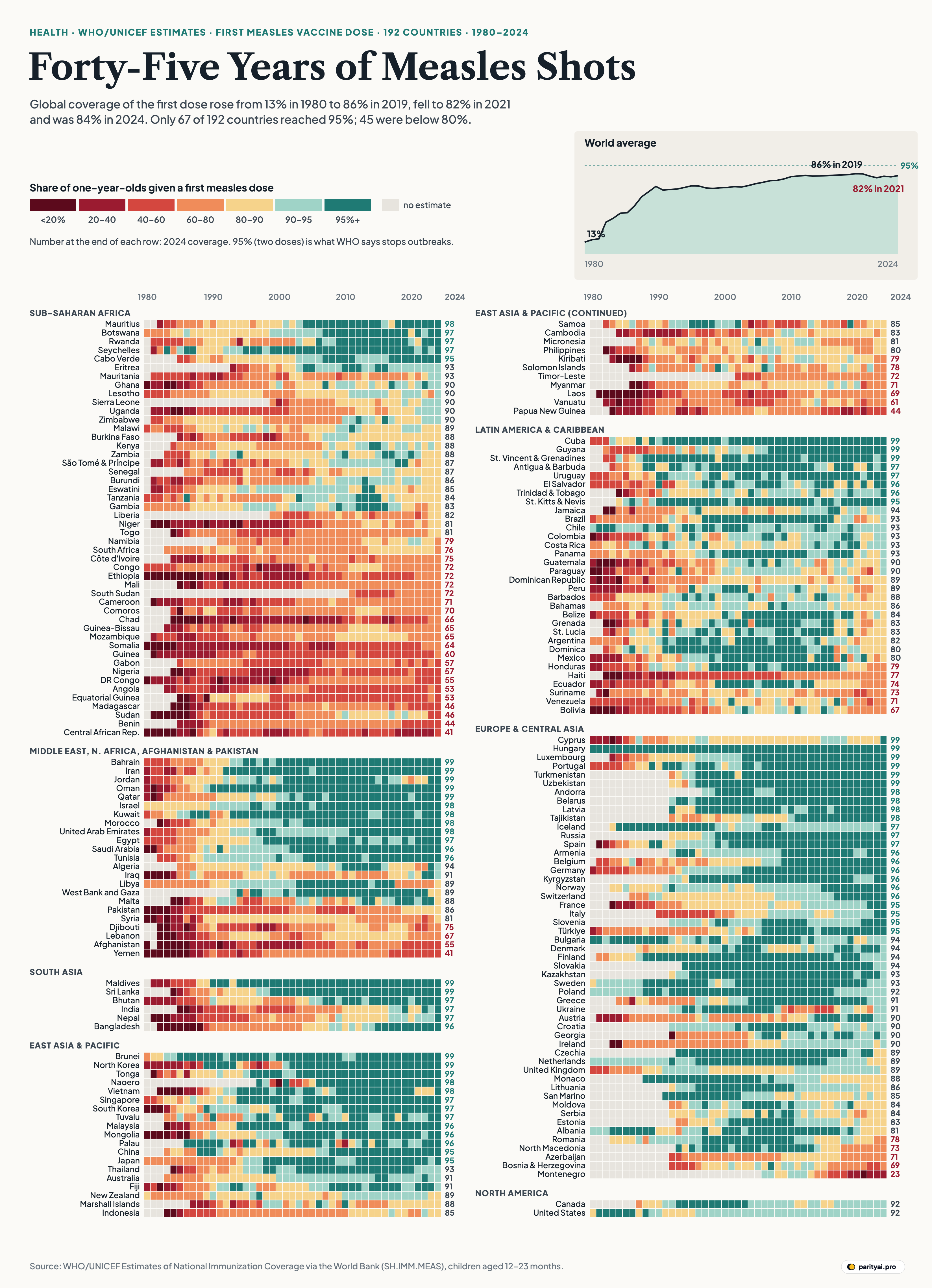
The heatmap above puts those headlines in a longer frame. It shows, for 192 countries and every year from 1980 to 2024, the share of children who received their first dose of measles vaccine by their second birthday, according to the joint estimates of the World Health Organization and UNICEF. Each row is a country, grouped by region and sorted within each region by its 2024 coverage. Each small cell is a year. Dark red cells mean few children were vaccinated; orange and yellow mean most were; teal means 90% or more. Grey means no estimate. The number at the end of each row is the 2024 figure.
The story of the chart can be told in five numbers.
13%
In 1980, by the WHO and UNICEF estimates, 13% of the world's children got a first measles shot. That was six years after WHO launched its Expanded Programme on Immunization in 1974. Only 68 of the 192 countries on the chart have an estimate for that year at all, which is why the left edge of the heatmap is so grey. Of those with data, 45 were below half.
The cells that do exist are startling now. Ethiopia's coverage in 1980 was 4%, Pakistan's 1%, Yemen's 2% and DR Congo's 18%. Even some rich countries started low by this measure: Germany's estimate for 1980 is 25%, Britain's 53%. The United States was already at 86%.
Then the colours change, fast. By 1985 world coverage was 44%, and by 1990, 73%. Across most rows, the 1980s are where dark red gives way to orange and yellow within a few columns. In 1990, 20 of the 159 countries with data had reached 95%.
86%
The middle of the heatmap is a long, slow climb. World coverage stalled at around 72% through the 1990s, then rose again in the 2000s: 84% in 2010, 86% in 2019, the highest in the series. That progress is the reason WHO says the measles vaccine prevented an estimated 59 million deaths between 2000 and 2024.
The climb was uneven. India's row, in the South Asia band, is orange and red until the late 2000s; its coverage first reached 90% in 2017, and was 97% in 2024. Indonesia's first reached 90% in 2017. China reached it in 1988. In Sub-Saharan Africa, regional coverage was 57% in 1990, 50% in 2000 and 69% in 2024, still the lowest of any region.
| Region | Countries | Median coverage, 2024 | At 95% or more |
|---|---|---|---|
| Sub-Saharan Africa | 48 | 5 | |
| Middle East, N. Africa, Afghanistan & Pakistan | 23 | 12 | |
| South Asia | 6 | 6 | |
| East Asia & Pacific | 30 | 13 | |
| Latin America & Caribbean | 32 | 8 | |
| Europe & Central Asia | 51 | 23 | |
| North America | 2 | 0 |
82%
Look down almost any column from 2020 to 2022 and the cells lighten or redden. When the pandemic struck, routine immunization faltered. World coverage fell from 86% in 2019 to 84% in 2020 and 82% in 2021, the lowest since 2008.
Some of the sharpest dips are visible as stripes in otherwise steady rows. Brazil's coverage fell from 91% in 2019 to 73% in 2021, and the Philippines' from 83% to 64%. Indonesia went from 88% to 72%; India from 95% to 89%.
The recovery has been partial. World coverage was 84% in 2024, and the WHO and UNICEF estimates for 2025, published in July 2026, put it at 84 per cent again, still below the 2019 level. Of the countries on the chart, 107 had lower first-dose coverage in 2024 than in 2019, and 58 had higher.
The largest falls since 2019 came in very different places. Sudan's coverage went from 90% to 46%, Venezuela's from 93% to 71%, Vanuatu's from 80% to 61% and Mozambique's from 83% to 65%.
95%
Measles is one of the most contagious diseases known, and the threshold for stopping it is high. WHO says that at least 95% coverage with two measles vaccine doses is required to stop transmission. This chart shows only the first dose, so it flatters every country: the second dose, globally, reached 77 per cent in 2025.
Even on the first dose alone, only 67 of the 192 countries, 35%, were at 95% or above in 2024. In 2019 the figure was 82, and in 2010 85. 102 countries reached at least 90%, and 45 were below 80%. 35 countries have never once reached 90% in the 45 years of data.
The rich world sits around the threshold rather than above it. In 2024 the United States and Canada were both at 92%, the United Kingdom at 89%, Australia at 91% and New Zealand at 89%. France and Italy reached 95% and 95%, Germany 96%. In the North America band at the bottom of the right-hand panel, both rows were dark teal in earlier decades, the United States in the 1980s and Canada from 1993 to 2003, but they have been pale teal, between 90% and 95%, in recent years: high coverage, but not quite the 95% that would stop outbreaks. That gap is enough for measles to spread where unvaccinated children cluster. The outbreak in West Texas in 2025 reached 762 cases, with 99 people hospitalized and two school-aged children killed, before the state declared it over in August.
| # | Country | Region | 2024 | 2019 | 1980–2024 |
|---|---|---|---|---|---|
| 1 | Montenegro | Europe & Central Asia | 37% | ||
| 2 | Central African Rep. | Sub-Saharan Africa | 37% | ||
| 3 | Yemen | Middle East, N. Africa, Afghanistan & Pakistan | 54% | ||
| 4 | Benin | Sub-Saharan Africa | 58% | ||
| 5 | Papua New Guinea | East Asia & Pacific | 37% | ||
| 6 | Madagascar | Sub-Saharan Africa | 60% | ||
| 7 | Sudan | Sub-Saharan Africa | 90% | ||
| 8 | Angola | Sub-Saharan Africa | 59% | ||
| 9 | Equatorial Guinea | Sub-Saharan Africa | 51% | ||
| 10 | DR Congo | Sub-Saharan Africa | 65% | ||
| 11 | Afghanistan | Middle East, N. Africa, Afghanistan & Pakistan | 57% | ||
| 12 | Gabon | Sub-Saharan Africa | 62% | ||
| 13 | Nigeria | Sub-Saharan Africa | 58% | ||
| 14 | Guinea | Sub-Saharan Africa | 50% | ||
| 15 | Vanuatu | East Asia & Pacific | 80% | ||
| 16 | Somalia | Sub-Saharan Africa | 52% | ||
| 17 | Guinea-Bissau | Sub-Saharan Africa | 79% | ||
| 18 | Mozambique | Sub-Saharan Africa | 83% | ||
| 19 | Chad | Sub-Saharan Africa | 40% | ||
| 20 | Lebanon | Middle East, N. Africa, Afghanistan & Pakistan | 82% | ||
| 21 | Bolivia | Latin America & Caribbean | 79% | ||
| 22 | Laos | East Asia & Pacific | 70% | ||
| 23 | Bosnia & Herzegovina | Europe & Central Asia | 79% | ||
| 24 | Comoros | Sub-Saharan Africa | 76% | ||
| 25 | Cameroon | Sub-Saharan Africa | 61% |
First dose of measles-containing vaccine, children aged 12–23 months, WHO/UNICEF estimates.
23%
The lowest number in the right-hand column belongs to an unexpected place. Montenegro, a country in southern Europe, recorded first-dose coverage of 23% in 2024, the lowest of any country on the chart and down from 37% in 2019. Its row is the one strip of dark red in a sea of teal in the Europe and Central Asia band. Elsewhere in Europe, Bosnia and Herzegovina, North Macedonia and Romania were also below 80% in 2024. Ukraine's row carries an older red stripe: its coverage dropped to 42% in 2016, before recovering to 91% in 2024.
The rest of the bottom of the ranking is where you would expect it: places marked by war, poverty or weak health systems. The Central African Rep. and Yemen were at 41%, Benin and Papua New Guinea at 44%, and Madagascar and Sudan at 46%. Nigeria, Africa's most populous country, was at 57%, and DR Congo at 55%; neither has ever reached 90%. Afghanistan was at 55%. Pakistan, by contrast, reached 86%, its highest in the series.
These are the countries where measles still kills. WHO estimates that about 95,000 people, mostly children younger than 5, died of measles in 2024, out of about 11 million infections. In 2025, 57 countries reported large or disruptive outbreaks, according to the WHO and UNICEF release.
26
Not every row slipped after 2019. The biggest improvement on the chart is in Chad, where first-dose coverage rose by 26 percentage points, from 40% in 2019 to 66% in 2024. Mauritania rose from 75% to 93%, Libya from 73% to 89%, Ethiopia from 56% to 72% and Algeria from 80% to 94%. Somalia, at 64%, is also above its 2019 level of 52%, and Pakistan's 86% is the highest in its series.
These gains are why the picture is not simply one of decline. Several of the countries with the lowest coverage in the world are among those improving fastest, while some of the falls are in middle-income countries that had once reached 90% or more: Venezuela was at 93% in 2019 and Romania first reached 90% back in 1987. The right-hand columns are a mix of both movements, which is why the global average has barely moved.
How to read the cells
The estimates behind the chart are reconstructions. WHO and UNICEF combine the numbers that governments report with household surveys and revise the whole series every year, so a cell for 2010 may change in next year's release. Some sudden jumps or drops in a single year, like Mexico's swing from 73% in 2019 to 99% in 2021, may reflect changes in data sources as much as in vaccination. Grey cells in the early years mean no estimate, not no vaccination. And national averages hide local gaps: a country at 92% can still have districts at half that.
The chart also ends in 2024. The World Bank series it uses had not yet added the 2025 estimates when this piece was written, though WHO and UNICEF published them in July 2026.
What the right-hand edge says
The heatmap is a picture of one of public health's great successes: the left edge mostly red, the middle mostly teal. It is also a picture of how hard the last few percentage points are. The global average has hovered between 84% and 86% for most of the past fifteen years, and the share of countries at 95% is lower now than in 2010. The World Health Organization's Immunization Agenda 2030 aims for at least 90% coverage of core vaccines; its own mid-term review says progress is off track. The right-hand edge of the chart, more orange than it was a decade ago, is where that gap shows.
Sources and method
- WHO/UNICEF Estimates of National Immunization Coverage (WUENIC), via the World Bank: Immunization, measles (% of children ages 12–23 months), SH.IMM.MEAS. 1980–2024, API updated October 8, 2026
- WHO and UNICEF, immunization coverage estimates (2025 release)
Each cell is the WHO/UNICEF estimate of the share of children who received their first dose of a measles-containing vaccine (MCV1) by their second birthday, the indicator the World Bank publishes as SH.IMM.MEAS. The estimates combine government reports and surveys and are revised every year, including for past years. Grey cells have no estimate. The 95% line refers to WHO's guidance that two-dose coverage of at least 95% is needed to stop measles spreading; this chart shows the first dose only, so it overstates protection. Countries are grouped by World Bank region and sorted within each by 2024 coverage. The 2025 estimates released by WHO and UNICEF in July 2026 were not yet in the World Bank series when it was retrieved.
Charts like this, from your own numbers.
Connect a spreadsheet or the tools you run on, and Parity builds the dashboard and writes the report, with every number checked.
Try Parity free