Charts like this, from your own numbers.
Connect a spreadsheet or the tools you run on, and Parity builds the dashboard and writes the report, with every number checked.
Try Parity freeOn October 6, 2026, the Royal Swedish Academy of Sciences awarded the Nobel Prize in Physics to Francis Halzen of the University of Wisconsin–Madison. Halzen was born in Tienen, a small town in Belgium, in 1944. In the prize records he is two things at once: a Belgian-born laureate and an American prize. Of the 8 people who won the physics, chemistry, medicine and economics prizes this month, he was the only one working outside the country of his birth.
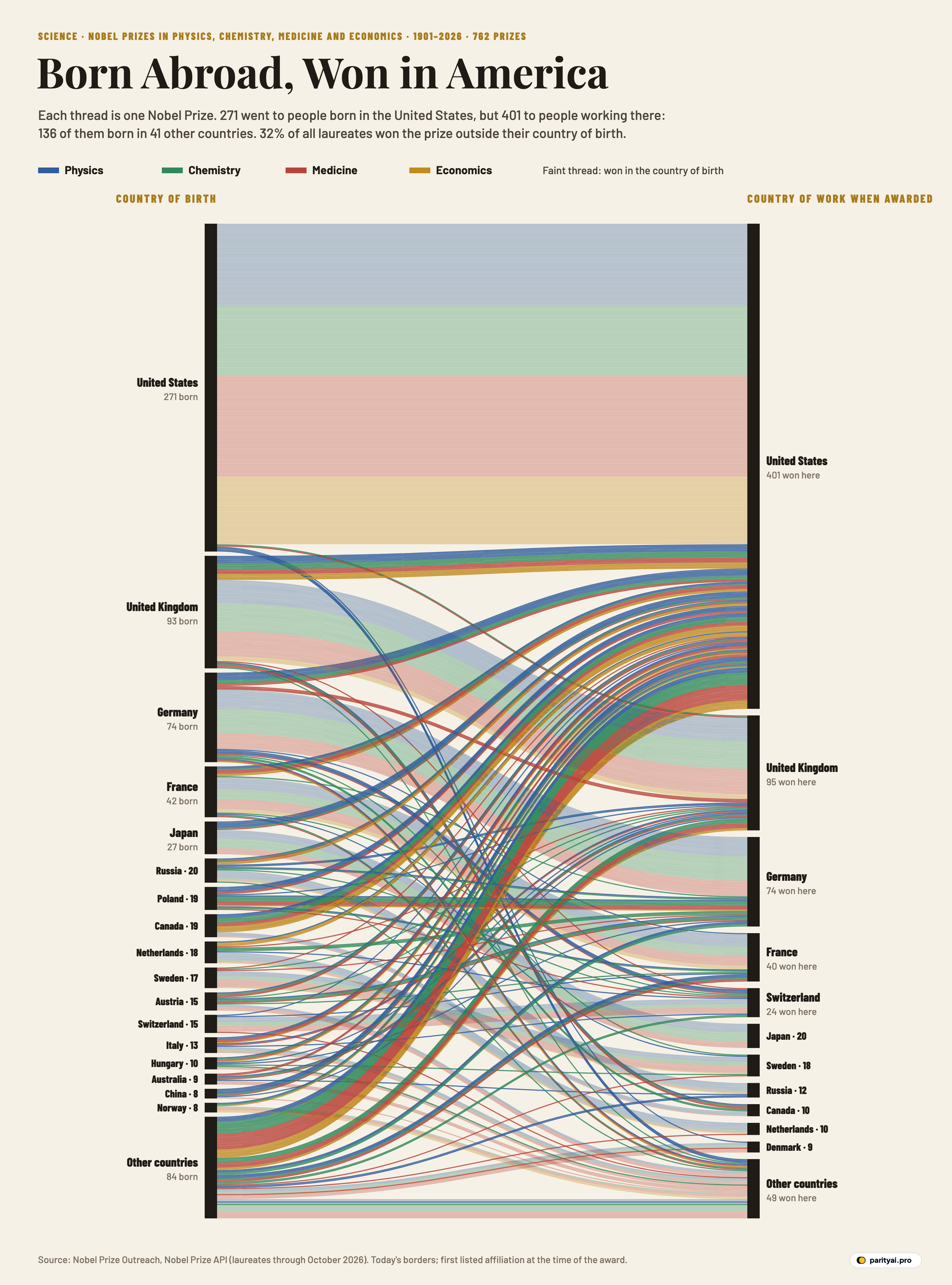
He is also one more thread in a pattern that runs through 125 years of Nobel science. The chart above draws all 762 prizes in those four fields that list an institution. Each thin thread starts at the laureate's country of birth on the left and ends at the country of the institution named when the prize was awarded, on the right. The colour is the field: blue for physics, green for chemistry, red for medicine, gold for economics. Faint threads are people who won where they were born; solid threads are people who had moved.
242 of the 762, or 32%, are solid. The pattern they make is easiest to read the way an airport does: departures, arrivals, and those who never left.
Arrivals: the United States
The block on the right for the United States is the tallest thing on the chart. People working at American institutions have won 401 of these prizes, 53% of the total. People born in the United States have won 271. The difference, 130, is the largest net gain of any country by a wide margin.
Look at the threads arriving in that block. 136 prizes, about a third of the American total, went to people born in 41 other countries. The largest single source is the United Kingdom, with 20 prizes, followed by Canada (15), Germany (11), France (8) and Japan (7). Poland and China each sent 6.
The traffic between the two biggest English-speaking scientific nations runs mostly one way. 20 British-born laureates won while working in the United States; 2 American-born laureates won while working in Britain.
These figures come close to a better-known count. The National Foundation for American Policy, a research group, calculates that between 1901 and 2025 "immigrants have been awarded 36% of the Nobel Prizes won by Americans in chemistry, medicine and physics", and 40% since 2000. Its counts differ slightly from ours because it uses the laureate's immigrant status rather than birth country and leaves out economics, where it puts the immigrant share at 31%. It also notes that its numbers do not include laureates who moved to America only after winning, such as Albert Einstein, Enrico Fermi and Niels Bohr. On this chart, those three appear in the country where they won.
Arrivals: the small exceptions
Only 5 countries have gained more prizes than they have produced: United States (+130), Switzerland (+9), Denmark (+2), United Kingdom (+2), Sweden (+1). Switzerland is the clear second. Its block on the right is taller than on the left: 24 prizes were won by people working there, against 15 by people born there. Only 12 of the Swiss-based prizes went to people born in Switzerland.
The others barely tip into the black. The United Kingdom has gained 95 prizes and produced 93, a net gain of 2: the laureates it attracted from abroad slightly outnumber the British-born laureates who left.
| # | Country | Born there | Working there | Net | Born and won there |
|---|---|---|---|---|---|
| 1 | United States | 271 | 401 | ▲ 130 | 265 |
| 2 | United Kingdom | 93 | 95 | ▲ 2 | 67 |
| 3 | Germany | 74 | 74 | 0 | 49 |
| 4 | France | 42 | 40 | ▼ 2 | 29 |
| 5 | Japan | 27 | 20 | ▼ 7 | 20 |
| 6 | Switzerland | 15 | 24 | ▲ 9 | 12 |
| 7 | Sweden | 17 | 18 | ▲ 1 | 14 |
| 8 | Russia | 20 | 12 | ▼ 8 | 9 |
| 9 | Canada | 19 | 10 | ▼ 9 | 4 |
| 10 | Netherlands | 18 | 10 | ▼ 8 | 9 |
| 11 | Austria | 15 | 7 | ▼ 8 | 5 |
| 12 | Italy | 13 | 7 | ▼ 6 | 5 |
| 13 | Poland | 19 | 0 | ▼ 19 | 0 |
| 14 | Denmark | 7 | 9 | ▲ 2 | 7 |
| 15 | Australia | 9 | 5 | ▼ 4 | 3 |
| 16 | Norway | 8 | 5 | ▼ 3 | 5 |
| 17 | Hungary | 10 | 2 | ▼ 8 | 2 |
| 18 | Belgium | 6 | 5 | ▼ 1 | 4 |
| 19 | Israel | 5 | 5 | 0 | 3 |
| 20 | China | 8 | 1 | ▼ 7 | 1 |
| 21 | India | 6 | 1 | ▼ 5 | 1 |
Science and economics prizes, 1901–2026, today's borders. Net = prizes won while working in the country minus prizes won by people born there.
Departures: the countries that lost their laureates
Most countries on the left side of the chart have a bigger block there than on the right.
Poland has the largest net loss on the chart. 19 prizes went to people born within the borders of today's Poland, and 0 to people working there. The Nobel Foundation records birth places with both their historical country and today's equivalent; a laureate born in Breslau when it was part of Germany counts as born in Wrocław, Poland. Several of the threads leaving Poland therefore end in Germany, and others in the United States (6) and France. Marie Curie, born in Warsaw, won her 1911 chemistry prize while working in France.
Canada sent 15 of its 19 prize-winners to American institutions; only 4 Canadian-born laureates won while working in Canada. Hungary produced 10 laureates and kept 2. Austria produced 15 and kept 5. The Netherlands, Russia and Italy all have a net loss of six to eight.
Asia's outgoing threads lead mostly to the United States. 27 prizes went to people born in Japan; 20 of them were won in Japan, and 7 in the United States. Of the 8 Chinese-born laureates in these fields, 6 won at American institutions and 1 in China. India produced 6 and kept 1.
The great migration of the 1930s
Some of the most famous threads date from one decade. When the Nazis took power in Germany in 1933, Jewish and politically suspect scientists were driven from their posts. Physics Today, tracing 129 displaced physicists, found that "three of the displaced scientists—Einstein, Franck, and Schrödinger—were already physics Nobel laureates; five more would eventually receive the prize." A review of the book Hitler's Gift summed up the effect on Germany: between 1901 and 1932 German scientists won one-third of all Nobel science prizes, but from 1933 to 1960 only eight.
The effect on the receiving country is visible in other research. Economists Petra Moser, Alessandra Voena and Fabian Waldinger found that US patents in the research areas of émigré chemists rose 31 percent between 1933 and 1970.
On the chart, Germany ends up exactly balanced: 74 prizes born, 74 won there. Its outgoing threads, 11 of them to the United States, are matched by 25 incoming ones, mostly from Poland, Austria and the Netherlands; 11 of those came before 1933.
The timetable
The direction of the flow changed over the century. In the prizes awarded from 1901 to 1938, people working in the United States won 11% of the science and economics prizes. Between 1946 and 1999 the share was 60%, and since 2000 it has been 63%. The share of laureates who won outside their country of birth has been steadier: 28% before the war and 33% since 2000. What changed was less how often scientists moved than where they went.
The NFAP brief makes a related point about timing. Immigrants won 22 American science prizes between 1901 and 1959, it says, and 96 in the period from 1960 to 2023, the decades in which the American research system grew fastest.
| Born in | Prizes won in the US |
|---|---|
| United Kingdom | |
| Canada | |
| Germany | |
| France | |
| Japan | |
| Poland | |
| China | |
| Russia | |
| Italy | |
| South Africa | |
| Austria | |
| Hungary | |
| Netherlands | |
| Norway | |
| India |
Of 401 science and economics prizes won by people working in the United States, 136 went to people born elsewhere.
Field by field
The four colours tell slightly different stories. In physics, 34% of the 229 prizes on the chart went to people working outside their country of birth, and 48% were won at American institutions. Chemistry has the same share of movers, 34% of 200, but a lower American share, 43%. Medicine has the fewest movers, 29% of 234, though just over half of its prizes, 52%, went to people working in the United States.
Economics is the outlier. It is the youngest prize and the most concentrated: 84% of its 99 prizes went to people working in America, while 31% went to people who had moved, close to the other fields.
Those who stayed
Faint threads make up most of the chart, and they are worth a look too. 265 of the 271 American-born laureates won at home. Of 93 British-born laureates, 67 won in Britain. Germany kept 49 of 74, France 29 of 42, and Sweden 14 of 17.
This year's prizes were mostly faint threads. Of the 8 laureates in the four fields, 3 were born in the United States and won there, two were born in Germany and won there, one was French and one Japanese, both working at home. Halzen was the only arrival.
How to read the threads
A few rules shape what the chart shows. Countries are given within today's borders, because that is how the Nobel Foundation's records allow them to be compared; England, Scotland, Wales and Northern Ireland are combined as the United Kingdom. The right-hand side is the first institution listed when the prize was awarded, which is usually but not always where the prize-winning work was done; many laureates are honoured decades after their discovery, by which time they have moved. People who won twice appear twice. Literature and peace are left out because their laureates seldom have an institution. Women are a small minority throughout: 29 of the 762 threads.
The prize itself has grown with the flow. The Nobel Foundation set the 2026 award at 12.0 million Swedish kronor per full prize. The economics prize, which the Swedish central bank established in 1968, joins the chart from 1969, and its gold threads run overwhelmingly into the American block: 83 of the 99 economics prizes on the chart were won by people working in the United States.
The pull of one block
Strip the chart down to its essentials and it shows a world that trains scientists everywhere and honours them, disproportionately, in one place. Of the threads that cross from one country to another, more than half end in the United States. Each of them is a career: a student who crossed an ocean, a professor who fled a regime, a researcher who followed the money and the colleagues. This October, Francis Halzen's thread from Belgium to Wisconsin joined the others.
Sources and method
- Nobel Prize Outreach, Nobel Prize API v2.1 (laureates). All laureates through the October 2026 announcements, retrieved October 29, 2026
Each thread is one prize awarded to one person in physics, chemistry, physiology or medicine, or economic sciences (the Sveriges Riksbank Prize in Economic Sciences, awarded since 1969). Literature and peace prizes are left out because laureates in those fields seldom have an institutional affiliation. Countries are given within today's borders, as recorded by the Nobel Foundation ('countryNow'), so a laureate born in Breslau in 1900 counts as born in Poland; England, Scotland, Wales and Northern Ireland are combined as the United Kingdom. The destination is the country of the first affiliation listed at the time of the award. People who won twice appear twice. Prizes with no affiliation listed are counted in the totals but not drawn. Countries with fewer than eight threads on a side are grouped as 'Other countries'.
Charts like this, from your own numbers.
Connect a spreadsheet or the tools you run on, and Parity builds the dashboard and writes the report, with every number checked.
Try Parity free