Key takeaways
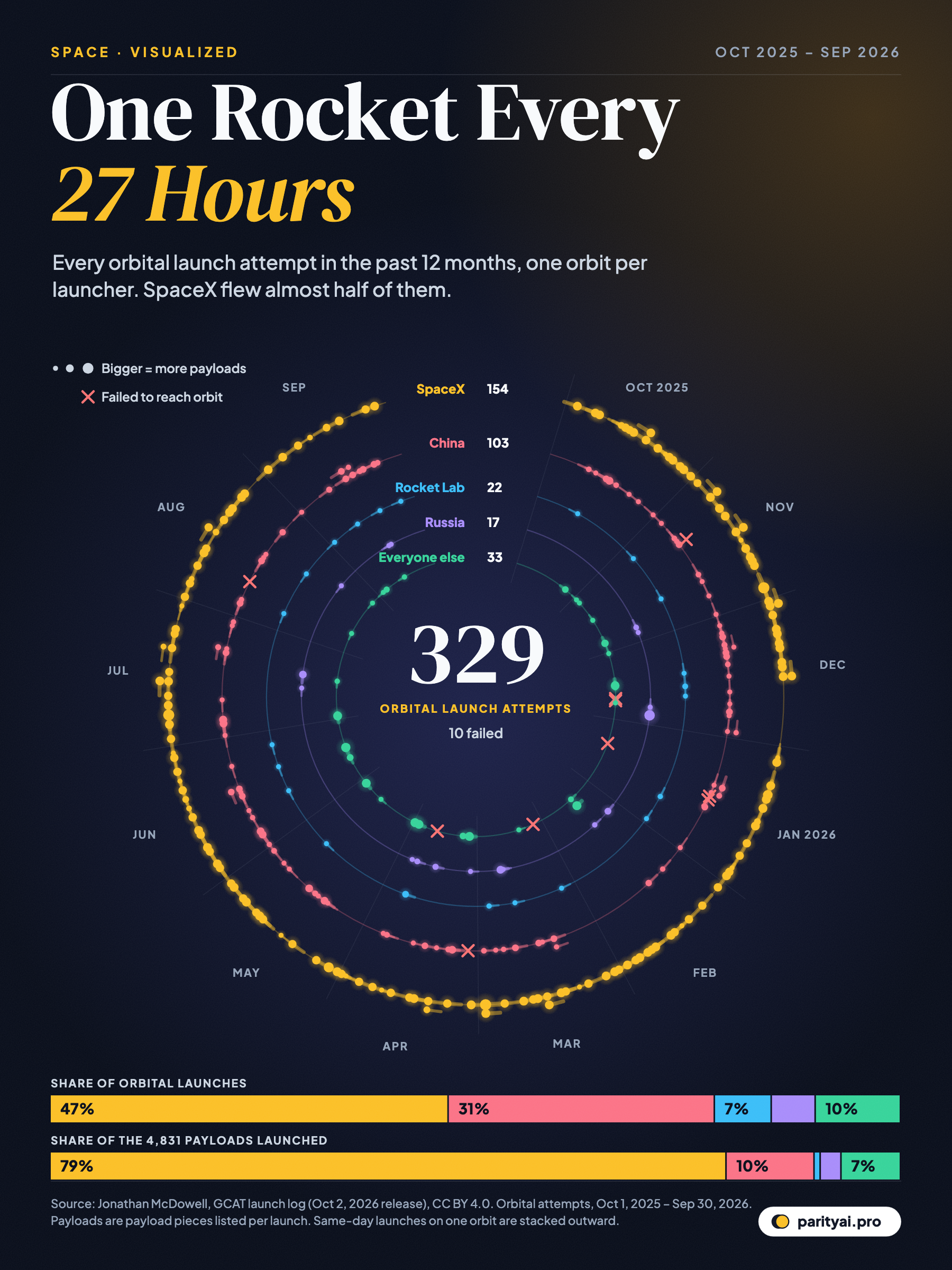
- Between October 1, 2025 and September 30, 2026, the world made 329 orbital launch attempts, one every 27 hours on average. 10 of them failed.
- SpaceX flew 154 of them (47%) without a single failure. It carried 3,840 of the 4,831 payloads that went up, or 79%.
- China was the only other country in triple digits, with 103 launches from at least 9 launch organizations. Rocket Lab flew 22, Russia 17, and the rest of the world 33 combined.
Not long ago, a rocket launch was an event. In 2020, the world made 114 orbital launch attempts, according to astronomer Jonathan McDowell, who keeps the most complete public record of everything humanity has sent to space. In the twelve months to September 2026, it made 329. Launch has become a routine logistics business, run mostly by one company.
The graphic above lays out that year as a circular calendar. October 2025 starts at the top right and the months run clockwise. Each ring is one launcher: SpaceX on the outside, then China, Rocket Lab, Russia and everyone else at the centre. Every orbital launch attempt is a comet on its ring. The size of its head shows how many payloads it carried, and red crosses mark the launches that failed to reach orbit. The bars at the bottom compare each group's share of launches with its share of everything launched.
The data comes from McDowell's General Catalog of Artificial Space Objects (GCAT), in the October 2, 2026 release of its launch log. We count every launch with an orbital launch code, successful or not, between October 1, 2025 and September 30, 2026. By coincidence, our twelve-month total matches calendar 2025, which Ars Technica reported also had 329 orbital attempts, 25% more than the previous record in 2024. The figures below always refer to the October-to-September window.
The outer ring: SpaceX
SpaceX's ring is so crowded that its comets nearly merge into a single band. The company flew 154 orbital missions in the year: 149 on the Falcon 9, 1 on the Falcon Heavy, and 4 Starship test flights that GCAT logs among orbital attempts. Not one of them failed to reach orbit. That averages a launch every 2.4 days, from pads in Florida, California and Texas.
The pace is the product of reuse. Falcon 9's first stage lands and flies again, and the turnaround is now measured in days. In August 2026, one booster, B1067, made a record 37th flight. It had entered service in June 2021. Spaceflight Now counted it as the 654th Falcon booster landing.
Reuse also changed the economics. A NASA study published in 2018 put the Space Shuttle's cost at about $54,500 per kilogram to low Earth orbit. Falcon 9's advertised price worked out to about $2,720 per kilogram, before reuse pushed SpaceX's internal costs lower still.
Most of those rockets carried SpaceX's own satellites. Starlink payloads accounted for 3,180 of the 4,831 payloads launched worldwide in the year, 66% of the total. McDowell's Starlink statistics showed more than 11,000 Starlink satellites in orbit at the start of October 2026. That is roughly two-thirds of all working satellites, according to one industry count.
Starship and the next step up
Three of SpaceX's flights mark what may become the next chapter. Starship's third-generation design, V3, flew for the first time on May 22, 2026, with new Raptor 3 engines. It deployed 20 dummy satellites and two modified Starlinks before splashing down in the Indian Ocean. A second V3 flight followed in July. On September 28, the third, Flight 14, reached orbit for the first time and released 26 full-size Starlink V3 satellites.
A fully reusable Starship would carry many times Falcon 9's payload. If it reaches routine operations, the outer ring of a chart like this in two years could look very different: fewer comets, each far heavier.
The second ring: China
China's ring is the other busy one. It flew 103 orbital attempts, 31% of the world total, but carried only 500 payloads (10%). Where SpaceX packs dozens of satellites onto a reused booster, most Chinese launches carry a few satellites on an expendable rocket.
What sets China apart is the number of players. The state-owned Long March (Chang Zheng) family still flies most missions, but commercial companies are moving in quickly. The year's launches included Zhuque, Lijian, Kuaizhou, Jielong, Gravity (Yinli) and Tianlong rockets alongside many Long March variants. That mix came with growing pains. 5 of the year's 10 failures were Chinese, including two from Galactic Energy's Gushenxing (Ceres) rockets and one from Space Pioneer's Tianlong-3 in April 2026.
China's launch rate is tied to its own megaconstellations. The state-backed Guowang network had 136 satellites in orbit by January 2026 and is targeting 310 more during 2026. The Shanghai-backed Qianfan (Thousand Sails) constellation had about 200 satellites up by June. Both plan thousands more, which means China's ring is likely to keep filling.
The inner rings
Rocket Lab flew 22 Electron missions from New Zealand and Virginia without a failure. That made it the busiest launcher outside SpaceX and China, though its small rocket carried just 35 payloads. Its larger Neutron rocket, built to compete in the medium-lift market, is running late. In August 2026, Spaceflight Now reported that the window for a 2026 debut was narrowing, with the rocket due at the pad in the fourth quarter.
Russia flew 17 times, all successfully, mostly on Soyuz rockets. A decade ago Russia was among the busiest launching nations. Today its ring is one of the emptiest on the chart.
Everyone else, the innermost ring, accounted for 33 launches: Europe (10, counting Ariane 6, Vega C and Isar Aerospace's Spectrum), Japan (5), India (5), South Korea, Iran and the U.S. launchers other than SpaceX and Rocket Lab (11). It is also where most of the red crosses sit. This group had 5 failures, half the world's total.
The failures
The full list of the year's failures is: Gushenxing 1 (Nov 10, 2025); H3-22S (Dec 22, 2025); HANBIT-NANO (Dec 23, 2025); PSLV-DL (Jan 12, 2026); Chang Zheng 3B (Jan 16, 2026); Gushenxing-2 (Jan 17, 2026); Kairos (Mar 5, 2026); Tianlong-3 (Apr 3, 2026); New Glenn 7x2 (Apr 19, 2026); Chang Zheng 7A (Aug 10, 2026).
Two of them stood out. On April 19, 2026, Blue Origin's New Glenn landed its reused booster, but an upper-stage engine underperformed and left its satellite in the wrong orbit. The rocket was grounded while the FAA investigated. Japan's H3 also suffered a failure in December 2025, a setback for a rocket meant to replace the long-serving H-IIA.
Europe's Ariane 6 flew without failure, but at a slower pace than planned. In September 2026, SatNews reported that a turbopump anomaly would cap its 2026 flights at five or six, down from eight.
Overall, 97.0% of the year's orbital attempts reached orbit. That is a remarkable record for a business where a single failure used to ground a rocket for a year. It is also mostly SpaceX's record: excluding its 154 flights, the rest of the world failed about one launch in 18.
Payloads tell a different story than launches
The two bars at the bottom of the graphic make the point. Measured by launches, SpaceX has a near-majority at 47%. Measured by payloads, it has 79%. A Falcon 9 carrying Starlinks typically takes more than 20 satellites at once, and its Transporter rideshare missions can carry well over 100 small satellites for other customers.
The second-largest payload owner was not a government. It was Amazon, whose Project Kuiper (now branded Amazon Leo) had 267 satellites launched in the window on rockets from ULA, SpaceX and others. By July 2026, Amazon had 396 satellites in orbit after the final flight of ULA's Atlas V. That is still far short of the 1,600 the U.S. regulator had originally required by mid-2026.
The busiest month was December 2025, with 40 orbital launches worldwide. The busiest single day saw 4 launches, on February 12, 2026.
| Launcher | Attempts | Share | Failures | Payloads carried | Share |
|---|---|---|---|---|---|
| SpaceX | 47% | 0 | 79% | ||
| China | 31% | 5 | 10% | ||
| Rocket Lab | 7% | 0 | 1% | ||
| Russia | 5% | 0 | 2% | ||
| Everyone else | 10% | 5 | 7% | ||
| Total | 100% | 10 | 100% |
UTC dates. Rocket Lab counts Electron launches from New Zealand and Virginia. Payloads are separately catalogued payload pieces.
Counting rules
A few caveats about the counting:
- A launch is a launch, whether it carries a 15-tonne space station module or a single cubesat. The comet sizes show payload counts, not mass. A future version could weight by tonnes to orbit.
- "Payload" means a separately catalogued payload piece. A rideshare with 100 cubesats counts 100. A single Starlink is one.
- Groups follow the launch provider, not the customer. Satellites launched by SpaceX for other governments and companies count on SpaceX's ring.
- GCAT is updated continuously. Classifications, especially of partial failures, can change as more information comes out.
The trend is unlikely to slow. SpaceX, China's constellations, Amazon Leo and a crowd of new rockets all point to more launches, not fewer. If the past five years are a guide, a chart like this in 2030 will need a much bigger circle. As recently as 2020, according to the AIAA, SpaceX made 25 orbital launches in the whole year. Its ring alone now holds six times that.
Sources and method
- Jonathan McDowell, General Catalog of Artificial Space Objects (GCAT), launch log. Release of October 2, 2026. Licensed CC BY 4.0
A launch is counted once per launch tag in GCAT's launch log. Orbital attempts are launches with an orbital launch code (successful or failed); suborbital tests and deep-space-only codes are left out except where GCAT records them as orbital. Payloads are the payload pieces GCAT lists for each launch, so a rideshare with 100 cubesats counts 100. Launcher groups follow the launching agency: SpaceX; every Chinese launch provider; Rocket Lab's Electron (from New Zealand and Virginia); Russia; and everyone else.
Charts like this, from your own numbers.
Connect a spreadsheet or the tools you run on, and Parity builds the dashboard and writes the report, with every number checked.
Try Parity free