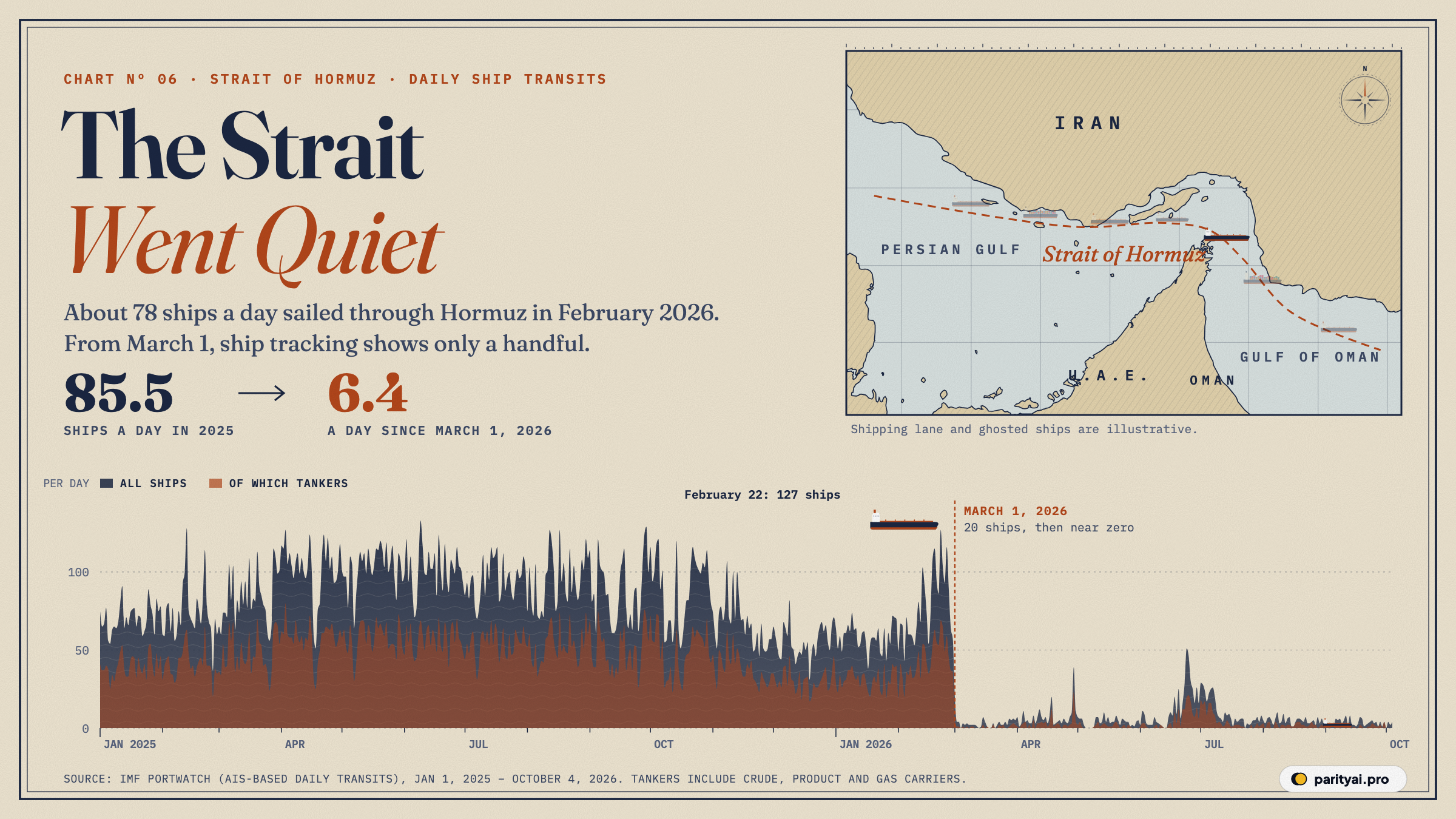
On February 22, 2026, 127 ships passed through the Strait of Hormuz. That was a busy day, but not an unusual one for the narrow channel between Iran and the Arabian Peninsula, which carried about a fifth of the world's oil. Ten days later, on March 4, the ship-tracking record shows none.
The chart above follows every day from January 2025 to October 4, 2026, using the International Monetary Fund's PortWatch counts of vessels crossing the world's main maritime chokepoints. PortWatch builds those counts from AIS, the radio transponders that commercial ships broadcast their position on. The dark sea is every vessel; the rust layer underneath is tankers carrying crude oil, refined fuel and gas. The dashed line marks March 1, 2026. Everything to its right is the strait after the war started.
What follows is a diary of that collapse, told through the daily numbers and the reporting that explains them.
Before: a strait running at full tide
In 2025, PortWatch recorded an average of 85.5 ship transits a day through Hormuz, 48.2 of them tankers. Traffic had been climbing for years. The daily average was 69.1 in 2019 and 92.3 in 2023. In April 2025 it reached 102.4 a day.
That traffic carried an extraordinary share of the world's energy. The U.S. Energy Information Administration estimated that oil flows through the strait averaged 20 million barrels a day in 2024, equal to about 20% of global consumption of petroleum liquids and more than a quarter of all oil traded by sea. Around a fifth of the world's liquefied natural gas trade passed the same way, almost all of it from Qatar.
The strait has always been the system's weak point. Its shipping lanes are only a few kilometres wide, and Iran's coast runs along the entire northern side. The EIA noted that Saudi Arabia and the United Arab Emirates have pipelines that can bypass it, but estimated that only about 2.6 million barrels a day of spare pipeline capacity was available to do so.
November–December 2025: the first dip
The chart shows a warning sign that was easy to miss at the time. Average daily transits fell to 67.4 in November 2025 and 55.5 in December, well below the previous summer.
There was a reason to be nervous. On November 14, Iran's Revolutionary Guard seized the tanker Talara about 20 nautical miles off the UAE coast. A security firm described it as the first such seizure in more than a year. But we found no reporting that fully explains the dip in AIS counts. The EIA estimated that petroleum flows through the strait were still 21.6 million barrels a day in the fourth quarter of 2025. Fewer vessels may have been carrying full loads, or more of them may have switched off their transponders. The diary records the dip without claiming to know its cause.
In February 2026 traffic was strong again, averaging 78 transits a day. The busiest single day was February 22, 2026, with 127.
February 27–28: the last normal days
On February 27, PortWatch counted 64 transits, and on February 28, 57. That day, the United States and Israel launched joint attacks on Iran, according to the Associated Press. Before the war, Brent crude traded at roughly $70 a barrel.
March 1: twenty ships
On March 1, 20 vessels crossed. Bloomberg reported a near halt to traffic through the strait, and quoted a spokesperson for the Revolutionary Guard saying Iran would not let oil leave the region. Brent rose about 6.7% that day to near $78, its biggest gain since June 2025.
For the rest of March, the daily count stayed between zero and seven. The monthly average was 3.2 transits a day.
March: oil above $100
Markets took a few days to grasp the scale. In early March, Brent rose as high as nearly $120 a barrel before falling back under $90, the AP reported. By March 27 it was near $108, according to Bloomberg, after touching a crisis high of $119.50.
The shock spread beyond oil. QatarEnergy halted LNG production and declared force majeure on its shipments in early March. Qatar exported almost 81 million tonnes of LNG in 2025, about a fifth of the world's supply. The International Energy Agency's 32 members agreed to release a record 400 million barrels from emergency stocks, more than twice the previous record of 182.7 million barrels set in 2022.
Shipping insurance tells the same story in another currency. By mid-March, war-risk cover for ships entering the area had risen roughly tenfold. Lower-risk vessels paid about 1% of the hull's value for a single passage, and higher-risk ones were quoted 7.5% to 10%. On those terms, few owners wanted to try.
The dark transits
The PortWatch counts depend on ships announcing themselves. During a war, some don't. Lloyd's List counted about 77 transits in the first half of March, of which 17 were "dark", made with transponders off, according to the same insurance report. Over March 1 to October 4, 2026, PortWatch's AIS-based count adds up to 1,404 crossings across 218 days, an average of 6.4 a day. Of those, 2.6 a day were tankers. The real number, including dark transits, is certainly somewhat higher.
AIS was built for safety, not surveillance. Ships broadcast their identity, position and speed so that other ships can avoid them, and satellites and coastal receivers pick the signals up. PortWatch counts a transit when a vessel's track crosses a line drawn across each chokepoint. In peacetime almost every large merchant ship keeps its transponder on. In a war zone, a captain may judge that being invisible to missile crews is worth breaking the rules. Some of the ships still sailing are also part of the so-called shadow fleet, which often sails dark to avoid sanctions. That makes AIS-based counts a floor, not a census.
Even so, the gap is enormous. At 2025's pace, the strait would have seen roughly 17,241 more crossings over the same period than PortWatch recorded. On 13 days since March 1 it recorded none at all.
June: escorts and a brief recovery
The only visible hump on the right of the chart came in June. American warships began escorting tankers through the strait at night, sometimes more than 20 ships per night, according to Bloomberg via gCaptain. Daily transits averaged 12.9 in June, and the busiest day after March 1 was June 24, 2026, with 51 crossings. The U.S. military said 55 merchant ships made the passage on a single Saturday that month, carrying more than 17 million barrels.
It didn't last. On June 20, NBC News reported that the Revolutionary Guard declared the strait closed again, after Israeli strikes in Lebanon. An interim arrangement had committed Iran to keep it open, toll-free, for 60 days. Transits fell to 10.2 a day in July and 3.6 in September.
How the oil got out
With the strait mostly shut, the Gulf's producers leaned on the pipelines. Saudi Arabia's East-West line to the Red Sea ran at its full capacity of 7 million barrels a day, and the kingdom shipped around 3.43 million barrels a day from its western ports in May. The UAE's line to Fujairah, on the Gulf of Oman, could carry about 1.8 million barrels a day more. Together that is a fraction of what used to sail through Hormuz. The EIA estimated petroleum flows through the strait at 4.9 million barrels a day in the second quarter of 2026, against 21.6 million in late 2025.
The workaround has its own chokepoint. Oil leaving Saudi Arabia's Red Sea ports still has to pass the Bab el-Mandeb strait or the Suez Canal. The Houthis resumed attacks on Red Sea shipping on July 22, 2026, and struck at least four tankers within weeks.
Meanwhile, on the long way round
PortWatch shows how much the world's shipping map had already bent before this war. The Suez Canal handled 73.7 transits a day in 2023, before Houthi attacks began driving ships away from the Red Sea. In 2026 so far it is handling 40.8. The Bab el-Mandeb strait at the Red Sea's southern end fell from 74.0 to 33.6. Around the Cape of Good Hope, traffic rose from 49.1 a day in 2023 to 90.8 in 2026, as ships between Asia and Europe took the long way round Africa.
Hormuz has no long way round. There is no ocean route that reaches Kuwait, Qatar or Iraq's Basra terminals without passing through it. That is why its line drops to the floor of the chart, where Suez's merely sagged.
October: still quiet
In the first days of October, the latest data available, PortWatch counted between two and three transits a day on average. QatarEnergy has extended its force majeure on LNG cargoes through November, with gas prices near their highest since late 2022. The EIA now expects Brent to average about $87 in 2026.
| Month | Ships per day | Tankers per day | vs same month 2025 |
|---|---|---|---|
| Jan 2025 | – | ||
| Feb 2025 | – | ||
| Mar 2025 | – | ||
| Apr 2025 | – | ||
| May 2025 | – | ||
| Jun 2025 | – | ||
| Jul 2025 | – | ||
| Aug 2025 | – | ||
| Sep 2025 | – | ||
| Oct 2025 | – | ||
| Nov 2025 | – | ||
| Dec 2025 | – | ||
| Jan 2026 | ▼ 17% | ||
| Feb 2026 | ▲ 6% | ||
| Mar 2026 | ▼ 96% | ||
| Apr 2026 | ▼ 93% | ||
| May 2026 | ▼ 96% | ||
| Jun 2026 | ▼ 87% | ||
| Jul 2026 | ▼ 89% | ||
| Aug 2026 | ▼ 95% | ||
| Sep 2026 | ▼ 96% | ||
| Oct 2026 | ▼ 97% |
Monthly average of daily AIS-tracked transits, January 2025 to October 4, 2026. The last month is partial. March 2026, the first month of the war, is highlighted.
The diary has no last entry yet. What the daily counts already show is how quickly the world's most important energy artery went from more than a hundred ships on a busy day to a handful a day, and how long it has stayed that way.
Sources and method
- IMF PortWatch, Daily Chokepoint Transit Calls and Trade Volume Estimates. Daily transits derived from AIS ship-tracking data, retrieved October 8, 2026
- Natural Earth land (via world-atlas)
Transits are PortWatch's daily count of vessels crossing each chokepoint, estimated from AIS satellite and terrestrial ship-tracking signals. Ships that switch off their transponders are not counted, so the true number of crossings since March 2026 may be somewhat higher than shown. 'Since March 1' averages run from March 1, 2026 to the latest day available.
Charts like this, from your own numbers.
Connect a spreadsheet or the tools you run on, and Parity builds the dashboard and writes the report, with every number checked.
Try Parity free