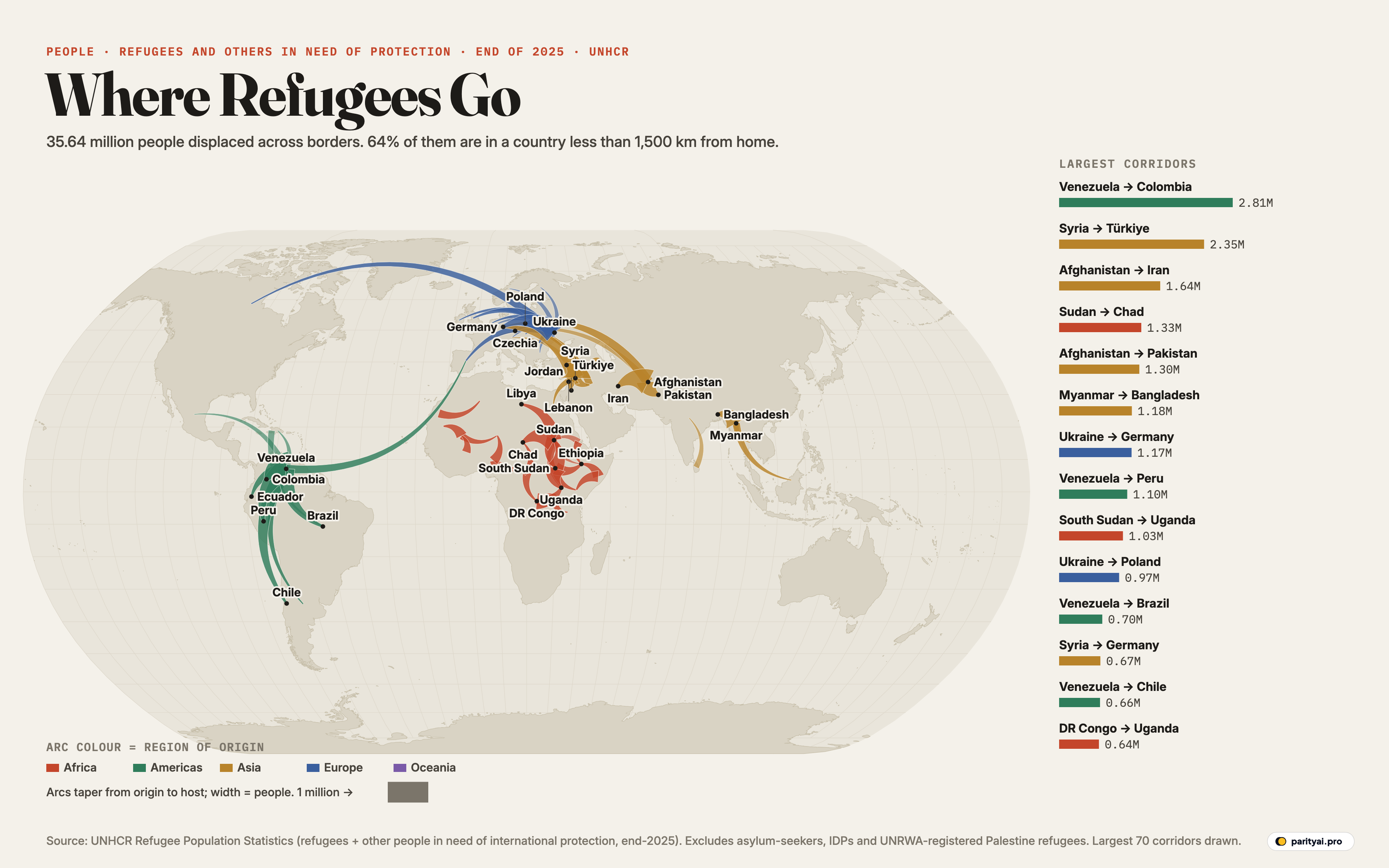
The picture many people carry of refugees is of long journeys: boats crossing the Mediterranean, caravans heading for the US border, families arriving at airports in Europe or North America. Those journeys are real. But the map above shows that they are the exception.
It draws the 35.64 million people who, at the end of 2025, were living outside their country as refugees under the mandate of UNHCR, the UN refugee agency, or as "other people in need of international protection", a category UNHCR uses mainly for Venezuelans. Each arc runs from a country of origin to a country of asylum. It is widest where it starts and tapers to a point where it ends, and its width shows how many people made that move. The 70 largest corridors are drawn, out of 4,843 in the data, and they are coloured by the region people fled from.
The thickest arcs on the map are the shortest. 64% of these people live in a country whose centre is less than 1,500 kilometres from the centre of the one they left. UNHCR's own Global Trends report puts it more simply: 65% of refugees live in a country neighbouring their own.
The biggest corridor runs from Venezuela to Colombia
The single largest arc on the map is the stubby green one in the north of South America. Venezuela → Colombia accounts for 2.81 million people, more than any other pair of countries in the world.
Venezuela is now the largest country of origin in UNHCR's data, with 6.46 million people abroad. Almost all of them, 6.04 million, are counted not as refugees but as other people in need of international protection: people who left a country in economic and political collapse, most of whom have never applied for asylum, but who UNHCR considers cannot safely go back. Green arcs fan out across the continent: Venezuela → Peru (1.10 million), Venezuela → Brazil (699,000) and Venezuela → Chile (663,000), plus smaller ones reaching Ecuador, Argentina, the Dominican Republic, Mexico and, across the Atlantic, Spain.
Syria's arc is shrinking
The second-thickest arc, Syria → Türkiye, carries 2.35 million people. Nearly all the refugees Türkiye hosts are Syrians. A thinner arc runs on to Germany (669,000), and smaller ones reach Lebanon and Jordan, which host some of the largest refugee populations in the world relative to their own size.
This arc is getting thinner. After the fall of Bashar al-Assad's government in December 2024, UNHCR counted around 1.3 million Syrians returning from abroad during 2025, nearly three times as many as the year before. The number of Syrian refugees fell by 18%, to 4.87 million on our count.
Afghanistan: two neighbours, and a wave of returns
The ochre arcs from Afghanistan split in two directions: Afghanistan → Iran (1.64 million) and Afghanistan → Pakistan (1.30 million). Between them, Iran and Pakistan host about four in five of the Afghans who have fled.
Both countries pushed large numbers of Afghans to go home in 2025, through deportations and tighter rules on residence. UNHCR recorded 1.9 million Afghan returns during the year, and the number of Afghans abroad fell by more than a third, to 3.70 million. Many went back to a country that is poor, under Taliban rule, and struggling to absorb them.
| # | From | To | People | Distance |
|---|---|---|---|---|
| 1 | Venezuela | Colombia | 843 km | |
| 2 | Syria | Türkiye | 526 km | |
| 3 | Afghanistan | Iran | 1,078 km | |
| 4 | Sudan | Chad | 1,209 km | |
| 5 | Afghanistan | Pakistan | 534 km | |
| 6 | Myanmar | Bangladesh | 712 km | |
| 7 | Ukraine | Germany | 1,503 km | |
| 8 | Venezuela | Peru | 2,022 km | |
| 9 | South Sudan | Uganda | 711 km | |
| 10 | Ukraine | Poland | 898 km | |
| 11 | Venezuela | Brazil | 2,444 km | |
| 12 | Syria | Germany | 2,869 km | |
| 13 | Venezuela | Chile | 4,639 km | |
| 14 | DR Congo | Uganda | 1,074 km | |
| 15 | South Sudan | Sudan | 964 km | |
| 16 | Sudan | South Sudan | 964 km | |
| 17 | Sudan | Libya | 1,733 km | |
| 18 | Syria | Lebanon | 269 km | |
| 19 | Venezuela | Ecuador | 1,656 km | |
| 20 | South Sudan | Ethiopia | 1,041 km |
Refugees plus other people in need of international protection, end of 2025. Distance between country centres.
Myanmar to Bangladesh: the camps that stayed
A short, thick ochre arc crosses the Bay of Bengal's northern shore: Myanmar → Bangladesh, with 1.18 million people. Almost all of them are Rohingya, a Muslim minority who fled a military crackdown in Myanmar's Rakhine state, most of them in 2017.
Nearly nine years later, most still live in the sprawling camps around Cox's Bazar in south-eastern Bangladesh, one of the largest refugee settlements in the world. Myanmar does not recognise most Rohingya as citizens, and the civil war that followed the 2021 military coup has made return even less likely. In total, 1.52 million people from Myanmar are living abroad as refugees, making it the seventh-largest country of origin on the map.
Ten corridors, nearly half the total
Although the data list 4,843 separate corridors between 198 countries of origin and 169 host countries, displacement is highly concentrated. The ten largest corridors alone hold 42% of everyone on the map. Each of them is a crisis that has lasted for years: Venezuela's collapse, Syria's civil war, Afghanistan's decades of conflict, Sudan's war, Myanmar's persecution of the Rohingya, South Sudan's instability and Russia's invasion of Ukraine.
That concentration is why a single political change can reshape the whole map. The fall of the Assad government and the expulsions from Iran and Pakistan were among the main reasons the global total of displaced people fell in 2025, for the first time in a decade.
Africa: Sudan and its neighbours
The red arcs in Africa are short and tangled, because most African refugees move between neighbouring countries in the same region. The thickest is Sudan → Chad: 1.33 million Sudanese have crossed into Chad, one of the poorest countries in the world.
Sudan's war, which began in April 2023, has produced the world's largest displacement crisis. Most of it does not appear on this map at all, because 9.1 million people remain displaced inside Sudan. But the number of Sudanese refugees abroad grew by 35% in 2025, to 2.82 million, and Sudan was the largest source of new cross-border flight in the world that year. The Rapid Support Forces' capture of El Fasher, in Darfur, in October 2025 after an 18-month siege, drove another wave.
Other red arcs carry people out of South Sudan (2.39 million in total), the Democratic Republic of the Congo (1.18 million) and Somalia. Uganda, which receives arcs from South Sudan (1.03 million) and the DR Congo (645,000), is the largest host country in Africa, with 1.94 million. Some arcs run in both directions: South Sudan → Sudan accounts for 635,000 people, South Sudanese who fled to Sudan before Sudan's own war began.
Europe: Ukraine's two arcs
The blue arcs out of Ukraine reach across Europe. The thickest go to Germany (1.17 million) and Poland (972,000), with smaller ones to Czechia and much of the rest of the continent. On our count, about 4.75 million Ukrainians are living in European countries, most of them under the EU's temporary protection scheme. In total there are 5.22 million Ukrainians abroad.
Germany receives arcs from both Ukraine and Syria, which is why it ranks second among the world's hosts with 2.66 million people, behind only Colombia. It is the only rich country in the top five.
| # | Hosting country | People hosted | Country of origin | People displaced abroad |
|---|---|---|---|---|
| 1 | Colombia | Venezuela | ||
| 2 | Germany | Ukraine | ||
| 3 | Türkiye | Syria | ||
| 4 | Uganda | Afghanistan | ||
| 5 | Iran | Sudan | ||
| 6 | Chad | South Sudan | ||
| 7 | Pakistan | Myanmar | ||
| 8 | Bangladesh | DR Congo | ||
| 9 | Peru | Somalia | ||
| 10 | Ethiopia | Central African Republic |
The long arcs
A few arcs do stretch across oceans. The longest among the corridors drawn is Ukraine → Canada. Others run from Venezuela to Spain and from Ukraine to the United Kingdom and Spain. They are visible precisely because they are unusual: thin lines across the empty Atlantic.
The United States hosts about 458,000 people in this data. That figure excludes the much larger number of people with pending asylum claims, who are counted separately by UNHCR as asylum-seekers and are not drawn here.
Who carries the load
Look at where the arcs end and a pattern appears. The biggest hosts are mostly middle- and low-income countries next door to a crisis: Colombia, Türkiye, Uganda, Iran, Chad, Pakistan, Bangladesh, Peru and Ethiopia. UNHCR reports that low- and middle-income countries host 68% of the people under its mandate.
That is happening while the money to support them is shrinking. UNHCR received only about half of its 2025 budget and has cut thousands of jobs, after the United States, historically its largest donor, reduced its contributions. Resettlement, the programme that moves a small number of refugees from countries of first asylum to wealthier countries, fell by more than half in 2025, to 81,800 people, mainly because the United States suspended its programme.
What the map leaves out
- People displaced inside their own country. At the end of 2025 there were 68.7 million internally displaced people worldwide, far more than the number of refugees. They have no arc, because they never crossed a border.
- Asylum-seekers. Almost 9 million people were waiting for a decision on an asylum claim. They are not counted until they are recognised.
- Palestine refugees. The 6 million Palestine refugees registered with UNRWA, a separate UN agency, are not part of UNHCR's figures.
- Centre to centre. Arcs start and end at the centre of each country, not where people actually crossed or live, and distances are approximate.
Including all of these, UNHCR counted 117.8 million people forcibly displaced at the end of 2025. It was the first fall in that total in a decade, driven by returns to Syria and Afghanistan, though many of the Afghan returns took place under pressure from host governments.
The shape of the map
Strip away the long, thin arcs and what is left is a map of neighbours. Colombians took in Venezuelans, Chadians took in Sudanese, Ugandans took in South Sudanese and Congolese, Bangladesh took in Rohingya from Myanmar, and Poland and Germany took in Ukrainians. Most refugees stay as close to home as they safely can, often hoping to go back. The arcs show where the world's displaced people actually are, and it is mostly not where the political arguments about refugees are loudest.
Sources and method
- UNHCR Refugee Population Statistics Database (API), end-2025 figures. Refugees and other people in need of international protection, by country of origin and asylum, retrieved October 10, 2026
- UNHCR, Global Trends: Forced Displacement in 2025 (June 2026)
- Natural Earth country shapes via world-atlas
Each arc joins a country of origin to a country of asylum. Its width is the number of refugees under UNHCR's mandate plus other people in need of international protection (a category used mainly for Venezuelans) in that country at the end of 2025. Asylum-seekers awaiting a decision, internally displaced people and Palestine refugees under UNRWA's mandate are not included. The 70 largest corridors are drawn; the rest are summarised in the totals. Arcs start at the centre of each country's main landmass and taper towards the host, curving clockwise so that flows in opposite directions do not overlap.
Charts like this, from your own numbers.
Connect a spreadsheet or the tools you run on, and Parity builds the dashboard and writes the report, with every number checked.
Try Parity free