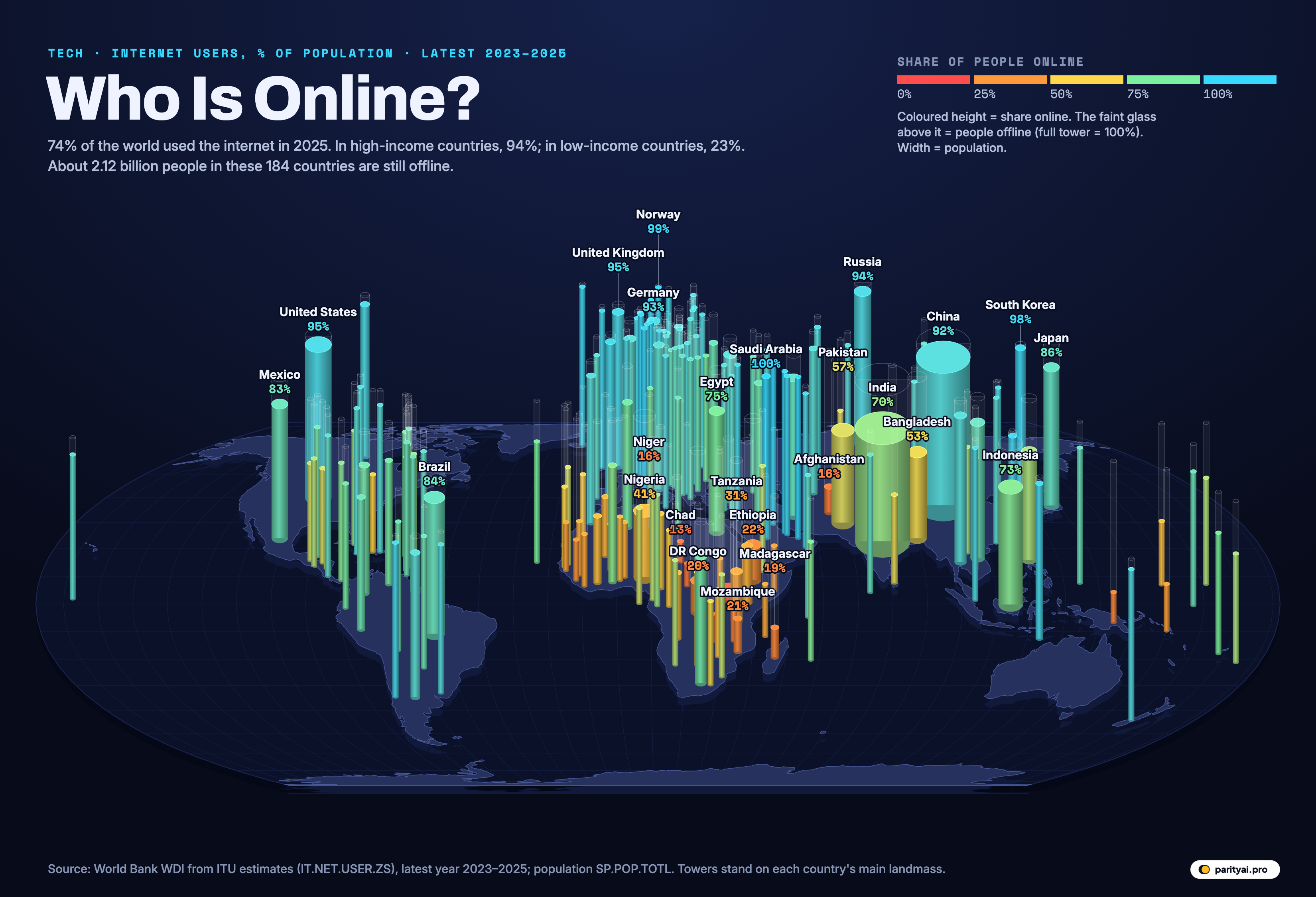
Seen from a distance, the map above looks like a city at night. Over Europe, the Gulf, East Asia and the Americas, rows of cyan towers rise almost to the same height. Over much of Africa and parts of South Asia, the skyline drops away to stubby orange and red cylinders, many of them topped by a tall, empty column of glass.
Each tower is a country. Its coloured height is the share of the population that used the internet in the latest year available, mostly 2024 or 2025, from estimates the International Telecommunication Union compiles and the World Bank publishes. The faint glass above the colour is the rest: the share of people who are not online. A tower's width shows its population, so India and China are the fattest towers on the map.
Worldwide, 74% of people used the internet in 2025. The ITU's latest count is that about 6 billion people are online and 2.2 billion are not. Adding up the 184 countries on our map gives about 2.12 billion people offline. That is a smaller gap than it has ever been, and a much larger one than the skyline of full-height towers might suggest.
The ceiling has been reached in the rich world
In high-income countries, 94% of people use the internet. Of the 184 countries on the map, 55 are at 90% or higher, and 27 at 95% or higher. Saudi Arabia (100%), the United Arab Emirates (100%), Norway (99%) and South Korea (98%) are effectively fully connected; the tiny remainder includes very young children and the very old.
For these countries the question is no longer whether people are online but how well: the speed and price of their connections, and how much of daily life, from banking to healthcare, now assumes them. Even the United States (95%) has about 18 million people who don't use the internet, and Japan (86%) has 18 million, many of them older people.
Most offline people live in a handful of countries
The glass is where the story is. Because India is so large, even its 70% share online leaves more people offline there than anywhere else: about 439 million. Next come Nigeria (140 million), China (118 million), Pakistan (109 million) and Ethiopia (106 million). Those five countries alone account for 43% of all the offline people on the map.
That list mixes two very different situations. China's share online is high, 92%, but in a country of 1.4 billion even a small remainder is a large number of people, many of them older or rural. Nigeria, Pakistan and Ethiopia are the opposite: younger, fast-growing countries where a majority, or close to it, is still offline. In Ethiopia, the figure is 22% online. In the Democratic Republic of the Congo, 20%.
| # | Country | People offline | Share online | 2015–2025 |
|---|---|---|---|---|
| 1 | India | 70% (2025) | ||
| 2 | Nigeria | 41% (2024) | ||
| 3 | China | 92% (2025) | ||
| 4 | Pakistan | 57% (2024) | ||
| 5 | Ethiopia | 22% (2024) | ||
| 6 | DR Congo | 20% (2024) | ||
| 7 | Bangladesh | 53% (2024) | ||
| 8 | Indonesia | 73% (2024) | ||
| 9 | Tanzania | 31% (2024) | ||
| 10 | Uganda | 9% (2024) | ||
| 11 | Philippines | 67% (2024) | ||
| 12 | Kenya | 35% (2024) | ||
| 13 | Afghanistan | 16% (2024) | ||
| 14 | Brazil | 84% (2024) | ||
| 15 | Egypt | 75% (2024) |
People offline = population × share not using the internet, latest year 2023–2025.
Africa is where the skyline drops
Sub-Saharan Africa as a whole has 36% of people online, by the World Bank's count. Across Africa as a whole the ITU puts the figure at 36%, against 77% in Asia-Pacific and around 90% in Europe and the Americas.
The lowest values on the map are in Burundi (9%), Uganda (9%) and Chad (13%). 13 countries are below 25%, and 38 are below half. Most of them are in a band stretching from the Sahel through Central and East Africa: Niger (16%), Madagascar (19%), Malawi (19%), Mozambique (21%) and Tanzania (31%). Outside Africa, Afghanistan (16%) stands out.
These are some of the poorest countries in the world, and the link is not a coincidence. In low-income countries overall, only 23% of people use the internet. In lower-middle-income countries the figure is 63%, and in upper-middle-income countries 89%. Income is the single best predictor of a tower's height.
Neighbours, different heights
Region and income explain a lot, but not everything. Some of the most interesting comparisons on the map are between countries that sit side by side.
In Africa, South Africa (78%) and Egypt (75%) have towers far taller than their neighbours, closer to Latin America than to the rest of the continent. Nigeria, Africa's most populous country, is at 41%; Kenya, often described as a mobile-money pioneer, is at 35%. Paying for things by phone and browsing the internet turn out to be different things: a basic phone can send money by text message without ever going online.
South Asia shows a similar spread. Pakistan (57%) and Bangladesh (53%) are well below India (70%), and all three are below Southeast Asian countries such as Indonesia (73%), the Philippines (67%) and Vietnam (84%). Vietnam's tower is as tall as Brazil's (84%) and taller than Mexico's (83%), even though Vietnam is poorer than both.
In the Middle East the contrast is starker still. The Gulf monarchies are full to the brim, while Afghanistan, not far to the east, has one of the shortest towers on the map. Iran (85%) and Türkiye (90%) sit near the top, alongside much of Europe.
These differences come from many places: how competitive mobile markets are, what governments charge in taxes on phones and data, how many people can read, and whether there is useful content in local languages. A tower's height is not fixed by geography.
Coverage is not the problem
It is tempting to imagine the offline population as people living beyond the reach of any signal. Mostly, they aren't. The GSMA, the mobile industry's association, estimates that 96% of the world's population lives within range of mobile internet. Only about 300 million people, 4% of the world, have no coverage at all.
The gap is in use. Billions of people live where a signal is available but do not use mobile internet, and the reasons are mostly about money and skills. By the GSMA's estimate, the cheapest internet-capable phone costs about 16% of average monthly income in low- and middle-income countries, and nearly half of monthly income for the poorest fifth of people. Data plans add to that. Many people also say they don't know how to use the internet, can't read well enough to use it, or don't see what it would do for them.
That is why the stubby towers in the middle of Africa are not simply a matter of building more masts. The networks are often already there. The phones, the prices and the reasons to go online are not.
The gaps inside the towers
A tower's single colour hides divides within each country.
- Cities and countryside. Worldwide, 85% of urban residents use the internet, against 58% of rural ones. In low-income countries, only about one rural resident in seven is online.
- Men and women. 77% of men are online, against 71% of women, which means about 280 million more men than women use the internet. The gap tends to be widest in the poorest countries.
- Young and old. Among 15- to 24-year-olds, 82% are online, ten points higher than among everyone else. In most countries, the offline population skews old.
So two countries with towers of the same height can be very different places. In one, nearly every young person is online and the gap is among the elderly; in another, the gap runs between cities and villages, or between men and women.
| # | Country | Share online | Population | Year |
|---|---|---|---|---|
| 1 | Burundi | 14 million | 2024 | |
| 2 | Uganda | 51 million | 2024 | |
| 3 | Chad | 21 million | 2024 | |
| 4 | Central African Republic | 6 million | 2024 | |
| 5 | Niger | 28 million | 2024 | |
| 6 | Afghanistan | 44 million | 2024 | |
| 7 | Zambia | 22 million | 2024 | |
| 8 | Madagascar | 33 million | 2024 | |
| 9 | Papua New Guinea | 11 million | 2024 | |
| 10 | Malawi | 22 million | 2024 | |
| 11 | DR Congo | 113 million | 2024 | |
| 12 | Mozambique | 36 million | 2024 |
The skyline is rising fast
The towers look fixed, but most of them are growing. The ITU estimates that the world's online population grew by more than 240 million people in 2025 alone. In the least developed countries, internet use is growing about 7% a year, more than twice the global rate.
Among countries with more than 10 million people, the biggest jumps since 2015 came in Iraq, from 15% to 81%, Cambodia, from 6% to 68%, and India, from 15% to 70%. India's rise, driven by cheap smartphones and some of the world's lowest mobile data prices, has brought hundreds of millions of people online in a decade, a shift big enough to move the world average on its own.
| Country | 2015 | Latest | Points gained |
|---|---|---|---|
| Iraq | 15% | 81% | |
| Cambodia | 6% | 68% | |
| India | 15% | 70% | |
| Thailand | 39% | 91% | |
| Indonesia | 22% | 73% | |
| Ghana | 23% | 72% | |
| Uzbekistan | 43% | 90% | |
| Pakistan | 11% | 57% | |
| Bolivia | 37% | 80% | |
| Jordan | 54% | 96% |
Reading the towers
- Latest year varies. Most countries' figures are for 2024; a few, including India and China, have 2025 values. Some are modelled by the ITU where no recent survey exists, and some countries, such as North Korea, have no estimate and no tower.
- "Using the internet" is a low bar. It means using it at least once in the previous three months, from any device and any place. It says nothing about speed, cost or how often.
- Positions, not borders. Each tower stands on the centre of its country's largest landmass. Small countries in crowded regions overlap.
- The tilt. The map is tilted to give the towers room to stand, so northern countries appear further back. Compare tower heights, not their positions on the page.
The last two billion
For most of the internet's history, the hard part was building networks. That job is now largely done: 5G alone already reaches more than half the world's people. What remains is harder to fix with engineering, because it is about poverty, literacy, the price of a phone and the cost of data.
The skyline on this map will keep rising. But the last towers to reach full height will be the ones in the poorest countries, and getting them there will depend less on the next generation of mobile networks than on whether a farmer in Malawi or a shopkeeper in Chad can afford a phone and find a reason to use it.
Sources and method
- World Bank, World Development Indicators: Individuals using the Internet (% of population), IT.NET.USER.ZS, based on ITU data. Latest year 2023–2025 per country, API updated October 8, 2026
- World Bank, World Development Indicators: Population, total (SP.POP.TOTL)
- ITU, Facts and Figures 2025
- Natural Earth country shapes via world-atlas
Internet users are people who used the internet from any location in the last three months, as estimated by the International Telecommunication Union from household surveys and, where none exist, modelled estimates. For each country we use the latest value published between 2023 and 2025. Each tower stands on the centre of the country's largest landmass. Tower height is proportional to the share online; the area of its top is proportional to population. People offline are the population multiplied by the share not online.
Charts like this, from your own numbers.
Connect a spreadsheet or the tools you run on, and Parity builds the dashboard and writes the report, with every number checked.
Try Parity free