The page that drew the most views on English Wikipedia in the first nine months of 2026 was not about a war, a film or a footballer. It was the article on .xxx, the internet domain ending, with 51.1 million views. Almost none of them came from people.
Wikimedia, the foundation behind Wikipedia, filters out traffic from bots that identify themselves. Plenty of automated traffic doesn't. Scripts and scrapers that load the same page over and over can pass for human readers, and they tend to leave a fingerprint: views that come almost entirely from desktop computers, or almost entirely from phones, in a way real readers never do. Wikipedia's own volunteer Top 25 Report screens out articles with that pattern, and the foundation did something similar for its list of 2025's most-read articles.
We did the same. Before ranking, we removed any article whose desktop share of views was above 70% or below 6%. That took out 7 entries that would otherwise have crowded the top of the list: .xxx, Neatsville, Kentucky, .xyz, Limonene, Nahui Ollin, XXX (film series), Ansel Adams. A small community in Kentucky, a citrus-scented chemical and an Aztec calendar symbol did not suddenly fascinate millions of people.
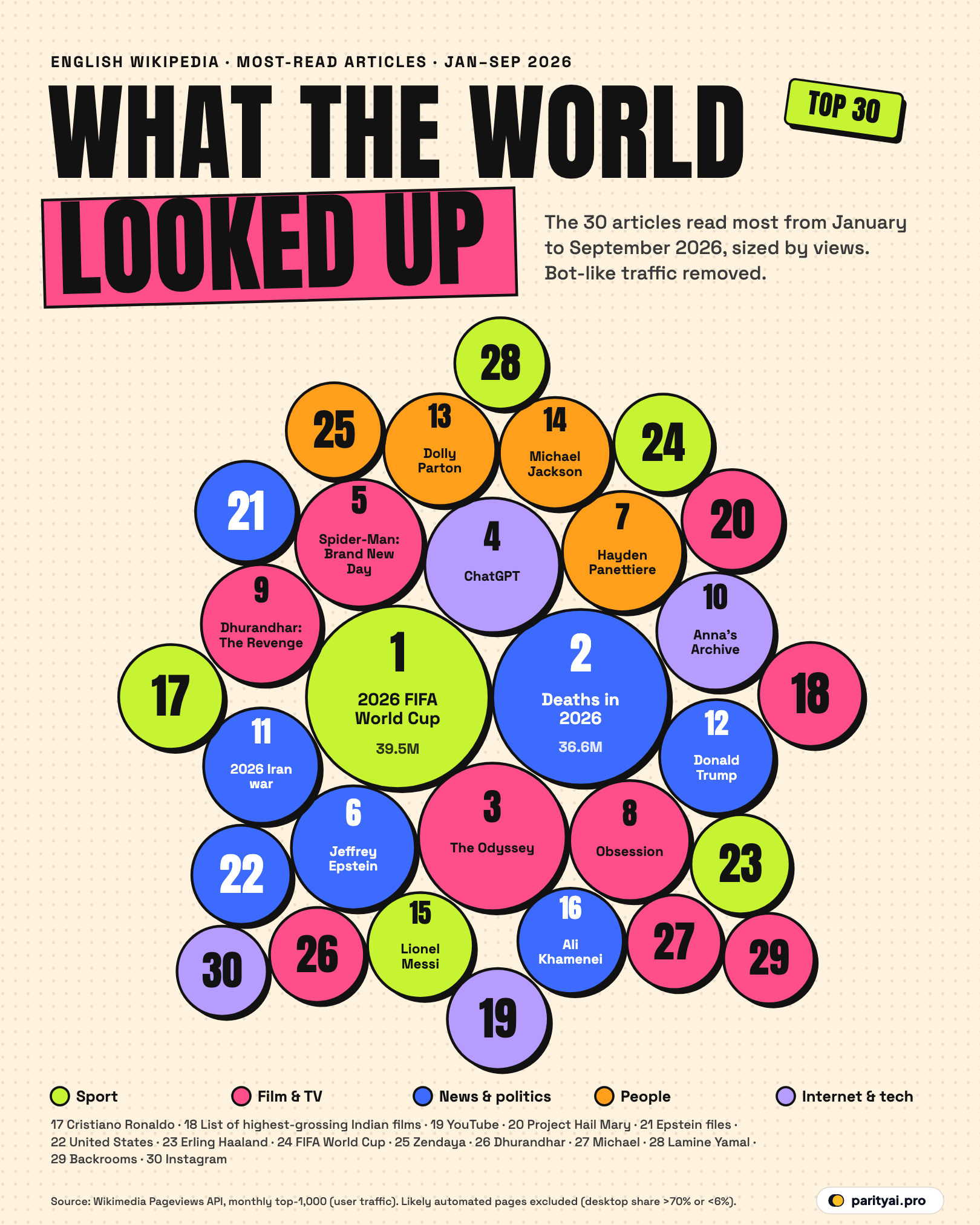
What's left is the chart above: the 30 English Wikipedia articles read most from January to September 2026, sized by views and coloured by subject. Together they drew 473.5 million views. The data comes from Wikimedia's public pageview API, which publishes each month's thousand most-read articles. If you sort the readers behind those 30 bubbles, they fall into five groups.
The fans: 98.7 million views
The biggest bubble belongs to the summer. The 2026 FIFA World Cup article was read 39.5 million times, more than any other, peaking in June. The tournament, the first men's World Cup held in North America in more than three decades, ended on July 19 at MetLife Stadium outside New York. Spain beat Argentina 1–0 after extra time, with a goal from Ferran Torres, according to NPR. It was Spain's second title, ESPN noted.
The World Cup pulled its stars into the top 30 with it: Lionel Messi (13.2 million) and Cristiano Ronaldo (12.9 million), both peaking in July, along with Erling Haaland (11.6 million) and Spain's teenage winger Lamine Yamal (9.9 million). The general FIFA World Cup article, which is mostly a history of past tournaments, added 11.5 million more. In all, 6 of the top 30 were about football.
The audience: 135.0 million views
Film and TV made up the largest group by views: 9 articles. This was a big year at the cinema, and Wikipedia readers followed the box office closely.
Christopher Nolan's The Odyssey, released by Universal on July 17, was the third most-read article of the year at 25.8 million. The film has taken more than $1.77 billion worldwide, according to The Numbers. Two weeks later came Spider-Man: Brand New Day (19.3 million), which has grossed over $2.5 billion, per The Numbers.
The rest of the group is more surprising. Obsession, a low-budget horror film by Curry Barker, drew 17.1 million views, peaking in June. Horror magazine Fangoria reported that it cost less than $1 million to make and had passed $400 million worldwide by its eighth weekend. A24's Backrooms, a horror film adapted from an online video series, had 9.7 million. Michael, the Michael Jackson biopic released on April 24, had 10.6 million and crossed $1 billion at the box office. It also helped push the Michael Jackson article itself to 14.7 million. Project Hail Mary, adapted from Andy Weir's novel, had 12.0 million.
India's cinema shows up too. Dhurandhar: The Revenge, released on March 19, drew 17.0 million. Its predecessor, Dhurandhar, drew 10.7 million, and the evergreen List of highest-grossing Indian films drew 12.8 million. India is one of English Wikipedia's largest audiences, and its film fandom regularly shows up in the rankings.
The newsreaders: 122.8 million views
The news group is the one shaped most by single days. Jeffrey Epstein (18.2 million) and the Epstein files (12.0 million) both peaked in February. On January 30 the Justice Department released more than three million pages of documents from the investigations, as NPR reported.
A month later, the war began. The 2026 Iran war article drew 15.8 million views, peaking in March. Ali Khamenei, Iran's supreme leader, drew 13.2 million. He was killed, aged 86, in the joint US-Israeli strikes that opened the war, NPR reported on March 1, citing Iranian state media. Donald Trump (15.4 million) and the United States article (11.6 million) are fixtures of every year's list.
The second-biggest bubble belongs here too. Deaths in 2026 is a running list of notable people who have died this year, and it drew 36.6 million views. A year-in-deaths list is almost always near the top: "Deaths in 2025" was the most-read article of last year, with about 49.6 million views.
The mourners: 57.5 million views
When someone famous dies, Wikipedia is where millions go to read their life story. Two of the four "people" articles in the top 30 belong to stars who died this year.
Hayden Panettiere, the actress known for Heroes and Nashville, died at 36, NPR reported on August 17. Her article drew 17.1 million views and appeared in the monthly top lists in only 3 months, which shows how concentrated the attention was. Barely a week later the country music star Dolly Parton died at 80 in Nashville, after what her publicist called a brief battle with cancer, according to NPR. Her article drew 14.9 million, nearly all of it in the weeks after her death.
The other two people are there for their work. Michael Jackson owes his place mostly to the biopic. Zendaya (10.8 million, peaking in August) starred in both Spider-Man: Brand New Day and The Odyssey, which opened two weeks apart.
The netizens: 59.5 million views
The last group is about the internet itself. ChatGPT drew 21.5 million views and was the fourth most-read article of the year. It peaked in January and stayed on every monthly list. YouTube (12.1 million) and Instagram (9.6 million) are perennials, read by people checking a fact, a founder or a feature.
The oddity here is Anna's Archive, a "shadow library" search engine for books and papers, with 16.3 million views and a January peak. We could not confirm from a primary source what drove its January peak. Shadow libraries draw attention whenever they face legal action or move address, and when a site people depend on becomes hard to reach, many go to Wikipedia to find out what happened.
The year, month by month
Each article's busiest month gives a rough calendar of what people were curious about.
January belonged to technology and politics. ChatGPT, Donald Trump and Anna's Archive all peaked then, and so did the first Dhurandhar film, a month after its December release. February was the Epstein month: both Epstein articles peaked, alongside Instagram. March was the war: 2026 Iran war and Ali Khamenei both peaked, while Dhurandhar: The Revenge and Project Hail Mary opened in cinemas.
April was quieter. The List of highest-grossing Indian films peaked as the Dhurandhar sequel climbed the charts. May belonged to Michael Jackson, a few weeks after the biopic opened. June was the start of the World Cup, when both World Cup articles peaked, along with the horror hits Obsession and Backrooms.
July was the summer of football and film. The Odyssey peaked, and so did Messi, Ronaldo, Haaland and Yamal during the knockout rounds, along with YouTube and the United States article. August was the most crowded month of all. Spider-Man: Brand New Day was in cinemas, Zendaya was in two blockbusters, and two deaths, Hayden Panettiere's and Dolly Parton's, sent millions to their biographies. Deaths in 2026 had its busiest month too.
What the list says about 2026
Put the five groups side by side and the year's shape is clear. It was a year of big screens and a big tournament. Film and TV led with 135.0 million views across 9 articles, and football had the single largest bubble. The news group was not much smaller, at 122.8 million, and almost all of it came from two stories: the Epstein documents and the war with Iran.
These lists also have limits. They count page views, not people: a reader who returns to the same article ten times counts ten times. They cover English Wikipedia only, which skews toward the United States, Britain and India. And our bot filter is a blunt tool. It catches the most obvious automated traffic but may miss subtler scraping, or remove a page that real people read mostly on one kind of device.
| # | Article | Views | Month by month | Busiest month | Category |
|---|---|---|---|---|---|
| 1 | 2026 FIFA World Cup | June | Sport | ||
| 2 | Deaths in 2026 | August | News & politics | ||
| 3 | The Odyssey (2026 film) | July | Film & TV | ||
| 4 | ChatGPT | January | Internet & tech | ||
| 5 | Spider-Man: Brand New Day | August | Film & TV | ||
| 6 | Jeffrey Epstein | February | News & politics | ||
| 7 | Hayden Panettiere | August | People | ||
| 8 | Obsession (2025 film) | June | Film & TV | ||
| 9 | Dhurandhar: The Revenge | March | Film & TV | ||
| 10 | Anna's Archive | January | Internet & tech | ||
| 11 | 2026 Iran war | March | News & politics | ||
| 12 | Donald Trump | January | News & politics | ||
| 13 | Dolly Parton | August | People | ||
| 14 | Michael Jackson | May | People | ||
| 15 | Lionel Messi | July | Sport | ||
| 16 | Ali Khamenei | March | News & politics | ||
| 17 | Cristiano Ronaldo | July | Sport | ||
| 18 | List of highest-grossing Indian films | April | Film & TV | ||
| 19 | YouTube | July | Internet & tech | ||
| 20 | Project Hail Mary (film) | March | Film & TV | ||
| 21 | Epstein files | February | News & politics | ||
| 22 | United States | July | News & politics | ||
| 23 | Erling Haaland | July | Sport | ||
| 24 | FIFA World Cup | June | Sport | ||
| 25 | Zendaya | August | People | ||
| 26 | Dhurandhar | January | Film & TV | ||
| 27 | Michael (2026 film) | May | Film & TV | ||
| 28 | Lamine Yamal | July | Sport | ||
| 29 | Backrooms (film) | June | Film & TV | ||
| 30 | February | Internet & tech |
User traffic on all platforms. A month counts as zero if the article was outside that month's top 1,000. Likely automated pages are excluded (see method).
Even with those caveats, a list like this is a useful record of what people wanted to know. Every bubble on the chart is a moment when millions of people independently typed the same name into a search bar.
Sources and method
- Wikimedia REST API, Pageviews: top articles by month (en.wikipedia, user traffic). Monthly top-1,000 lists for January to September 2026, all access, desktop and mobile web, retrieved October 8, 2026
Views are the sum of each article's monthly totals in Wikimedia's top-1,000 lists for January to September 2026 (user traffic, all platforms), so an article that fell out of a month's top 1,000 is slightly undercounted. Site pages (Main Page, Special:, Wikipedia: and similar) are excluded. Wikimedia already removes self-identified bots, but some automated traffic still looks human; we exclude articles whose desktop share of desktop-plus-mobile-web views is above 70% or below 6%, a pattern typical of scripted traffic. Categories are our own editorial grouping.
Charts like this, from your own numbers.
Connect a spreadsheet or the tools you run on, and Parity builds the dashboard and writes the report, with every number checked.
Try Parity free