Your accountant hands you net income, but your bank, and anyone who ever wants to buy your business, will ask for EBITDA instead. EBITDA stands for earnings before interest, taxes, depreciation and amortization: what the business earned from its day-to-day work before loan costs, income tax and the slow write-off of its equipment are taken out.
That second number is usually much bigger than the first, and it's the one people use to decide how much you can borrow and what the business is worth. This guide works through a full year of books for Granite Bay HVAC, an example heating and air conditioning contractor, so you can see exactly where the number comes from, who uses it and for what, and where it can mislead you.
What each letter takes out, and why
Start from net income, the bottom line of your profit and loss statement. EBITDA puts four kinds of cost back in. Each one is removed for a reason, and the reason tells you what the number is for.
- Interest. Two identical HVAC companies can have very different interest bills because one bought its vans with a loan and the other with cash. Adding interest back shows the business before anyone decides how to finance it.
- Taxes. Income tax depends on your entity type, your state and your owner's personal situation. Many small businesses are S corporations or LLCs where the business itself pays little or no federal income tax and the owner pays it instead. Adding tax back puts every structure on the same footing.
- Depreciation. When you buy a $55,000 van, your books usually spread the cost over several years as depreciation instead of expensing it all at once. That yearly charge is a real cost, but no cash leaves the bank when it's booked. Tax rules can allow much faster write-offs (the IRS covers them in Publication 946), so your tax return and your management accounts may show different depreciation. Your accountant can tell you which you're looking at.
- Amortization. The same idea for things you can't touch: a customer list, a franchise fee, a software licence or the goodwill from buying another business.
What's left is a measure of the profit the operations produce, independent of the loans, the tax structure and the age of the equipment. That is why it travels well between businesses. It is also why it flatters any business that owns a lot of equipment, which we'll come back to.
The EBITDA formula, worked through a small P&L
There are two ways to calculate EBITDA, and on clean books they give the same answer:
- Bottom-up: EBITDA = net income + interest + income taxes + depreciation + amortization
- Top-down: EBITDA = operating income + depreciation + amortization
Here is Granite Bay HVAC's year, a made-up example with numbers that add up. It ran $2.4 million of installs and service calls, kept $984,000 after the cost of jobs, and paid its office staff, rent, vehicle running costs, insurance, marketing and the owner's $120,000 salary from that.
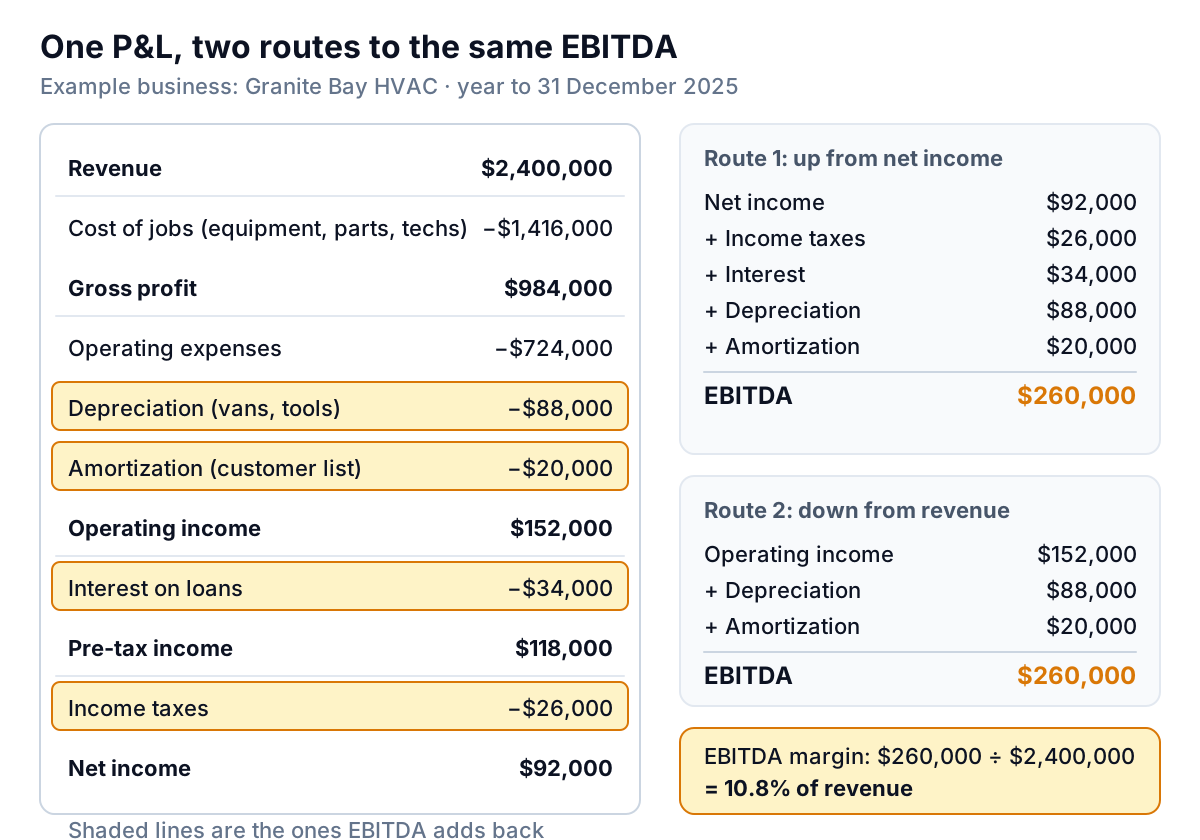
Working it bottom-up: $92,000 net income + $26,000 tax + $34,000 interest + $88,000 depreciation + $20,000 amortization = $260,000. Top-down: $152,000 operating income + $88,000 + $20,000 = $260,000.
The owner's net income was $92,000. His EBITDA is almost three times that. Neither number is wrong. They answer different questions. Net income says what the owners earned after every cost. EBITDA says what the operations produce before financing, tax and the wear on assets bought in earlier years.
Divide EBITDA by revenue and you get the EBITDA margin: $260,000 ÷ $2,400,000 = 10.8%. The margin is what you compare year to year, and it gets its own guide.
When the two routes disagree
On real books the two routes often differ, and the gap is a clue. The usual culprit is anything in "other income" or "other expenses" below operating income: a gain on selling an old van, an insurance payout, a one-off write-off. Bottom-up EBITDA includes those; top-down leaves them out. For public companies, the SEC's staff guidance says "earnings" in EBITDA means net income, and anything calculated differently should be called something else, such as adjusted EBITDA. You aren't bound by that, but it's a good habit: start from net income, then list every extra adjustment separately so the reader can see it.
Why lenders and buyers ask for it
You may never look at EBITDA yourself. Two kinds of people will.
Lenders: can the business carry the loan?
For SBA loans, EBITDA is written into the rules. The SBA's lending procedures, SOP 50 10, define operating cash flow as EBITDA and require a debt service coverage ratio (operating cash flow divided by the business's yearly loan payments, principal plus interest) of at least 1.15. Under the version that took effect on 1 October 2026, SOP 50 10 8.1, loans to buy a business or buy out an owner need 1.25. Lenders can adjust the figure, and banks outside the SBA program set their own tests, so ask your lender how they calculate it.
Granite Bay pays $34,000 of interest and $62,000 of principal a year, so its coverage is $260,000 ÷ $96,000 = 2.7. If the owner wanted to finance a second location and the new loan added $70,000 of yearly payments, coverage would fall to $260,000 ÷ $166,000 = 1.57. That clears the 1.15 floor, but a weaker year would eat into the margin fast.
Buyers: what are the earnings worth?
Larger businesses are usually priced as a multiple of EBITDA, because a buyer brings their own financing and tax position and wants to see the operations on their own. Smaller, owner-run businesses are more often priced on seller's discretionary earnings (SDE): EBITDA plus one owner's pay and any personal or one-off costs run through the business. A CPA writing for business brokers puts the dividing line roughly at $2.5 million of revenue: below it SDE dominates, above $10 million EBITDA does, and in between buyers use both.
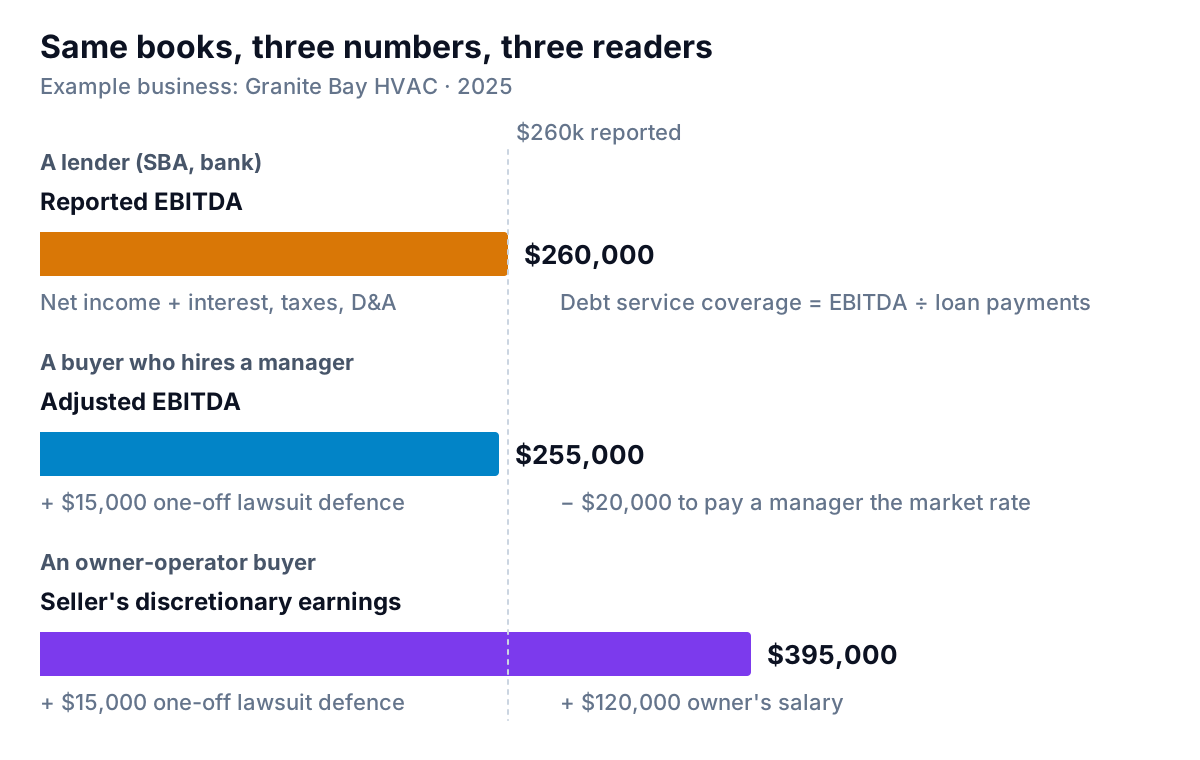
Granite Bay sits right at that line, so its owner should expect to see both. An owner-operator buying the business would look at SDE: $260,000 + the owner's $120,000 salary + a $15,000 lawsuit defence that won't recur = $395,000. A buyer who would install a general manager would look at adjusted EBITDA: $260,000 + $15,000, minus $20,000 because a manager would cost $140,000, not the $120,000 the owner pays himself, giving $255,000.
For a sense of scale, BizBuySell's figures for businesses sold in the second quarter of 2026 put the median sale at $349,250, on median cash flow of $155,921, with an average multiple of 2.7 times cash flow. Your business, industry and the buyer's view of risk decide your own multiple, so treat those as context, not a price tag, and get a proper valuation before you negotiate.
What EBITDA is not
EBITDA is often described as a stand-in for cash flow. For a business that owns vans, tools and equipment, it can be a long way off.
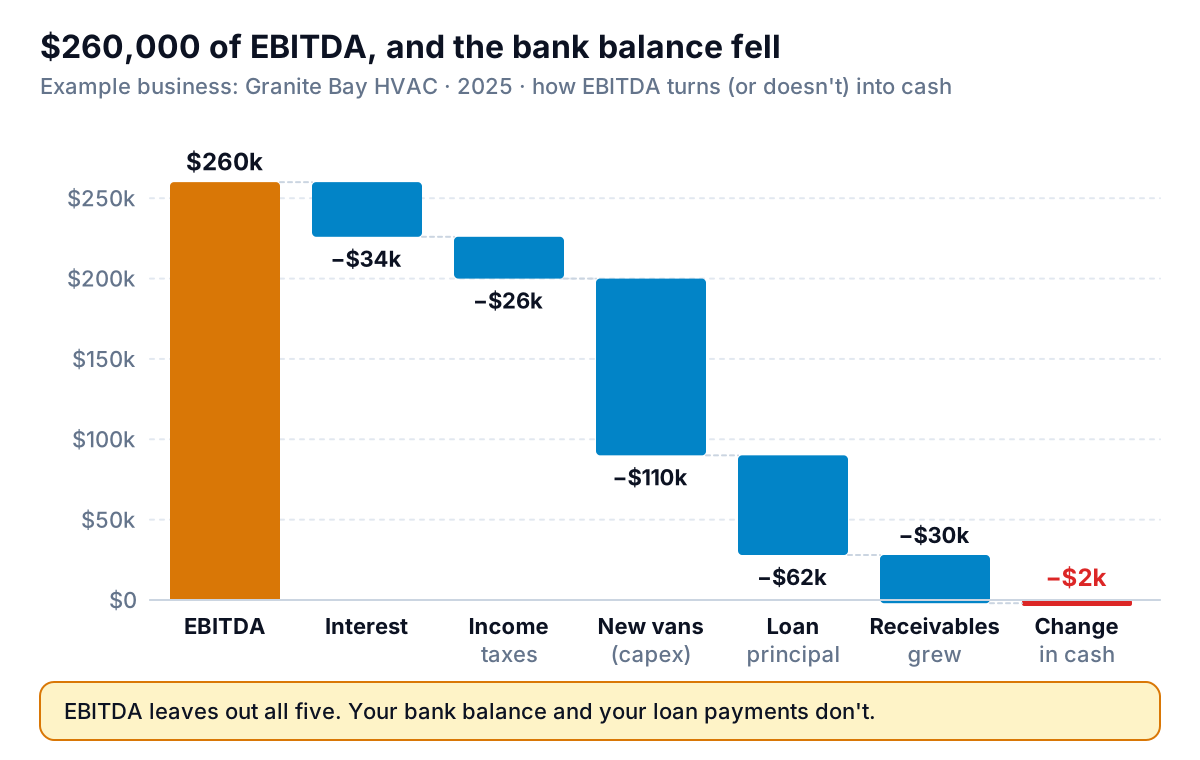
In 2025 Granite Bay replaced two vans for $110,000, paid $62,000 of loan principal, and let customers take longer to pay, so $30,000 more sat in receivables at year end. Add interest and tax, and the $260,000 of EBITDA turned into a $2,000 fall in cash. Nothing went wrong. It's what a year looks like when you reinvest in equipment.
Warren Buffett made the point most memorably in Berkshire Hathaway's 2000 shareholder letter: "does management think the tooth fairy pays for capital expenditures?" Depreciation is the accounting echo of money you already spent, or will have to spend again. For an HVAC contractor, a landscaper or a restaurant, equipment wears out on a schedule. Ignore it and EBITDA tells you the business is richer than it is.
So keep three things in view alongside EBITDA:
- Capital spending. Compare yearly depreciation with what you actually spend on equipment. If you spend far more, EBITDA is overstating what's available.
- Working capital. Growing businesses tie up cash in receivables and stock. EBITDA can rise while cash falls. A cash flow forecast catches this; EBITDA won't.
- Debt. EBITDA ignores the loan entirely. The payments still come out every month.
Getting EBITDA out of QuickBooks, Xero or a spreadsheet
No accounting package has an "EBITDA" button on its standard reports, but the inputs are all on your profit and loss statement.
- Run the P&L for a full year. In QuickBooks Online it's under Reports; the Profit and Loss Comparison report puts this year next to last year, which is what a lender will look at. Xero has an equivalent Profit and Loss report in its reports library. Use accrual basis if you have the choice, because cash basis can shift revenue and costs between years.
- Find the four lines. Interest is usually under "Other expenses". Depreciation and amortization may be one combined account or sit inside operating expenses. Income tax often doesn't appear at all if your business is a pass-through entity; that's normal, and the "T" is simply zero.
- Check that depreciation has been booked. Many accountants post depreciation once, at year end. If you calculate EBITDA from a mid-year P&L, it may already equal operating income because there's no depreciation in it yet. That's fine for EBITDA, but it means your monthly operating income looks better than the year-end number will.
- Add back, and write down what you added. In a spreadsheet, put net income in one cell and each add-back on its own row with a label, then sum. One row per adjustment is what makes the number credible to someone else.
For more on which QuickBooks report holds which number, see our guide to QuickBooks reports.
Mistakes that change the number
- Adding back things that recur. A "one-off" legal bill is one-off once. If it appears three years running, it's a cost of doing business. Buyers will check the prior years.
- Counting other income. A gain on selling equipment, a grant or an insurance payout lifts net income, and therefore bottom-up EBITDA, without saying anything about how the business runs. Pull it out and show it separately.
- Treating leases inconsistently. Under US accounting rules a finance lease is expensed as amortization and interest, both of which EBITDA adds back, while an operating lease shows up as a single rent-like cost that stays in. The same van can lift EBITDA on one kind of lease and not the other. Ask your accountant how your leases are booked before you compare years or businesses.
- Comparing a month to a year. Seasonal businesses swing hard. An HVAC contractor's summer months can look nothing like its spring. Compare trailing twelve months to trailing twelve months.
- Using EBITDA to decide what you can afford. Spending decisions come from cash, after loan payments and equipment replacement. Use EBITDA for comparing performance and for lender and buyer conversations, not for deciding whether you can hire.
When your EBITDA moves
EBITDA changes for only three reasons: revenue changed, the cost of delivering it changed, or overheads changed. Work through them in that order.
- Revenue. Was it volume (fewer jobs), price (smaller average ticket) or mix (more low-margin installs, fewer service contracts)? A financial dashboard that splits revenue by type answers this in a glance.
- Gross margin. If revenue held but gross profit fell, look at parts prices, technician overtime and jobs that ran over their quote.
- Overheads. Line by line against last year. A new hire, a bigger office or a marketing push shows up here, and it's often deliberate. Write down the reason next to the number, because a buyer will ask.
Once you know which of the three moved, the fix is usually obvious. Raise prices on the work that's underpriced, tighten quoting, or give the new overhead a date by which it has to pay for itself.
If you'd rather not rebuild this in a spreadsheet every quarter, Parity connects to QuickBooks Online directly, or takes an Excel or CSV export of your P&L from Xero or any other tool, and builds a dashboard with the headline numbers and their trends, charts, what explains the changes and a table of what needs attention. Ask for EBITDA with your add-backs listed, refine it by chat, and export it to PDF or Excel for your lender. Every number is checked against queries on the full dataset before you see it. If you need the write-up as well, ask it to write the report for your banker from the same data.
Connect QuickBooks Online or upload a P&L export, and get a checked dashboard of your earnings, margins and what moved them. Build a report from your data free
EBITDA is a lens, not a verdict. Use it to compare your business with itself over time and to speak the same language as lenders and buyers. Then check it against the bank balance, because that's the number that pays the bills.