The broker's marketing pack for Talon Pest Control, an example business we'll follow in this guide, put adjusted EBITDA at $694,000. Six weeks after the letter of intent, the buyer's accountants came back with $583,000. Both figures started from the same $434,000 of reported EBITDA. Adjusted EBITDA is that reported figure after "add-backs": costs (and occasionally income) that a new owner would not have, put back so the number shows what the business earns on its own.
The fight is always about which add-backs count. At Talon the seller listed $260,000 of them and the buyer accepted $149,000 net, after adding a deduction the seller never listed. This guide goes through that schedule line by line: the add-backs buyers and lenders usually accept, the ones they challenge, the adjustments that cut the number, and how to build a schedule that holds up. If you need the basic calculation first, start with what EBITDA is and how to work it out from your P&L.
Where the $111,000 went
Talon is a made-up residential and commercial pest control company: $3.4 million of revenue in 2025, 22 technicians, a fleet of service trucks, and an owner who has run it for fifteen years. Its 2025 profit and loss statement shows $286,000 of net income. Add back $38,000 of interest, $96,000 of depreciation on trucks and equipment and $14,000 of amortization on a customer list it bought from a retiring competitor, and reported EBITDA is $434,000. As an S corporation, Talon pays no federal income tax itself, so there's nothing to add back for tax.
Here is the add-back schedule as the seller's broker presented it, next to what the buyer's quality of earnings team accepted.
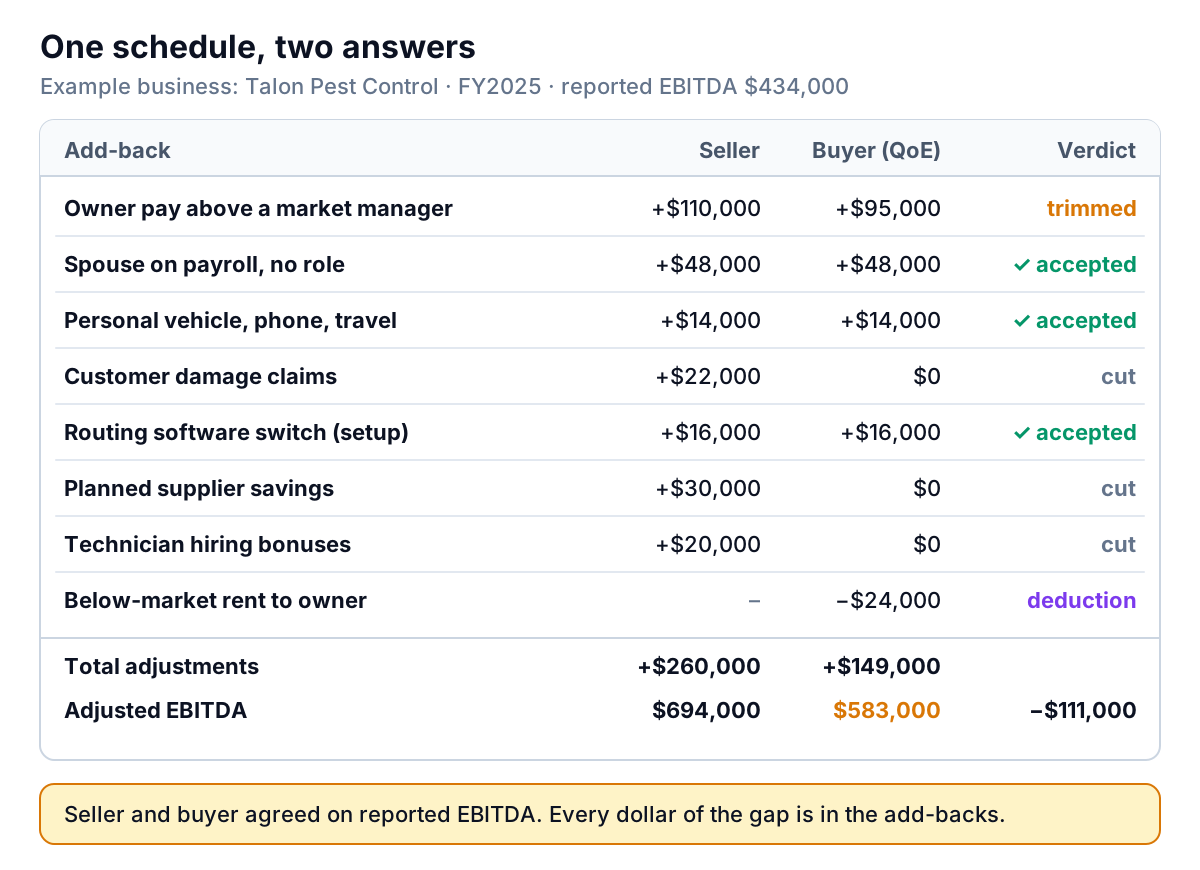
The $111,000 difference matters because businesses this size usually sell for a multiple of the adjusted figure. In the International Business Brokers Association's Market Pulse survey for the second quarter of 2026, advisors reported deals of $2 million to $5 million selling at 4.0 times EBITDA. At that multiple, every dollar of add-back that survives is worth about four dollars of price, and Talon's gap is worth about $444,000. Your own multiple depends on your industry, your customers and the buyer, so treat that as an illustration of the stakes, not a valuation.
Adjusted EBITDA add-backs that usually survive
An add-back survives when the buyer can see the cost in the books, agrees a new owner wouldn't pay it, and has the paperwork to prove both. Four of Talon's lines passed that test in full and one passed in part.
Owner pay above what a manager would cost
Talon's owner paid herself $260,000. A buyer who installs a general manager won't pay that, so the excess is an add-back. The question is what a manager costs. The broker used a $150,000 salary and claimed $110,000. The buyer's team priced the role at $165,000 once payroll taxes, health cover and a retirement match were included, and accepted $95,000. The International Business Brokers Association's glossary describes adjusted EBITDA the same way: owner or officer pay is adjusted to a market rate, not removed entirely. Removing all of it would give you seller's discretionary earnings instead, a different measure for a different buyer, which we cover in SDE vs EBITDA.
Price the role yourself before a buyer does. Use the total cost (salary, payroll taxes, benefits), and use the job a manager would actually do, which at Talon includes the commercial sales the owner handles herself.
Family on the payroll who don't work in the business
The owner's spouse drew $48,000 a year and had no role. That's a clean add-back, provided payroll records show the payments and nobody else would need to be hired to do whatever the spouse "did". If a family member does real work, only the amount above a market wage for that work comes back, and if they're underpaid, the adjustment goes the other way.
Personal costs run through the business
A personal vehicle, a family phone plan and some travel came to $14,000. Buyers accept these when each one is listed with its account and receipts. A single line marked "personal, est." is where doubt starts. Note that tax treatment is a separate question: if a cost was deducted on the business return, ask your accountant whether listing it as personal raises an issue before you hand the schedule to anyone.
Truly one-off projects
Talon switched to new routing and scheduling software in 2025 and paid $16,000 for implementation and data migration. That won't happen again next year, so it was accepted. The software's $9,000 annual subscription stayed in as a running cost. Split one-off projects that way, the setup cost out and the ongoing cost in, and they rarely get challenged.
Add-backs a buyer or lender will challenge
Three of Talon's add-backs, worth $72,000 together, were cut entirely. Each one fails in a way you'll see on many schedules.
- "One-time" costs that happen every year. The broker added back $22,000 of customer damage claims as unusual. The buyer pulled the general ledger for the previous two years and found $18,000 in 2023 and $15,000 in 2024. A pest control company that treats homes will have claims. Three years running makes it a cost of doing business, however unwelcome.
- Savings that haven't happened yet. The seller had negotiated a cheaper chemical supplier and added back the $30,000 it should save next year. Buyers rarely pay for savings that aren't yet in the numbers. If a saving is real and signed, show it as a separate note with the contract, and expect it to be discussed rather than counted.
- Normal costs of a growing business. Talon paid $20,000 of sign-on bonuses to hire technicians. In a business with ordinary turnover, recruiting is a recurring cost. The broker called it growth investment. The buyer called it the cost of keeping 22 trucks staffed.
Lenders apply their own version of the same skepticism. A bank loan's covenants usually define the EBITDA they'll test, including which add-backs are allowed and sometimes a cap on them. That definition is in your loan agreement, and it may be stricter than anything a buyer would use. Read it before you assume an add-back helps your covenant.
Adjustments that cut the number
Add-backs can go both ways, and a careful buyer will look for the downward ones too. Talon's owner owns the building through a separate company and charges the business $36,000 a year in rent. Comparable space nearby leases for about $60,000. The buyer will either pay market rent to the owner after the sale or rent elsewhere, so the quality of earnings team deducted $24,000.
Other common deductions:
- An owner who pays themselves too little. If you take $60,000 and the manager who replaces you would cost $140,000, the gap comes off.
- Unpaid family help. A parent who does the books for free is a cost the next owner will pay.
- Costs missing from the books. Year-end bonuses never accrued, a warranty liability nobody recorded, or vehicle maintenance put off to make the year look better. Deferred maintenance shows up as a cost a buyer will face soon after closing, and they'll price it.
- Income that won't continue. A one-off commercial fumigation job, an insurance payout or a pandemic-era grant inflates earnings. Take it out yourself before someone else finds it.
Listing your own deductions builds credibility. A schedule that only ever goes up reads as a sales document. One that shows the rent adjustment the seller could have hidden reads as a set of numbers you can trust.
What a quality of earnings review checks
A quality of earnings (QoE) review is the buyer's check that the adjusted EBITDA is real. It's usually done by an accounting firm after a letter of intent is signed, and unlike an audit it isn't about whether the books follow accounting standards. It asks whether the earnings will repeat. CLA, a US accounting firm, notes that unsupported add-backs are a leading cause of deals being repriced or falling apart, and suggests sellers commission their own sell-side review 12 to 24 months before a sale, so the add-backs are documented before buyers arrive.
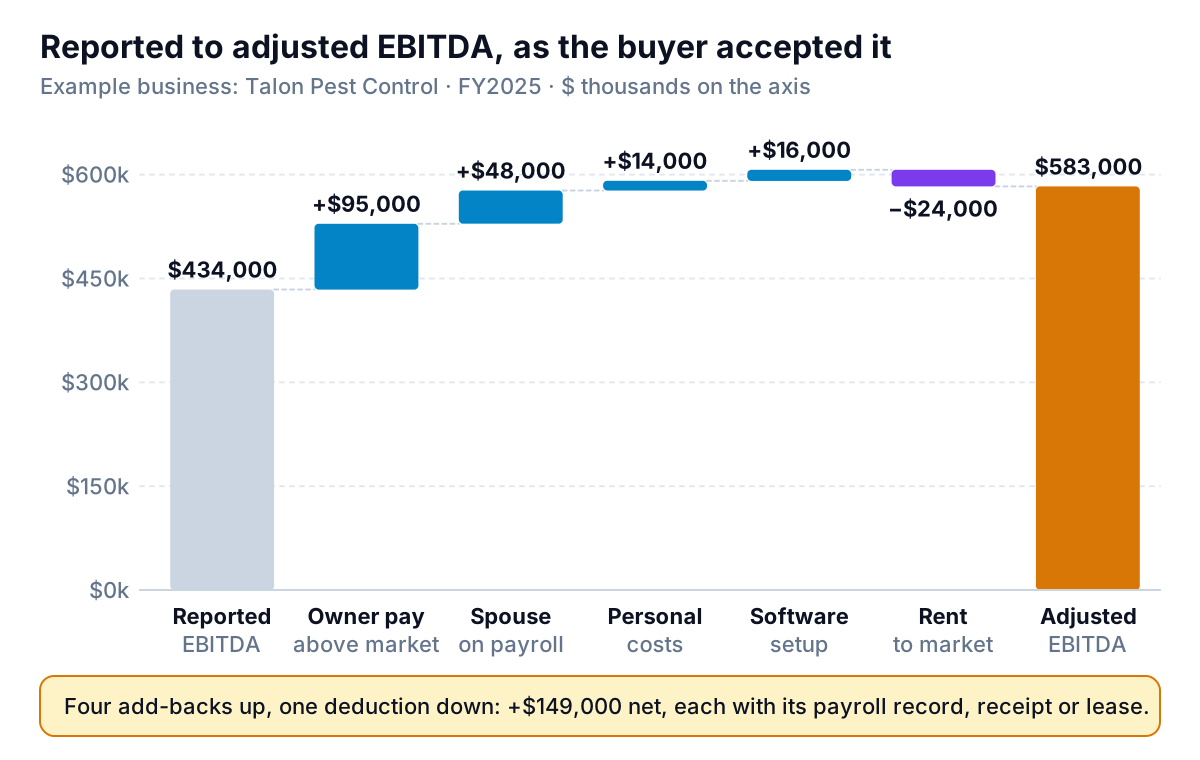
For Talon, the review did four things beyond reading the schedule:
- Tied revenue to the bank. Monthly deposits were matched to recorded revenue, so the buyer knew the $3.4 million was real cash and not invoices that would never be paid.
- Looked back two more years. That's how the damage claims were found. Any "one-off" that appears in earlier years will be found the same way.
- Checked the cut-off. Prepaid annual service plans are common in pest control. If a customer pays $480 in December for twelve months of visits, the revenue belongs to next year. Booking it all on receipt flatters the year being sold.
- Tested the trailing twelve months. Buyers price on the latest twelve months, not the last calendar year, so the review rebuilt adjusted EBITDA month by month to see whether the trend was rising or slipping.
The review also looks at working capital, because the purchase price usually assumes a normal level of receivables and payables is left in the business. That's a separate negotiation, but it uses the same monthly balance sheets, so have them ready.
The rules public companies follow, and why to borrow them
Listed companies can publish adjusted EBITDA, but the Securities and Exchange Commission's staff set limits in their guidance on non-GAAP financial measures. Among the points, as currently written:
- EBITDA should be reconciled to net income, not operating income.
- Leaving out normal, recurring cash operating expenses can make a measure misleading, and the staff count an expense as recurring even if it happens at irregular intervals.
- The GAAP figure must be shown with equal or greater prominence than the adjusted one.
A private business selling to a private buyer isn't bound by those rules, and this isn't legal advice. If you're preparing numbers for investors or a sale, talk to your accountant or attorney about what applies to you. But the three habits are worth copying anyway, because they're exactly what a buyer's accountants will check: start from net income, never add back a cost that recurs, and show the reported number first, every time.
Building an add-back schedule you can defend
You can start years before a sale, and the earlier you start, the less arguing there is at the end. Here's how to set it up from QuickBooks, Xero or a spreadsheet.
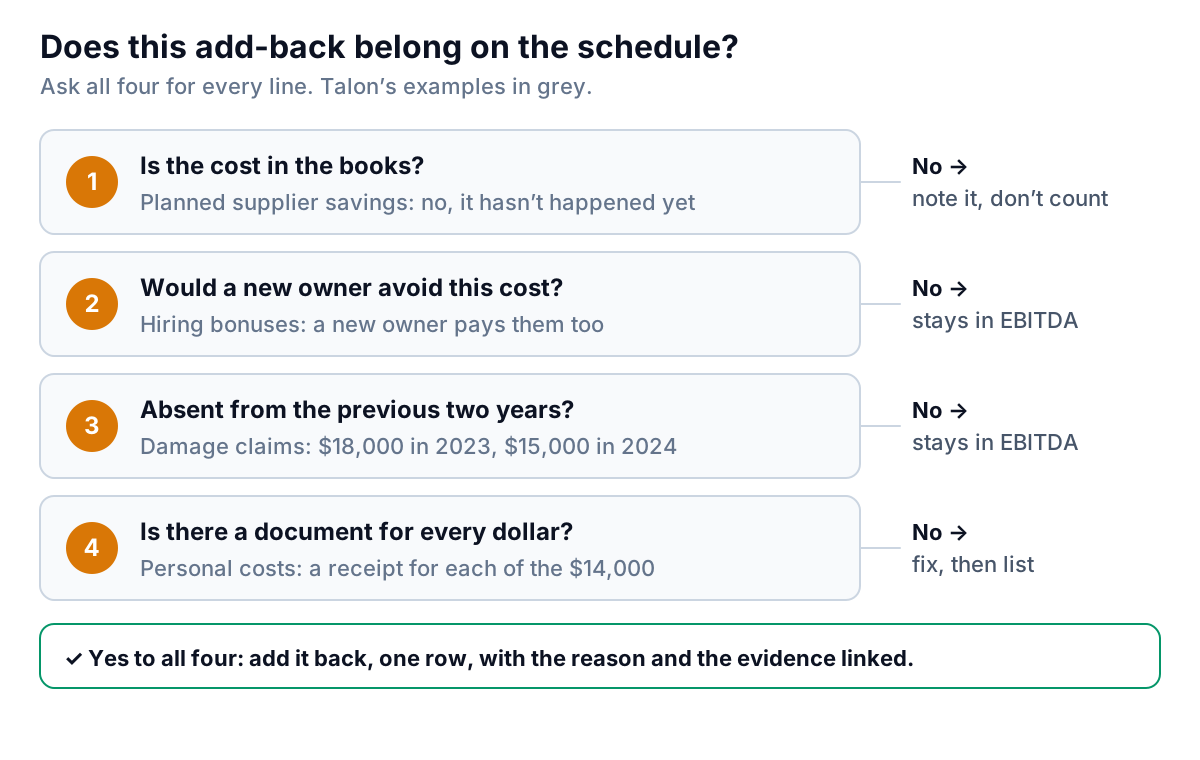
- Start from net income for a full year. Run the profit and loss statement for the last two full years and the trailing twelve months. Add back interest, tax, depreciation and amortization to get reported EBITDA, as in our profit and loss statement guide.
- Isolate the candidates as they happen. Put personal and one-off costs in their own accounts, or tag them with a class or tracking category, so you can total them with one report instead of hunting through the ledger later. In QuickBooks Online, a class or a dedicated sub-account works; in Xero, a tracking category does.
- One row per add-back. Amount, account, year, a one-line reason and a link to the evidence: payroll records, invoices, a contract, a board minute.
- Check three years for each "one-off". Filter the general ledger by vendor or account for the two prior years. If it's there, take it off the list.
- Add your own deductions. Below-market rent, unpaid family help, an underpaid owner, income that won't recur.
- Show both totals. Reported EBITDA on top, adjustments listed, adjusted EBITDA at the bottom. Then do the same for each month of the trailing twelve, so a trend is visible.
Keep the schedule current every quarter rather than rebuilding it once a buyer appears. A schedule built over three years, with evidence filed as costs happened, is much harder to argue with than one assembled in a hurry. It also shows you whether your EBITDA margin is improving on the adjusted basis, which is the trend a buyer will pay for.
If you'd rather not maintain it by hand, Parity connects to QuickBooks Online directly, or takes an Excel or CSV export of your P&L or general ledger from Xero or any other tool, and builds a dashboard with the headline numbers and their trends, charts, what explains them and a table of what needs attention. Ask by chat for reported and adjusted EBITDA with each add-back on its own row, by month. Every number is checked against queries on the full dataset before you see it, and you can share a read-only link with your accountant or export the schedule to Excel.
Connect QuickBooks Online or upload a P&L export, and get a checked view of reported and adjusted EBITDA, month by month. Build a report from your data free
Talon's owner could have closed the $111,000 gap herself. The damage claims would never have reached the broker's pack if she had checked the prior years, the supplier savings belonged in a note rather than the total, and the hiring bonuses were plainly a running cost, and the rent deduction would have looked like candour instead of a discovery. Every adjustment you make before the buyer arrives is one they don't get to make for you.