Two people asked for the numbers on Merrow Dry Cleaners, an example business we'll use throughout this guide, in the same month. One was a former plant manager who wanted to run the shop herself, and she worked from $308,000 a year. The other was a regional laundry group with its own managers, and it worked from $210,000. They had the same tax returns and the same profit and loss statement. The difference between them is the whole of SDE vs EBITDA: seller's discretionary earnings (SDE) counts everything one working owner takes out of the business, salary and perks included, while EBITDA (here, adjusted EBITDA) assumes the owner is replaced by a paid manager.
Neither buyer was wrong. Each picked the number that matches how they'd own the business. This guide shows how both are built from one set of books, what goes into "owner's pay and perks", which buyers use which number at which size, and the mistakes that make sellers overestimate what their business is worth. For the basic EBITDA calculation, see what EBITDA is.
SDE vs EBITDA on one set of books
Merrow is a made-up dry cleaner with one cleaning plant and two drop-off stores, $1.15 million of revenue in 2025 and eleven staff. The owner runs the plant and the books, about fifty hours a week. It's an S corporation, so the business itself pays no federal income tax.
Start from the bottom of the P&L and climb:
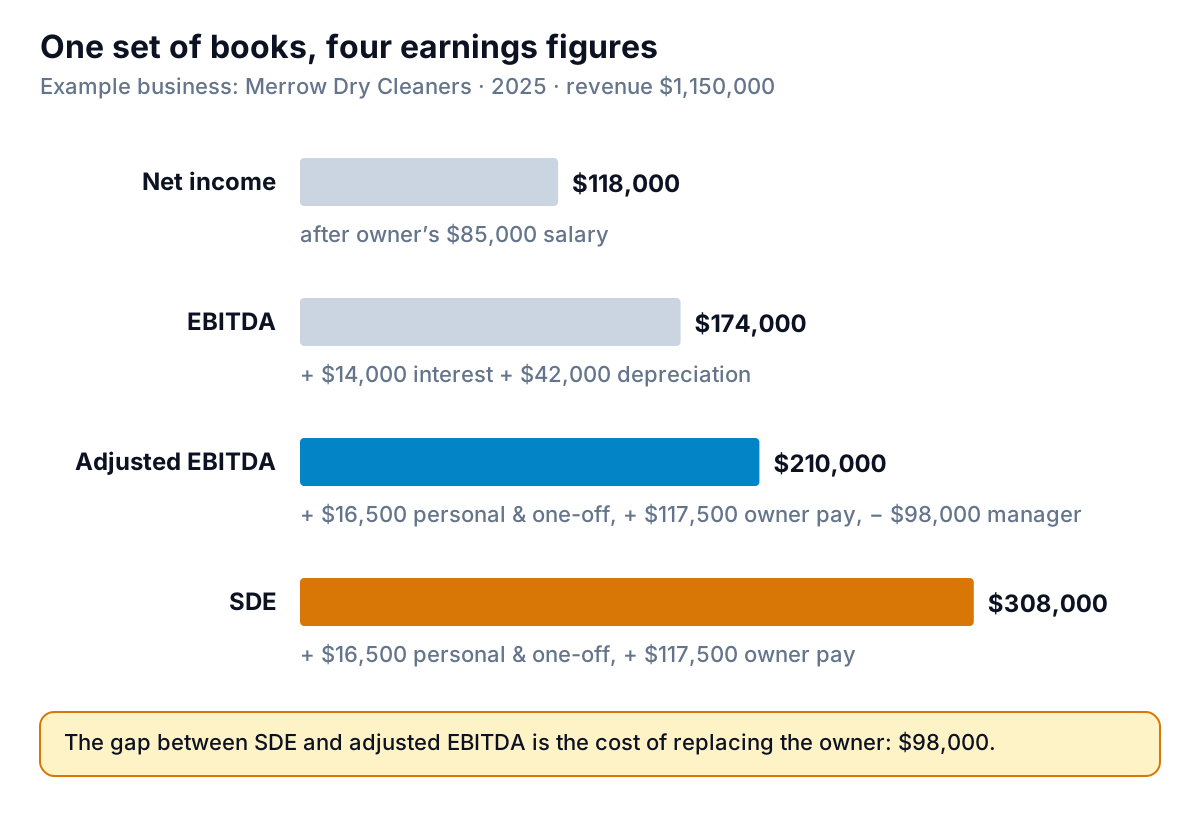
- Net income: $118,000. The bottom line, after the owner's salary.
- EBITDA: $174,000. Add back $14,000 of interest on the equipment loan and $42,000 of depreciation on the cleaning machines, boiler and van. There's no income tax to add back.
- Normalising adjustments: +$16,500. The owner's car and family phone plan ($11,500) and a $5,000 legal bill from a one-off lease dispute. Both buyers accept these, because neither would pay them.
- The owner's pay. The owner takes an $85,000 salary. The business also pays $6,500 of employer payroll tax on it, $18,000 for the family's health insurance and $8,000 into a retirement plan: $117,500 in all.
Here the paths split.
- SDE adds back the whole $117,500: $174,000 + $16,500 + $117,500 = $308,000. That's the pre-tax cash one full-time owner-operator gets from the business, before paying themselves anything.
- Adjusted EBITDA adds back the owner's pay and then subtracts what a plant manager would cost to do the same job, about $98,000 with payroll tax and benefits in this example: $174,000 + $16,500 + $117,500 − $98,000 = $210,000. That's what the business earns for an owner who doesn't work in it.
The International Business Brokers Association's glossary draws the same line. Its definition of discretionary earnings removes "one owner's entire compensation, including benefits and any non-business or personal expenses paid by the business", while its adjusted EBITDA puts owner or officer pay at a market rate instead. The gap between SDE and adjusted EBITDA is always the cost of replacing the owner. At Merrow it's $98,000.
What counts as owner's pay and perks
Most arguments about SDE are about this one line. Here's what usually goes in, what doesn't, and what a buyer will ask to see.
| Item | In SDE? | What a buyer will check |
|---|---|---|
| One owner's salary or wages | Yes, all of it | Payroll reports, W-2 |
| Employer payroll tax on that salary | Yes | Payroll tax filings |
| Owner's health insurance and retirement contributions | Yes | Policy and plan statements |
| Owner's car, phone, personal travel run through the business | Yes, if personal | Receipts, mileage logs, the account they're booked to |
| A second owner or spouse who works in the business | Only pay above a market wage for their job | Hours worked, what the job would cost to fill |
| Owner's draws or S corporation distributions | No, they were never an expense | That they don't appear on the P&L |
| Rent paid to the owner's own property company | Adjusted to market rent, up or down | The lease and local comparable rents |
Two rules catch most sellers out. First, only one owner's pay comes back. If Merrow's owner and her husband both worked full time, his pay would stay in as a cost, because a buyer would have to hire someone to do his job. Second, draws and distributions are not add-backs. They never reduced profit, so they're already in net income. Adding them back counts the same money twice.
That second point matters for S corporations, where owners often take a modest salary and the rest as distributions. The IRS expects a shareholder who works in the business to be paid reasonable compensation as wages before taking distributions, so your salary is partly a tax decision. That's a question for your accountant, but know that it changes your adjusted EBITDA and not your SDE: a lower salary lifts EBITDA, while SDE adds the salary back either way.
Which buyers use which number
The choice follows from who will run the business after the sale.
- Owner-operators, usually individuals buying one business to run themselves, think in SDE. The owner's pay is their pay. Some finance the purchase with an SBA 7(a) loan, which the SBA says can be used for changes of ownership, up to $5 million.
- Groups and investors (a competitor buying a fourth location, a private equity-backed platform, an owner who wants to stay hands-off) think in adjusted EBITDA, because they'll be paying a manager.
Size decides which buyer is likely, so size decides the number. The IBBA's quarterly Market Pulse survey of business brokers and M&A advisors reports deals under $2 million in purchase price as a multiple of SDE and deals from $2 million to $50 million as a multiple of EBITDA. Here are the multiples from its second quarter 2026 highlights:
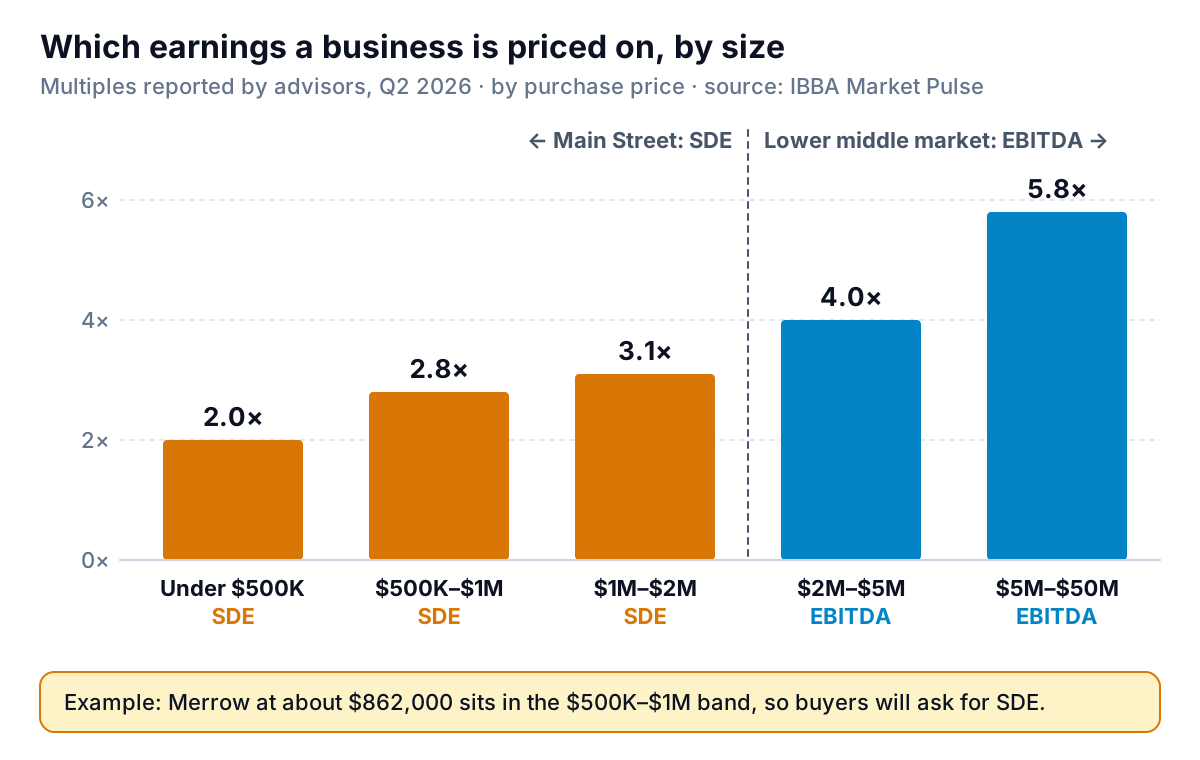
Those are survey figures from advisors, they vary a lot by industry and quarter, and the tiers are by purchase price, not revenue. Use them to see where your business sits and which number its likely buyers will ask for, not to price it.
Merrow's $308,000 of SDE at 2.8 times comes to about $862,000, inside the $500,000 to $1 million band where that multiple applies. So its most likely buyer is an owner-operator, and its owner should lead with SDE, while having adjusted EBITDA ready for the laundry group.
Why an SDE multiple looks smaller
A seller who reads "2.8 times SDE" next to "4.0 times EBITDA" may feel short-changed. They shouldn't, because the multiples are applied to different numbers. SDE is bigger, so its multiple is smaller.
Convert Merrow's price to see it: $862,000 is 2.8 times SDE of $308,000, and the same price is 4.1 times adjusted EBITDA of $210,000. One price, two ways of describing it.
The conversion also shows why owner-operators often outbid groups for small businesses. To the plant manager buying Merrow, $862,000 buys a job and a return. To the laundry group, it's 4.1 times earnings for a business below $1 million, when the survey's 4.0 multiple is for businesses at least twice that size. The group will probably offer less, and the plant manager can afford to pay more because part of what she's buying is her own salary.
What SDE has to pay for
SDE is the owner-operator's whole pot, and it isn't all profit. Before the buyer earns a return on the money they put in, SDE has to cover:
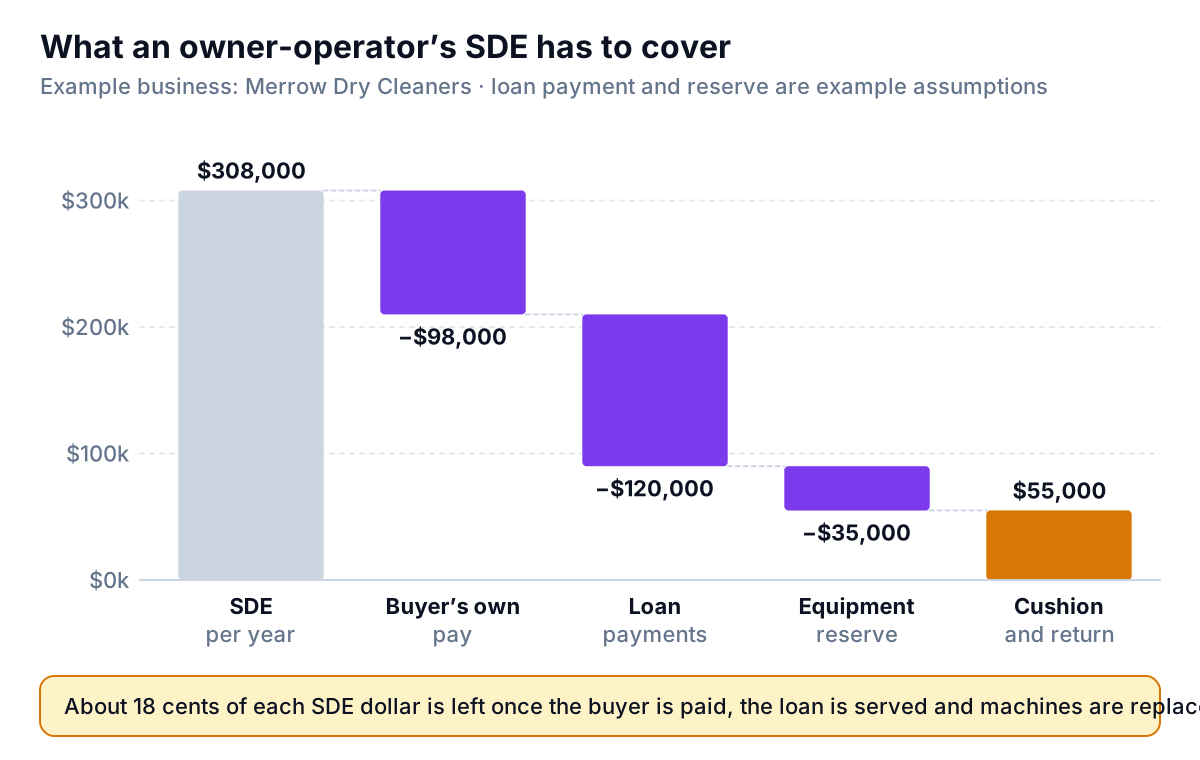
- The buyer's own living. If the new owner needs $98,000 a year, that comes first.
- Loan payments. In this example, $120,000 a year of principal and interest on the acquisition loan. Your lender's terms and their coverage test decide the real figure.
- Equipment replacement. SDE adds back depreciation, but cleaning machines, boilers and presses still wear out. Merrow's buyer sets aside $35,000 a year. Dry cleaners have a specific reason to be careful here: the EPA's December 2024 rule set a 10-year phase-out of perchloroethylene in dry cleaning, and the agency began reconsidering that rule in 2025. Check the current status and the age of each machine before you agree a price.
That leaves $55,000 a year, from $308,000 of SDE. That's the real return on the buyer's down payment, and the cushion for a bad year. A buyer who skips this step pays too much. A seller who understands it negotiates better, because they know where the buyer's ceiling is. Our cash flow forecast guide shows how to test those payments month by month.
Mistakes that inflate SDE
- Adding back two owners. Only one. A second working owner is a cost at market rate.
- Adding back draws or distributions. They were never deducted, so there's nothing to add back.
- Calling a working spouse "personal". If she runs the counter thirty hours a week, someone has to replace her.
- Personal costs without paper. A buyer will cut any line marked "est." Book personal items to their own account or class as they happen, so one report proves them. Your accountant should also look at how those costs were treated for tax before you list them.
- "One-off" costs that come back. A boiler repair every winter isn't one-off. Buyers check two or three years of ledgers. Our guide to adjusted EBITDA add-backs covers how to test each one.
- Using SDE for a business that already has a manager. If you work ten hours a week and a paid manager runs the shop, your pay isn't a job the buyer has to do. Lead with adjusted EBITDA.
Working out both from your books
You need three reports, all standard in QuickBooks Online and Xero: the profit and loss statement for the last two years and the trailing twelve months, a payroll summary showing the owner's wages, employer taxes and benefits, and a transaction list for any account that holds personal costs. Our QuickBooks reports guide shows where each lives.
- Calculate EBITDA from net income, adding back interest, tax, depreciation and amortization.
- List each normalising adjustment on its own row with the evidence.
- Add one owner's total pay to get SDE.
- Price a replacement manager honestly, including payroll tax and benefits, and subtract it to get adjusted EBITDA.
- Do it by month for the trailing twelve months, so you can see whether earnings are rising into the sale or slipping.
Parity does the monthly version for you. Connect QuickBooks Online, or upload a P&L and payroll export from any other tool, and it builds a dashboard with the headline numbers and their trends, charts, what explains them and a table of what needs attention. Ask by chat for EBITDA, adjusted EBITDA and SDE side by side by month, with each adjustment on its own row. Every number is checked against queries on the full dataset before you see it, and you can share a read-only link with your broker or accountant.
Upload your P&L and payroll exports, or connect QuickBooks Online, and get a checked dashboard of both, month by month. Build a report from your data free
Merrow's owner doesn't have to pick one number. She should know both, know that the $98,000 between them is the price of her own job, and know which buyer is reading which. The plant manager will ask about SDE and the laundry group about EBITDA, and she'll have the same books ready for each.