In March, a museum gift shop asked Pinwheel Toy Workshop, an example business we'll use throughout this guide, for 800 wooden toys at $18 each. The owner added a share of the year's fixed costs to each toy's materials and labor and got a full cost of $24.78. At $18 that looked like a loss of about $5,400, and she nearly said no. Rebuilt as a contribution margin income statement, the same books said the order would add about $3,200 to profit. That statement is the income statement rearranged by how costs behave: variable costs first, then contribution margin, then fixed costs, then operating income.
Our guide to contribution margin covers the measure itself, per product and as a ratio, and how it gives you a break-even point. This one is about the statement: how to lay it out, how to sort your costs, how to split it by channel, and the decisions it answers that a regular profit and loss statement can't.
The contribution margin income statement, line by line
Pinwheel makes wooden toys in a rented workshop and sells them three ways: its own online shop, wholesale to toy shops through a sales rep, and at craft fairs. Here's its 2025 shown in the usual layout and in the contribution format.
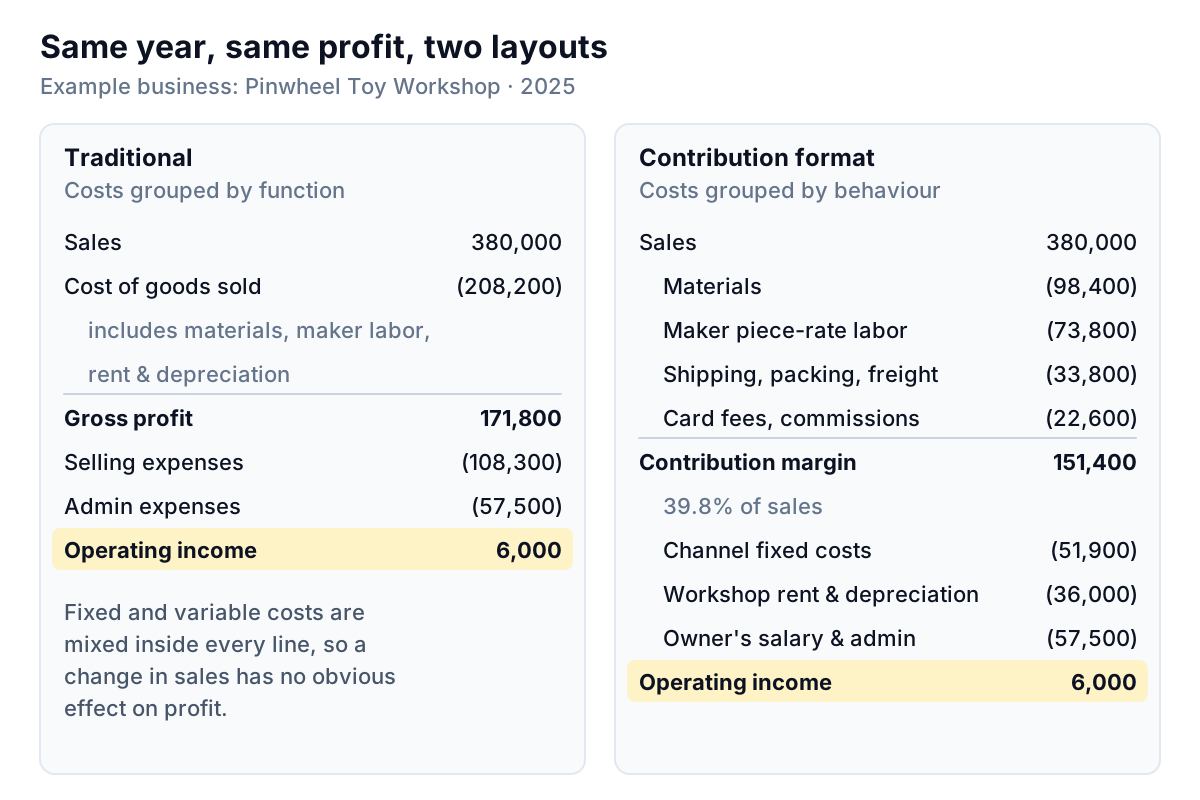
The traditional statement groups costs by what they're for: making the product (cost of goods sold), selling it, and running the business. It's the layout your accountant, your lender and the tax return use. Its weakness is that each group mixes costs that rise with every toy sold and costs that don't. Cost of goods sold includes both the wood in each toy and the workshop rent, which is the same whether Pinwheel makes 10,000 toys or 15,000.
The contribution format regroups the same costs:
- Sales: $380,000.
- Variable costs: every cost that rises with each unit sold. For Pinwheel: wood, paint and finishes ($98,400), makers paid by the piece ($73,800), packaging, shipping and wholesale freight ($33,800), card and marketplace fees and the wholesale rep's 10% commission ($22,600). Total: $228,600.
- Contribution margin: $151,400, or 39.8% of sales. This is what's left from sales to pay the fixed costs and then make a profit.
- Fixed costs: costs that stay put within a normal range of activity. Pinwheel's are $145,400: channel costs such as ads and fair booth fees ($51,900), workshop rent and equipment depreciation ($36,000), and the owner's salary, insurance and admin ($57,500).
- Operating income: $6,000, the same as the traditional statement.
The bottom line matches because the costs are the same; only the grouping changed. (There's one exception, covered below, when you build up inventory.) What the new layout adds is a single number, the 39.8% ratio, that tells you what each extra dollar of sales is worth: about 40 cents.
Sorting your costs into variable and fixed
Building a contribution margin income statement is mostly a sorting job. Go through every expense account on your P&L and ask one question: if we sold nothing extra next month, would this cost change? Here's how Pinwheel sorted the hard ones.
| Cost | Treated as | Why |
|---|---|---|
| Makers paid per finished toy | Variable | No toys, no pay. If the makers were salaried, this would be fixed. |
| Workshop rent, equipment depreciation | Fixed | The same at any volume Pinwheel can make in its space. |
| Card and marketplace fees | Variable | A percentage of each sale. |
| Wholesale rep's commission | Variable | 10% of each wholesale invoice. |
| Online ads | Fixed (channel) | Set by budget each month, not by sales. They belong to one channel, which matters below. |
| Fair booth fees and travel | Fixed (channel) | Paid per fair, whatever sells there. |
| Owner's salary | Fixed | Paid through payroll at a set amount. |
| Workshop electricity | Fixed | Mixed in theory (the saws run longer in busy months), but small. Not worth splitting. |
Three rules keep the sorting honest:
- Decide by behaviour, not by account name. "Labor" can be either. Piece-rate and hourly staff whose hours follow orders are variable; salaried staff are fixed.
- Split mixed costs only when they're big. A cost with a fixed base and a usage charge, such as a shipping platform with a monthly fee plus a per-label charge, can be split into its two parts. If it's under 1% or 2% of sales, pick the side it mostly sits on and move on.
- Check against reality. Over twelve months, a variable cost should track sales up and down; a fixed one should stay flat. If "variable" packaging stays the same in your slowest and busiest months, look again.
Adding channels: the segment margin
A contribution margin income statement gets most useful when you add a column for each product line, location or channel. Pinwheel's three channels:
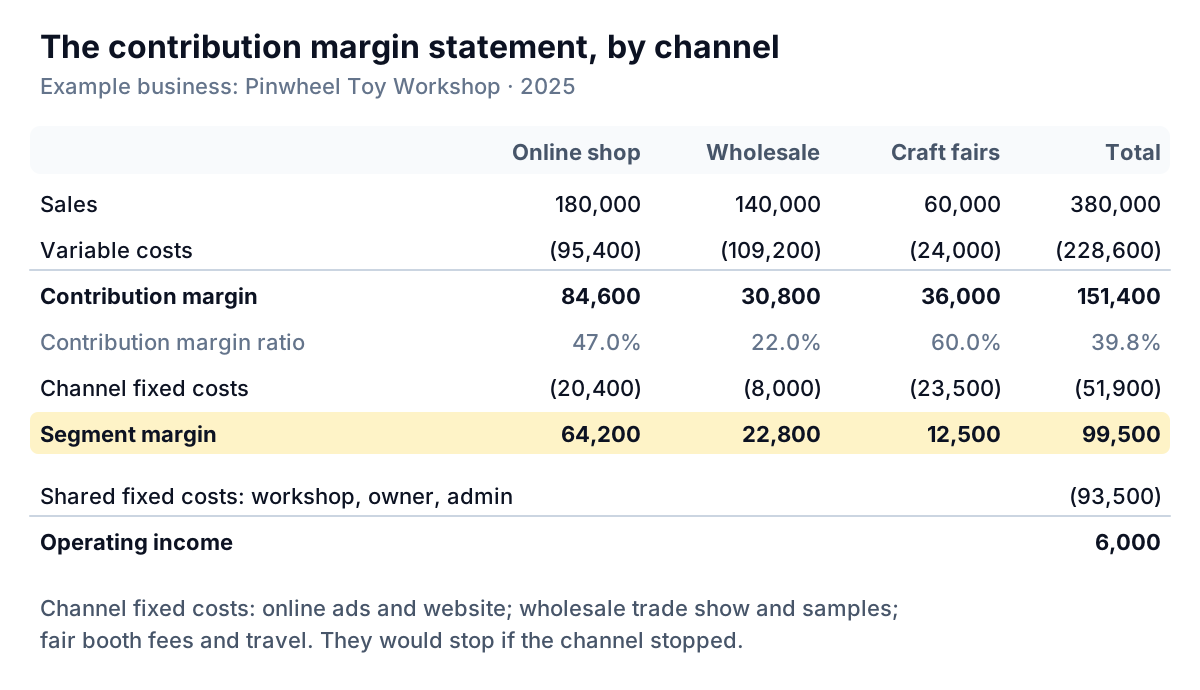
The extra line is the segment margin: contribution margin minus the fixed costs that belong only to that channel and would stop if the channel stopped. Online ads go away if the online shop closes. Booth fees go away without fairs. The workshop rent and the owner's salary don't go away if any single channel closes, so they stay in one shared line at the bottom and aren't spread across the columns.
That last point matters. If you divide the $93,500 of shared costs across channels by sales, wholesale gets $34,447 and its $22,800 segment margin turns into an $11,647 "loss". Close it on that basis and Pinwheel loses the $22,800 while keeping every dollar of the shared costs: operating income drops from $6,000 to a loss of $16,800. Allocated shared costs make channels look worse than they are. Leave them unallocated.
Four decisions it answers
1. Take the special order?
Back to the museum shop. Pinwheel's wholesale toys average $20 and carry $15.60 of variable cost, including the rep's $2.00 commission. The museum order comes direct, so there's no commission, but it needs custom tags at $0.40 a toy. Variable cost: $15.60 − $2.00 + $0.40 = $14.00. At $18, each toy contributes $4.00, and 800 toys add $3,200.
The $24.78 "full cost" came from loading $11.18 of fixed cost onto each toy ($145,400 ÷ 13,000 toys made). Those costs are paid whether the order comes or not, so they don't belong in the decision. The decision rule: take an order that covers its variable costs with something to spare, if you have spare capacity and it won't drag down the prices your regular customers pay. Pinwheel's makers are quiet from February to April and the museum isn't competing with its toy shops, so it said yes.
2. Drop the weakest fair?
Fairs as a whole earn a $12,500 segment margin, so the channel stays. One fair doesn't: $9,000 of sales, $5,400 of contribution, and $6,200 of booth fees and travel, for a segment margin of −$800. Dropping it adds $800 and gives the owner two weekends back. Run the same test one level down whenever a channel is made of separate events, stores or accounts.
3. Raise wholesale prices?
Wholesale has the thinnest ratio, 22.0%. A 5% increase, from $20 to $21 a toy, adds $1.00 per toy less $0.10 of extra commission: contribution rises from $4.40 to $5.30 per toy. Pinwheel sold 7,000 wholesale toys, so at the new price it could sell 17% fewer toys (about 5,800) and still earn the same $30,800. If the owner thinks fewer than one in six shop orders would be lost, the increase pays.
4. What if sales fall?
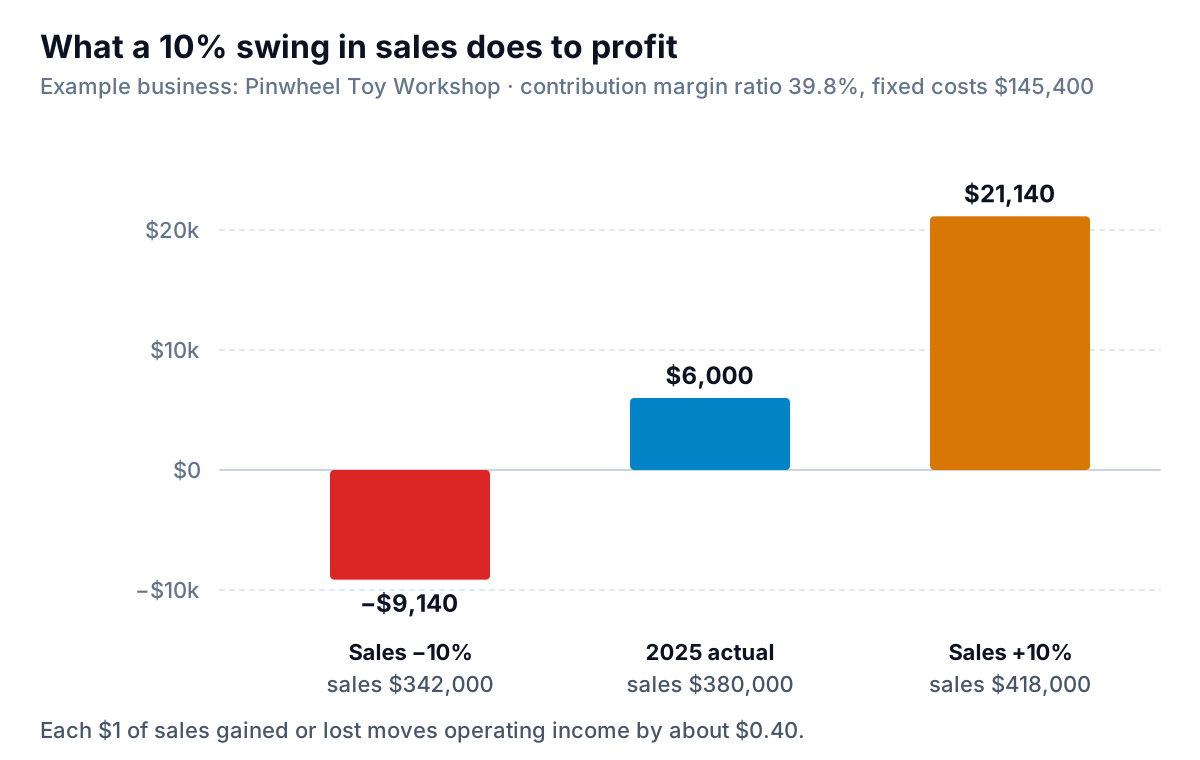
With fixed costs at $145,400 and a 39.8% ratio, a 10% drop in sales ($38,000) removes $15,140 of contribution and turns a $6,000 profit into a $9,140 loss. Contribution margin divided by operating income ($151,400 ÷ $6,000, about 25) measures how hard profit swings: each 1% change in sales moves operating income by about 25%. That's the real finding of Pinwheel's year. The business isn't losing money, but it's one soft holiday season away from it. For the break-even sales figure itself, see the contribution margin guide.
Why your accountant's statement looks different
Financial statements prepared under US GAAP use absorption costing: fixed production overhead is included in the cost of inventory, which is why your accountant's P&L uses the traditional layout. The 2004 FASB amendment to the inventory standard, summarised by IAS Plus, requires fixed production overhead to be allocated to inventory based on the normal capacity of the production facilities. The contribution margin income statement, which treats all fixed costs as costs of the period, is a management report. Use it to decide; don't send it to a lender as your financial statements unless they ask for it.
The two layouts give different profit when inventory changes. Suppose Pinwheel had made 14,000 toys and sold 13,000. On the traditional statement, part of the $36,000 of workshop rent and depreciation, about $2.57 per toy made, would sit in the 1,000 unsold toys on the balance sheet: $2,571 that wouldn't hit the P&L until they sold. Operating income would show $8,571. The contribution format expenses all $36,000 in the year and still shows $6,000. Neither is wrong. Just don't read a higher traditional profit in a year when you built stock as better trading.
Tax returns follow their own inventory rules. IRS Publication 538 covers inventories and the simpler options for small businesses that meet a gross-receipts test. Ask your accountant which apply to you; none of this changes how you build the management statement.
Building it from QuickBooks, Xero or a spreadsheet
- Export a year of the P&L by month to Excel, from whatever software you use, on the same accounting method your accountant uses.
- Add a column called "Behaviour" next to each account and mark it V (variable), F (fixed) or CF (channel fixed, with the channel name). Do this once; most accounts never change.
- Sum by behaviour with
=SUMIFS(C:C,B:B,"V")and the same for F. Contribution margin is sales minus the V total. - Split by channel if your books can. QuickBooks Online Plus tracks classes, and Intuit's list of reports by plan shows Profit and Loss by Class only in Plus. Without classes, take channel sales from Shopify, Square or your marketplace reports, and calculate variable costs from per-unit or percentage rates.
- Check the tie-out: operating income on your statement must equal operating income on the P&L. If it doesn't, an account was left unclassified.
Two mistakes are common. The first is putting cost of goods sold in as "variable" wholesale when it includes fixed items such as rent or salaried production staff. Our guide to the cost of goods sold formula shows what usually sits inside it. The second is building the statement once and never again. Variable cost ratios drift as suppliers raise prices and shipping rates change, and an 18-month-old ratio will give you the wrong answer on the next special order.
To keep it current, Parity connects to QuickBooks Online, Shopify, Square and Stripe directly, or takes an Excel or CSV export from anything else, and builds a dashboard with the headline numbers and their trends, charts, what explains them and a table of what needs attention. Every number is checked against queries on the full dataset before you see it. Ask for contribution margin by channel with your variable and fixed accounts marked, and refine it by chat. Then save it as a template and update it with next month's file.
Upload your P&L export or connect your store and get a checked dashboard of contribution and segment margin by channel. Build a report from your data free
If you want to see each cost as a share of sales instead of grouped by behaviour, the common size income statement does that with the layout you already have. Pinwheel uses both: the common size view to spot a cost creeping up, the contribution view to decide what to do about it.