Foxglove Pet Grooming's net income fell 40% last year, from $94,800 to $56,880. Its EBITDA rose 9%, from $171,000 to $186,000. Same business, same year, same accountant. The two numbers moved in opposite directions because they answer different questions: EBITDA vs net income is the difference between what the day-to-day operations earned and what was left after paying for the equipment, the loans and the tax.
Foxglove, an example business we'll follow in this guide, bought two mobile grooming vans in early 2025. That one decision is enough to pull the two numbers apart, and it makes Foxglove a good case for seeing how to walk from net income to EBITDA, where operating income fits between them, and which one to use for which decision. If you need the definition and formula from scratch, start with what EBITDA is.
Two numbers, opposite directions
Foxglove is a made-up grooming salon with a shop, six groomers and, from 2025, two vans that groom dogs in their owners' driveways. Revenue grew from $820,000 to $965,000. Here are the two headline numbers side by side.
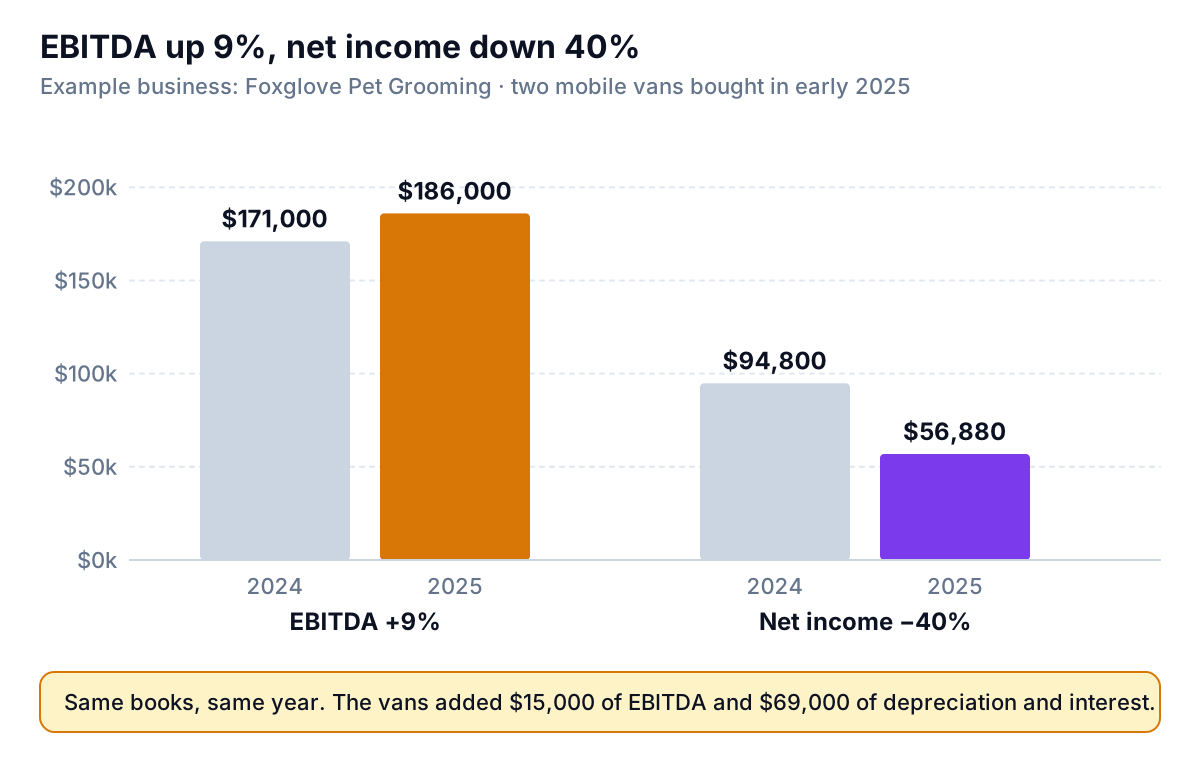
If the owner looked only at EBITDA, 2025 was a good year: the operations threw off more money than ever. If she looked only at net income, it was a bad one. Both views are partial. The useful thing is the gap between them, because it shows exactly what the vans cost to own.
The walk from net income to EBITDA
The walk adds back, one line at a time, what EBITDA leaves out. Foxglove is a C corporation, so unlike many small businesses it pays income tax itself, at the 21% federal rate the IRS sets out in Publication 542. (State tax is left out here for simplicity.) If your business is an S corporation or an LLC taxed as a partnership, the IRS treats it as a pass-through, the owners pay the income tax personally, and the tax line on your P&L will usually be zero.
| Example: Foxglove Pet Grooming | 2024 | 2025 |
|---|---|---|
| Net income | $94,800 | $56,880 |
| + Income tax (21%) | $25,200 | $15,120 |
| + Interest on loans | $10,000 | $28,000 |
| + Depreciation | $41,000 | $92,000 |
| + Amortization | $0 | $0 |
| EBITDA, starting from net income | $171,000 | $192,000 |
| − Gain on selling the old van | $0 | $6,000 |
| EBITDA from operations | $171,000 | $186,000 |
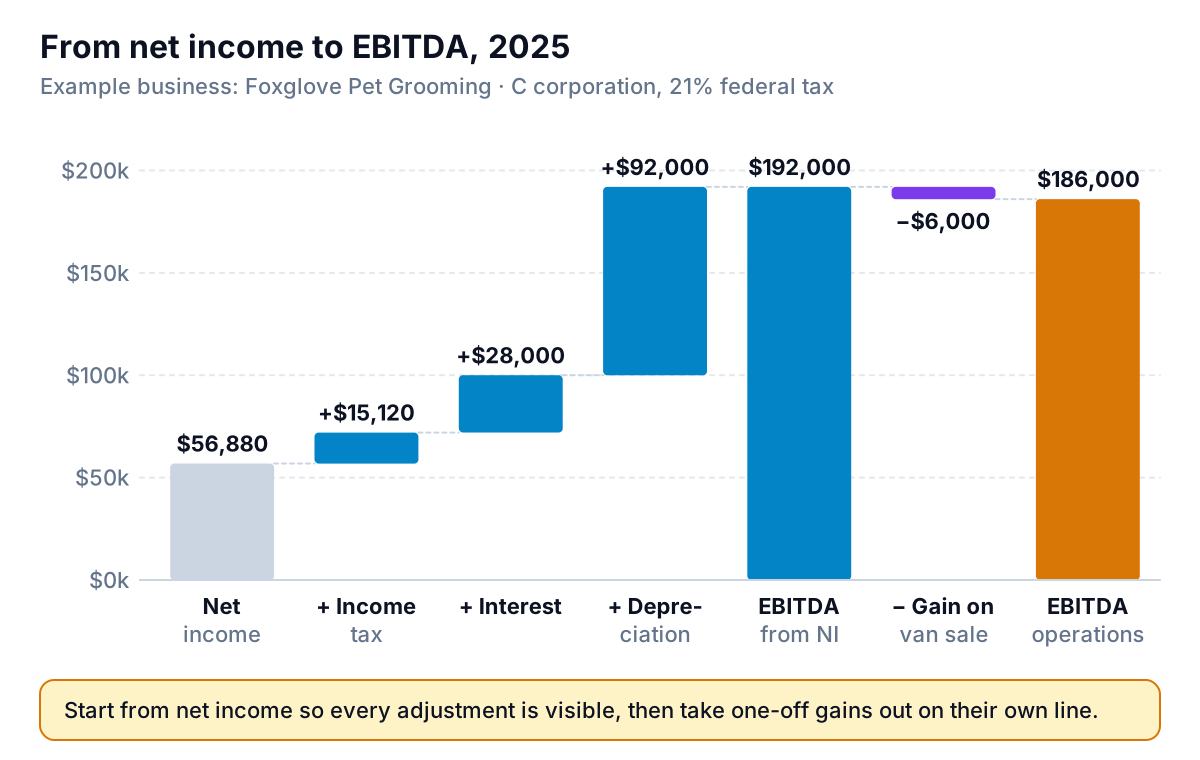
Three of the add-backs grew in 2025, and all three trace back to the vans:
- Depreciation rose by $51,000. The vans cost $255,000 together and are being written off over five years.
- Interest rose by $18,000 on the loan that paid for them.
- Tax fell by $10,080, because taxable profit fell. Lower tax is a consequence of the lower profit, not a saving.
The fourth adjustment is a one-off. Foxglove sold its old delivery van for $6,000 more than its value in the books, and that gain sits in net income. Starting from net income, EBITDA is $192,000. Take the gain out and you get $186,000, the figure that describes the grooming business. Show both, with the gain on its own line, so nobody mistakes a van sale for better grooming.
EBITDA vs operating income
Operating income sits between the two. It's revenue minus every operating cost, including depreciation and amortization, before interest, tax and anything outside the day-to-day business. On Foxglove's P&L:
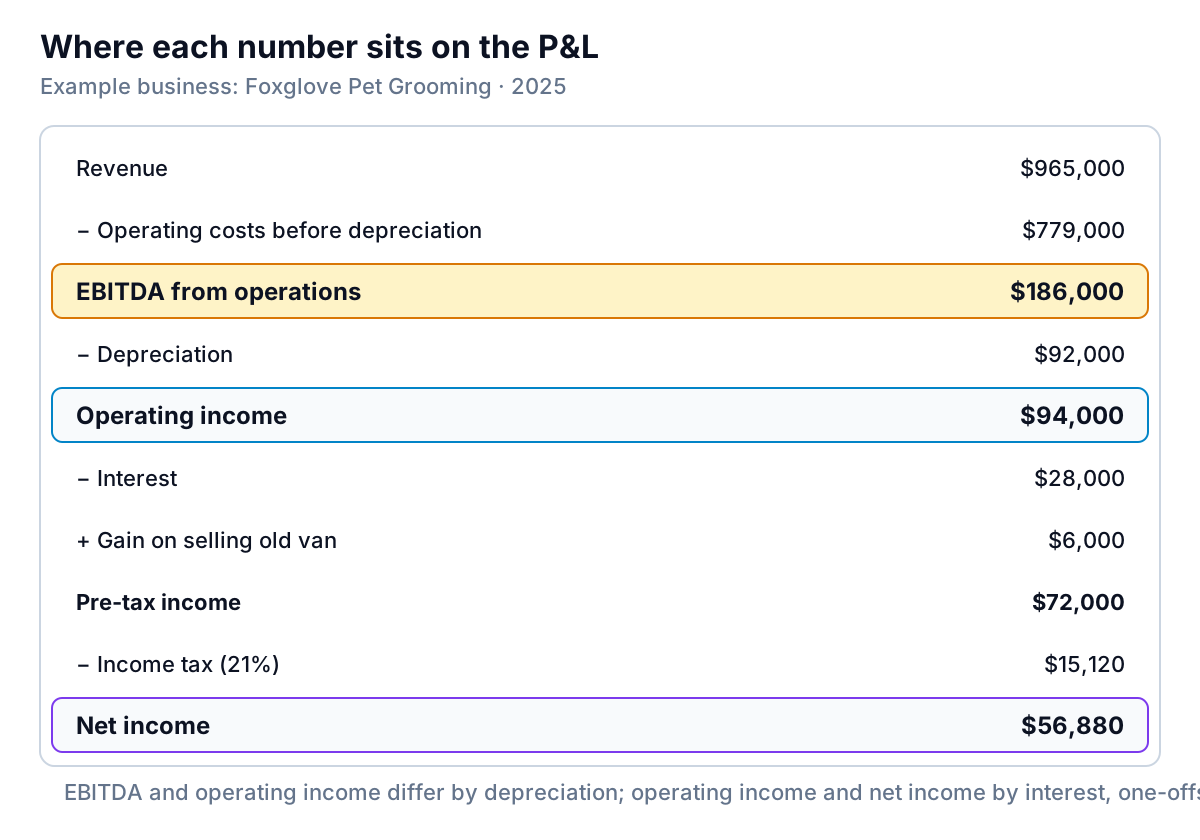
Two things separate EBITDA and operating income:
- Depreciation and amortization. Operating income subtracts them; EBITDA doesn't. For Foxglove that's $92,000, the yearly cost of owning the vans, the shop fit-out and the grooming tables.
- Items outside operations. Operating income leaves out the van-sale gain; EBITDA calculated from net income includes it unless you take it out.
That second point is why the US Securities and Exchange Commission's staff say EBITDA used as a performance measure should be reconciled to net income, not operating income: EBITDA adjusts for items that sit below the operating line. Those rules apply to public companies, not to Foxglove, but the habit is a good one. Start from net income, list each adjustment, and the reader can see every choice you made.
Which of the two is more useful depends on how much you own. For a consulting firm with laptops and a lease, depreciation is small and EBITDA and operating income are nearly the same. For Foxglove, with $92,000 of depreciation on $965,000 of revenue, they're $92,000 apart, and the difference is the real cost of the vans. Operating income divided by revenue is your operating margin, which gets its own guide.
EBITDA vs net income: which answers which question
Each measure leaves different things out, so each one is right for different questions.
| Question | Use | Why |
|---|---|---|
| Are the grooming operations getting better at turning revenue into profit? | EBITDA (from operations) | Ignores how the vans were paid for and how fast they're written off |
| Can the business carry another loan? | EBITDA, compared with loan payments | Lenders usually test coverage against it; ask yours how they calculate it |
| Does the business earn enough to replace what it owns? | Operating income | Includes depreciation, the yearly cost of the equipment wearing out |
| Did an equipment purchase pay off? | Operating income, then net income | Shows whether the extra earnings cover the depreciation and then the interest |
| What's left for the owners after everything? | Net income | The only one that counts interest and tax |
| How do we compare with a business financed differently? | EBITDA | Interest and tax depend on choices, not operations |
Net income is also the only one of the three defined by accounting standards. EBITDA and operating income can be calculated in slightly different ways by different people, which is why a list of adjustments matters whenever you share them.
Did the vans pay? Reading all three together
Here's how the owner can use the three numbers to judge the vans, one layer at a time. Compare 2025 with 2024:
- EBITDA: revenue rose $145,000 and cash operating costs (two mobile groomers, fuel, insurance, supplies) rose $130,000. The vans added $15,000 of EBITDA.
- Operating income: subtract the $51,000 of extra depreciation and the vans cost $36,000.
- Before tax: subtract $18,000 of extra interest and they cost $54,000 before the one-off van sale.
So EBITDA says the vans worked and net income says they didn't. The honest reading is that they haven't paid yet. Each van needs to earn enough EBITDA to cover its own depreciation and interest, $69,000 between them, or $34,500 each. In their first year they made $7,500 each.
That gives the owner a concrete test instead of a feeling. Each van has to find another $27,000 of EBITDA a year. With the groomer, fuel and insurance already paid for, most of the fee from each extra driveway visit drops straight to EBITDA, so the gap is about bookings: how many more visits a week each van needs, at what minimum price. She can work that out from her booking data, market the mobile service, and check the number every quarter. If the vans still fall short after two years, she sells one.
Where the inputs hide in QuickBooks, Xero or a spreadsheet
Every number in the walk comes from your profit and loss statement, but not always where you'd expect. Our profit and loss statement guide covers the layout; here's what to look for.
- Interest is often in an "Other expenses" section below the operating costs, but some charts of accounts put loan interest and card fees together under bank charges. Only loan interest belongs in the add-back. Card processing fees are an operating cost.
- Depreciation may be a single line or split by asset type. Many accountants book it only at year end, so a mid-year P&L may show none at all. If yours does, monthly operating income will look better than the full year will.
- Gains and losses on selling equipment usually sit under "Other income" or "Other expenses". Take them out of operating EBITDA and show them separately.
- Income tax only appears if your business pays it. For a C corporation, it may be booked as a year-end estimate; for a pass-through, there's usually nothing.
- Owner's pay stays as it is in all three numbers if it's a salary. If you take draws instead, none of the three includes your pay, which makes all three look better than they would for a business that pays a manager.
In a spreadsheet, put net income in one cell, each add-back on its own labelled row, and the one-off items below them. Do it for every month of the last two years, then total the trailing twelve months, so you can see the trend rather than one year against another.
Mistakes when comparing them
- Celebrating EBITDA growth bought with debt. Buying equipment on a loan can lift EBITDA and lower net income at the same time, as at Foxglove. Look at both before calling the year a success.
- Leaving one-off gains in EBITDA. A van sale, an insurance payout or a grant flatters EBITDA calculated from net income. List it separately.
- Treating EBITDA as cash. It isn't. Loan principal, new equipment and customers paying late all take cash that EBITDA doesn't see.
- Comparing a pass-through with a C corporation on net income. One pays income tax in the business and the other doesn't. Compare them on EBITDA or pre-tax income instead.
- Reading one year in isolation. A year with a big purchase will always look odd. To see what changed from one year to the next, line by line, build an EBITDA bridge.
If you'd rather not rebuild the walk every quarter, Parity connects to QuickBooks Online directly, or takes an Excel or CSV export of your P&L from Xero or any other tool, and builds a dashboard with the headline numbers and their trends, charts, what explains them and a table of what needs attention. Ask by chat for net income, operating income and EBITDA side by side by month, with one-off items on their own line. Every number is checked against queries on the full dataset before you see it, and you can update it with next month's export instead of starting again.
Connect QuickBooks Online or upload a P&L export, and get a checked dashboard of all three, month by month, with the walk between them. Build a report from your data free
Foxglove's owner doesn't need to choose between her two numbers. EBITDA told her the grooming business is getting stronger. Net income told her the vans haven't earned their keep yet. She needed both to see what to do in 2026: fill the vans' diaries, and give them a date to pay for themselves.