Three of the six barbers at Bellwether Barbers, an example shop we'll follow through this guide, asked to stop working on commission and rent their chairs instead, at $1,300 a month each. The owner ran the numbers on her monthly report and liked what she saw: gross margin would rise from 42.4% to 49.4%. Then she looked at the line above it. Gross profit would fall by $7,440 a month.
That's gross margin vs gross profit in one decision. Gross profit is the money left after the direct cost of what you sold, in dollars. Gross margin is the same money as a percentage of revenue. They're built from the same two numbers, and they usually move together, which is why it's easy to watch only one. This guide shows the situations where they split apart in a barbershop, which one to trust for which decision, and the accounting choice that can change both without anything in the shop changing.
Gross margin vs gross profit, side by side
Here's a normal month at Bellwether, a made-up six-chair shop where every barber is an employee paid 55% of the service revenue they bring in, and the shop sells a small range of hair and beard products at the counter.
| Example: Bellwether Barbers, March | Amount |
|---|---|
| Service revenue (six barbers × $9,000) | $54,000 |
| Product sales | $3,000 |
| Total revenue | $57,000 |
| Barber commission (55% of service revenue) | $29,700 |
| Service supplies: blades, neck strips, products used in the chair (3%) | $1,620 |
| Cost of products sold | $1,500 |
| Cost of sales | $32,820 |
| Gross profit (revenue − cost of sales) | $24,180 |
| Gross margin (gross profit ÷ revenue) | 42.4% |
The two answer different questions.
- Gross profit, $24,180, is what's available to pay rent, the front desk, insurance, software, card fees and the owner. It's the number that pays bills.
- Gross margin, 42.4%, says how much of each dollar a customer spends stays with the shop after paying for the work. It's the number that tells you whether your pricing and pay structure are holding.
The calculation itself, including what belongs in cost of sales, is covered step by step in our guide to how to calculate gross margin. Here we're interested in when the two numbers disagree.
When the percentage misleads: the booth rent switch
When a barber rents a chair, the shop stops recording their service revenue at all. The customer pays the barber, and the shop receives a fixed rent. Here's Bellwether's March redone as if three barbers were on commission and three were renting.
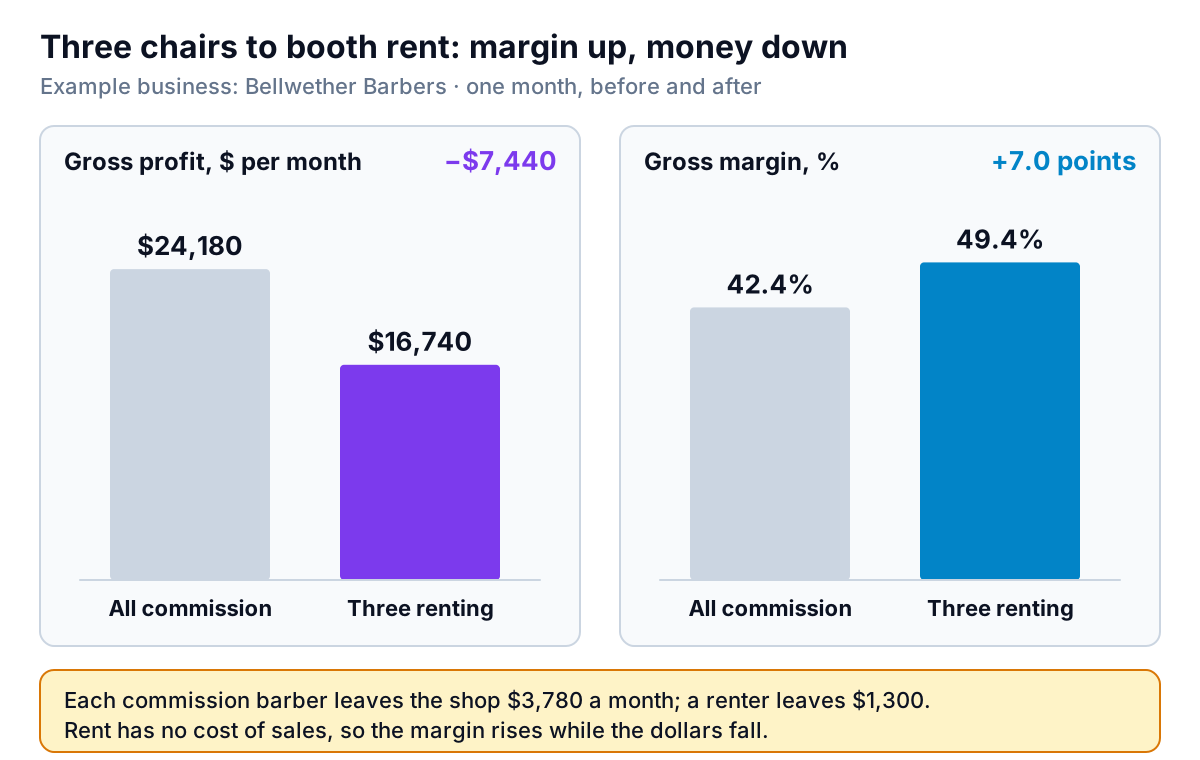
Line by line, the same month with the switch:
- Service revenue from three commission barbers: $27,000, costing $14,850 in commission and $810 in supplies.
- Product sales unchanged: $3,000, costing $1,500.
- Booth rent: $3,900, with no cost of sales at all.
- Revenue $33,900, cost of sales $17,160, gross profit $16,740, gross margin 49.4%.
The margin rose because rent is almost pure margin: there's nothing to subtract from it. The dollars fell because each of those barbers leaves the shop $3,780 a month of gross profit on commission ($9,000 less 55% commission and 3% supplies) and would leave $1,300.
That doesn't make booth rent a bad choice. Renters supply their own tools and products, the shop stops paying employer payroll taxes on their commission, and it may need less front-desk time. Those savings sit below gross profit, so they don't show on this comparison, and they narrow the gap. Whether they close it is a question for the full profit and loss statement. But a manager who watched only gross margin would have called the switch a 7-point improvement, and it wasn't one.
Classification matters too. Whether a barber is a renter running their own business or an employee isn't up to the label on the agreement. The IRS looks at the whole relationship and the right to direct and control the work, and states have their own tests. If the shop still sets the renters' hours and prices, talk to an accountant or employment lawyer before you switch.
When the percentage stays still and the money moves: raising prices
The owner is also weighing a rise in the standard cut from $40 to $45. On commission, the barber's share rises with the price, and so do the supplies at 3%. Here's one haircut before and after.
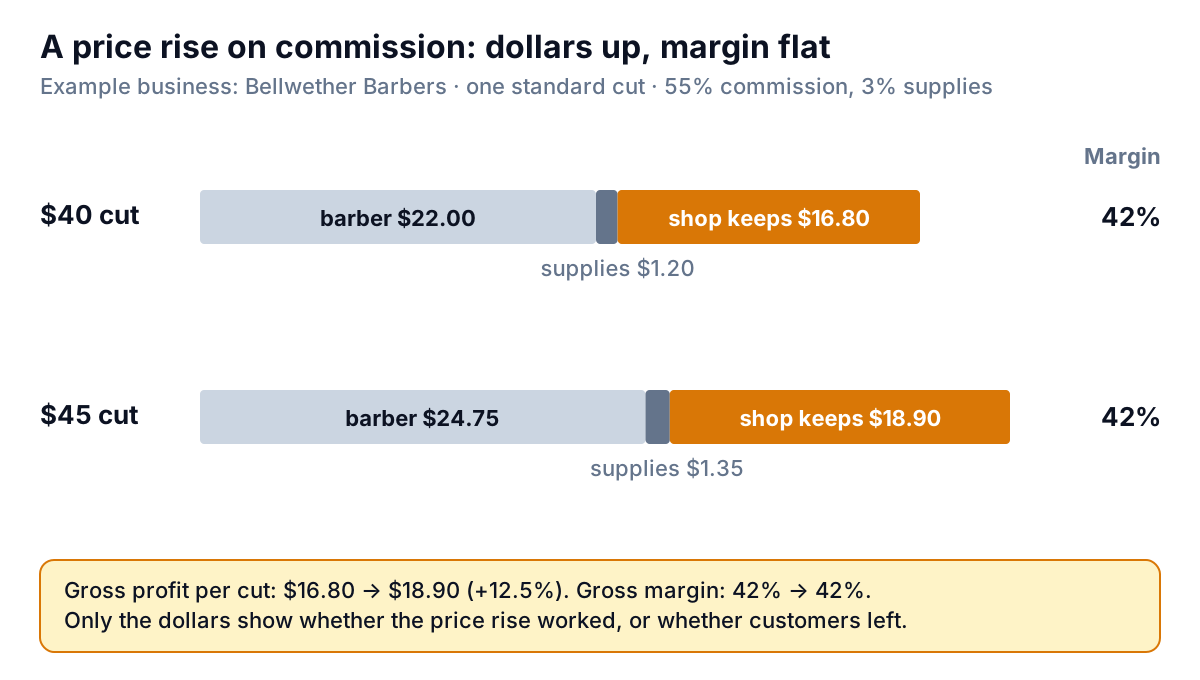
Gross profit per cut went from $16.80 to $18.90, up 12.5%. Gross margin stayed at 42%, because every cost of the cut is a percentage of its price. If the owner judged the price rise by gross margin, she'd conclude it did nothing. It adds $2.10 a cut, roughly $1,600 a month at Bellwether's March volume of about 750 standard cuts, if no customers leave.
That last condition is what the dollars let you check. If gross profit rises by less than $2.10 times the number of cuts, some customers went elsewhere or traded down to a cheaper service. Gross margin will never show that; it stays at 42% whether you lost customers or not.
The same logic works in reverse. A discount that barbers share on commission (10% off, and they're paid 55% of the discounted price) leaves gross margin untouched and cuts gross profit dollars. A discount the shop absorbs alone (the barber is still paid on the full price) cuts both, and cuts the margin hard. Our guide to margin vs markup has more on how price changes flow through.
When the dollars mislead: a record December
Last December was Bellwether's best month for gross profit: $25,650, against $24,180 in March. The owner was ready to call it a strong month. Then she looked at the margin: 39.8%.
What happened: holiday demand was strong, so to keep chairs filled late into the evening, she paid barbers 58% commission for the month instead of 55%. Service revenue rose to $60,000 and product sales to $4,500 with gift sets. Revenue was $64,500, up $7,500 on March. Gross profit rose only $1,470.
That's the number to look at when dollars grow: incremental margin, the extra gross profit divided by the extra revenue. December's was $1,470 ÷ $7,500 = 19.6%, less than half the shop's normal 42.4%. The extra revenue cost almost as much as it brought in. Whether the higher commission was worth it depends on what it bought: if it kept barbers from leaving in their busiest month, perhaps. But it should be a choice, made knowing what each extra dollar of revenue earned.
Dollars mislead in two other common ways:
- Months of different length. A five-Saturday month makes more gross profit than a four-Saturday month with nothing else changing. Compare gross profit per chair per week, or compare the same month last year.
- Comparing shops of different sizes. A ten-chair shop makes more gross profit than a six-chair shop. Compare margins between shops, and dollars only within one.
Where barber pay sits changes both numbers
Bellwether books barber commission as a cost of sales, so it sits above the gross profit line. Many shops book it as wages under operating expenses instead. Do that, and Bellwether's March gross profit becomes $53,880 and its gross margin 94.5%, without a single haircut changing.
Neither choice is wrong, but each gives a different picture:
- Commission in cost of sales makes gross margin a measure of the pay structure and pricing together. It's the view that catches the December problem.
- Commission in operating expenses makes gross margin a measure of product and supply costs only, which tells you very little in a service business.
For tax, the IRS's guidance on cost of goods sold in Publication 334 is written for businesses that make or buy goods to sell, which covers your retail products but not haircuts. How service labour is presented in your management accounts is a separate decision. Agree it with your accountant, write it down, and keep it the same every month. And when you compare your gross margin with another shop's, or with a figure in an article, find out where they put barber pay first, because a 45% shop and a 94% shop can be identical.
If your shop runs on Square, our Square reports guide shows which exports hold service and product sales separately, which you'll need to split gross profit by revenue type.
Which number to use for which decision
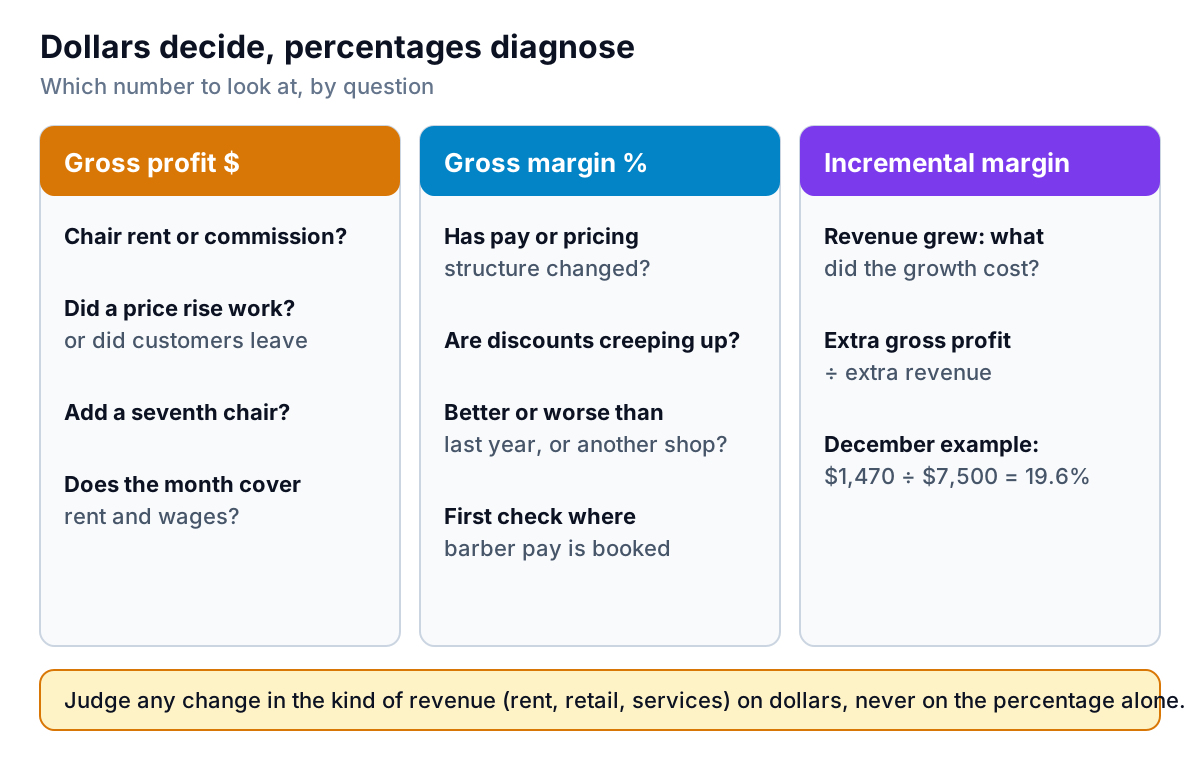
The pattern behind the table: dollars decide, percentages diagnose. Any decision about whether to do something (switch a chair to rent, add a seventh chair, stock a new product line) should be judged on how many gross profit dollars it adds per month, because dollars pay the rent. Percentages are for spotting that something changed in how each sale is priced or paid for, and for comparing like with like.
A monthly routine that uses both takes five minutes:
- Write down gross profit and gross margin for the month, the same month last year and the trailing twelve months.
- If gross profit moved, split it: how much came from more revenue, and how much from a change in margin?
- If margin moved, look for the cause in this order: commission rates, discounts, the mix of services, retail and rent, and supply costs.
- If revenue grew, work out the incremental margin. If it's well below your normal margin, find out what the growth cost.
- Split both numbers by revenue type (services, products, rent), because a single total hides shifts like the booth rent switch and December's commission rate.
Splitting by revenue type is where a shop with several services and a product shelf gets value from contribution margin too, which goes one step further and subtracts card fees and other costs that rise with each sale.
If you'd rather not rebuild this each month, Parity connects to Square and QuickBooks Online directly, or takes a CSV or Excel export from any booking or till system, and builds a dashboard with the headline numbers and their trends, charts, what explains them and a table of what needs attention. Ask by chat for gross profit and gross margin side by side, split by services, products and booth rent, with incremental margin when revenue grows. Every number is checked against queries on the full dataset before you see it.
Connect Square or QuickBooks Online, or upload an export, and get a checked dashboard of both numbers and what moved them. Build a report from your data free
Bellwether's owner didn't turn down the booth rent request. She priced it again with both numbers in front of her, and offered the three barbers a chair at $2,000 a month instead of $1,300. That still left the shop $5,340 a month short of its commission gross profit, before the payroll tax savings, and both sides could see it.