Law firm KPIs trace a lawyer's hour from the timesheet to the bank: how much of the day is billable (utilization), how much of that reaches an invoice (realization), how much of the invoice is paid (collection), how long the whole trip takes (lockup), and what each matter earned after its cost (matter profitability). The one most small firms skip is lockup: WIP days + accounts receivable days, where WIP days = unbilled work ÷ fees billed per day and AR days = unpaid bills ÷ fees billed per day.
Hale & Merritt LLP, an example ten-lawyer firm we'll use in this guide, billed more in the third quarter of 2026 than in any quarter before. Its utilization, realization and collection rates were all in the same range as the quarter before. Yet the partners were asked to delay their draws, because the bank balance had fallen. The three familiar rates couldn't explain it. Lockup could.
This guide covers the five law firm KPIs, with most of its space on the two that small firms tend not to measure: lockup and matter profitability. The three rates get a short treatment here because our billable hours guide covers them in depth. Rules on fees, trust money and confidentiality vary by state, so treat the ethics points below as a starting point and check your own state's rules.
Six numbers for the partners' meeting
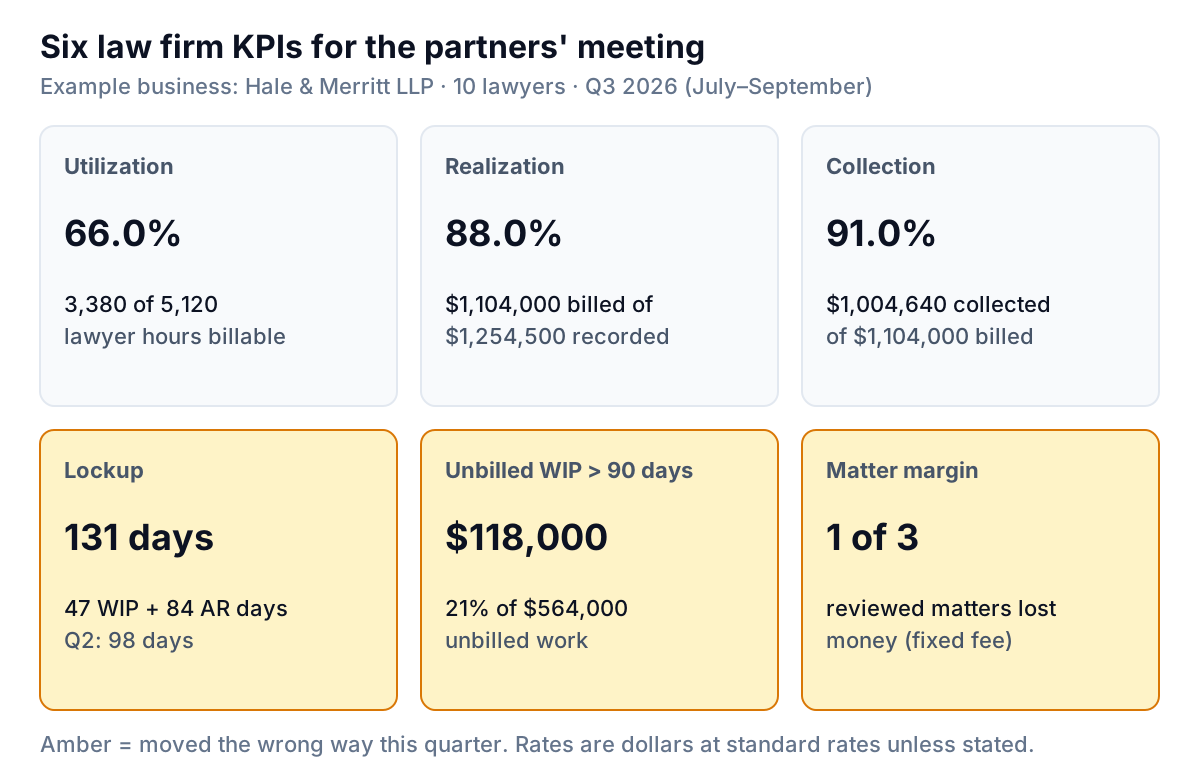
Here's the page Hale & Merritt's managing partner now brings to the quarterly meeting: the three rates across the top, and the three numbers that explain cash and profit underneath.
Utilization, realization and collection in brief
The three rates each use the previous stage as the denominator:
- Utilization = billable hours recorded ÷ available hours. Hale & Merritt's ten lawyers had 5,120 available hours in the quarter (64 working days × 8 hours × 10) and recorded 3,380 billable: 66.0%.
- Realization = value billed ÷ value recorded at standard rates. $1,104,000 billed of $1,254,500 recorded: 88.0%.
- Collection = cash collected ÷ value billed. $1,004,640 of $1,104,000: 91.0%.
For outside comparison, Clio's Legal Trends benchmarks, drawn from aggregated data across the law firms that use its software, put the 2025 averages at 38% utilization (about 3.0 billable hours captured in an 8-hour day), 88% realization and 93% collection. It's a vendor's dataset rather than a random sample, and firms define available hours differently, so treat the comparison loosely. Hale & Merritt's 66% utilization isn't comparable to Clio's 38% unless both count the day the same way.
All three rates are percentages, so they say nothing about time. A firm can bill and collect the same share of its work as last quarter and still collect it two months later. That's what happened here.
Lockup: the law firm KPI that explains cash
Lockup measures how many days of fees are tied up in work that hasn't been paid for. It has two parts:
- WIP days = unbilled work in progress ÷ fees billed per day. How long work waits before it's invoiced.
- AR days (also called debtor days) = unpaid invoices ÷ fees billed per day. How long invoices wait before they're paid.
Hale & Merritt billed $1,104,000 in the quarter's 92 days: $12,000 a day. At September 30 it had $564,000 of unbilled WIP (47 days) and $1,008,000 of unpaid invoices (84 days). Lockup: 131 days. At the end of June it had been 98.
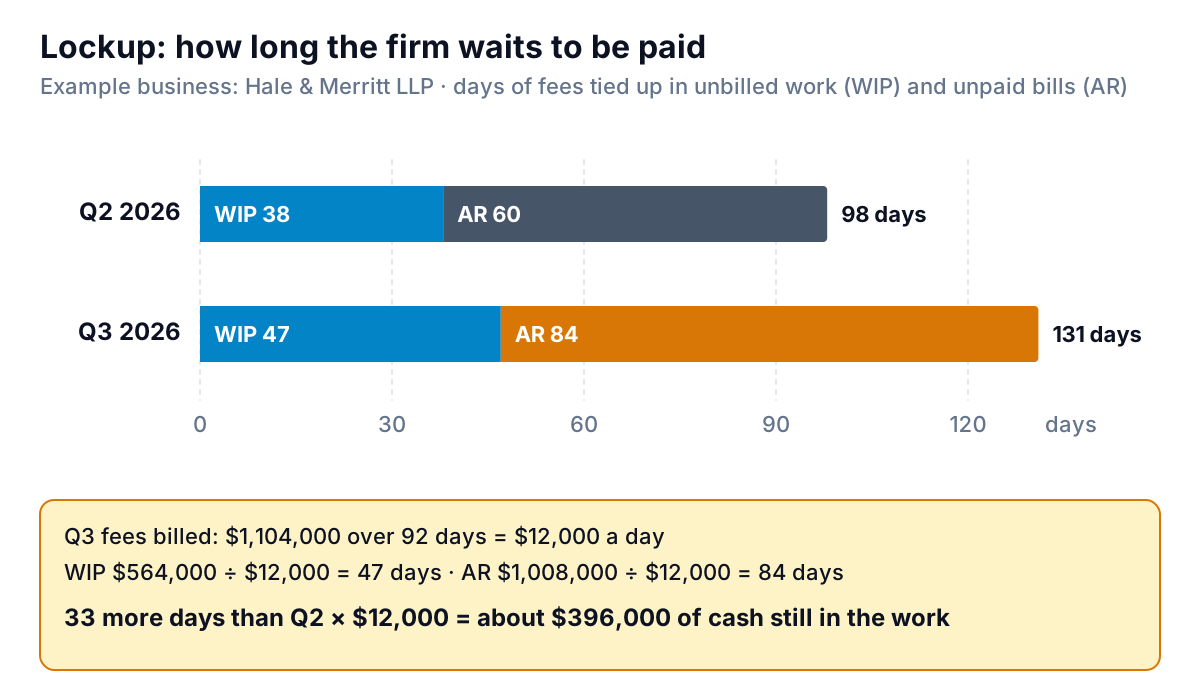
Each day of lockup holds about one day's fees. The extra 33 days hold about $396,000 that would otherwise be in the bank. That's the missing cash, and it's why the partners' draws were delayed in a record quarter.
Conventions vary: some firms use annual fees ÷ 365 as the daily rate, value WIP at cost rather than at standard rates, or count WIP net of expected write-downs. None of those choices is wrong. What matters is to pick one, write it down, and measure the same way every quarter. We haven't found a published lockup benchmark for small US firms that states its sample and method, so compare yourself with your own last four quarters.
What to do when lockup rises
Look at which part grew, then at the aged detail behind it.
| If this grew | Look at | Common fixes |
|---|---|---|
| WIP days | Unbilled time by matter and age; matters with no invoice in 60+ days | Bill monthly on every hourly matter; agree billing milestones on long matters; set a date by which pre-bill review must finish |
| AR days | The aged receivables list by client and invoice | Follow up at 30 days; agree payment terms in the engagement letter; offer card or online payment; ask for an advance deposit on new matters where your rules allow |
At Hale & Merritt, $118,000 of the unbilled WIP was older than 90 days, mostly on two long matters that hadn't been billed since spring. Old WIP is the most expensive kind: a client who receives a large invoice for work done months ago is more likely to dispute it, so it also drags down realization next quarter. On the receivables side, an accounts receivable aging report shows which invoices are late and by how much. Lockup is the law firm's version of the cash conversion cycle, and the logic is the same: shorten the time between doing the work and getting paid for it.
Matter profitability: what each matter actually earned
The rates and lockup describe the firm. Matter profitability describes the work. Matter profit = fees collected − cost to deliver − unrecovered expenses, where cost to deliver is each timekeeper's hours × a loaded cost per hour.
A loaded cost per hour is pay, payroll taxes and benefits, plus a share of overhead (rent, staff, software, insurance), divided by the billable hours you expect from that person in a year. For partners, use a notional market salary for the work rather than their actual draw, or every matter will look either free or ruinous depending on how profits were split. Hale & Merritt uses $210 an hour for partners, $120 for associates and $65 for paralegals, each based on 1,800 expected billable hours. For example, an associate costs $130,000 in salary, $26,000 in taxes and benefits and $60,000 in overhead share: $216,000 ÷ 1,800 = $120.
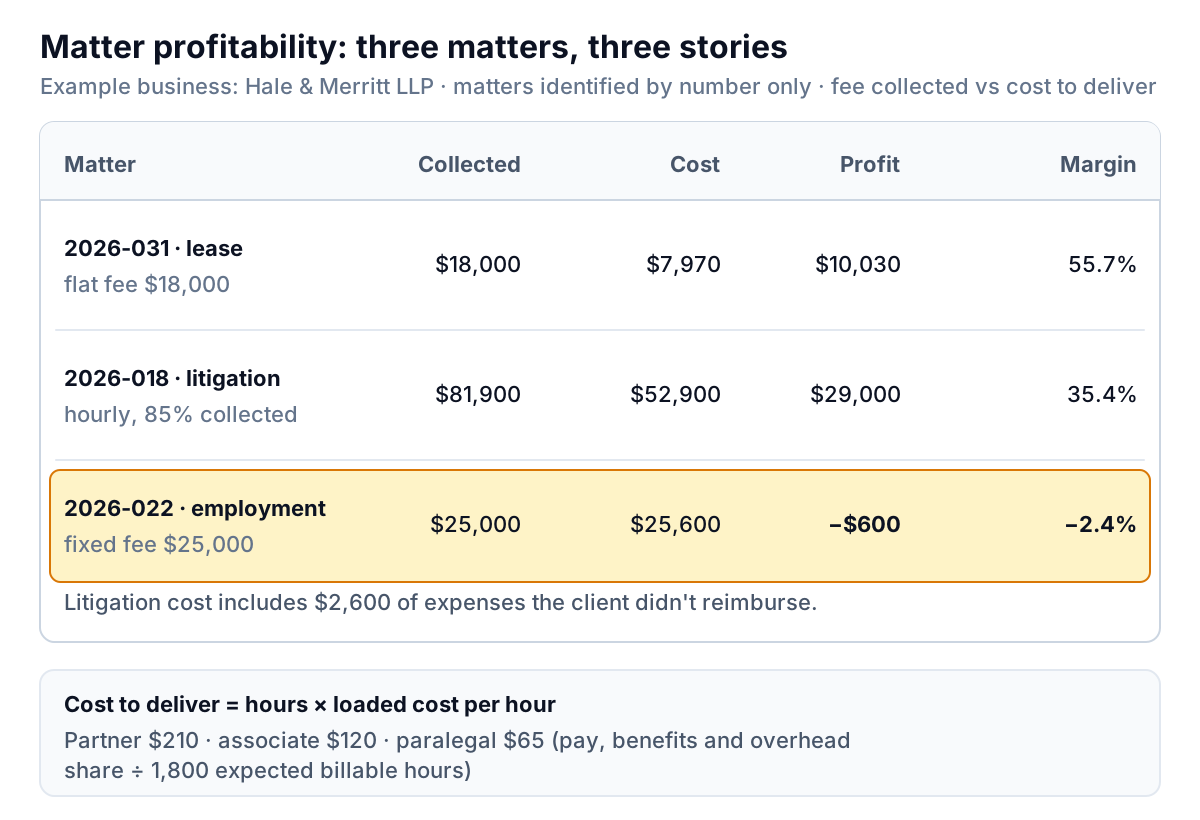
Three matters that closed in Q3 show why this view matters:
- 2026-031, a commercial lease, $18,000 flat fee. 12 partner hours, 40 associate hours, 10 paralegal hours: $7,970 to deliver. Profit $10,030, a 55.7% margin. A well-scoped, repeatable piece of work.
- 2026-018, hourly litigation. Billed $96,400 but collected $81,900, 85%, after the client disputed two invoices. 90 partner hours, 240 associate hours and 40 paralegal hours cost $50,300, plus $2,600 of expenses the client didn't reimburse. Profit $29,000, 35.4%. The largest fee, but the $14,500 billed and never collected came straight off its profit.
- 2026-022, employment dispute, $25,000 fixed fee. The matter went to a second round of mediation that the fee hadn't anticipated: 30 partner, 150 associate and 20 paralegal hours, $25,600 to deliver. A loss of $600.
The decision rules that follow are practical. Before quoting a fixed fee, look up the hours on the last five similar matters and price from the slowest of them, not the average. Write the scope into the engagement letter with what happens if it changes; ABA Model Rule 1.5 asks that the scope and basis of the fee be communicated to the client, preferably in writing (see the text of Rule 1.5), and your state's version may say more. And review profitability by matter type every six months: if one type keeps landing below your floor, raise its price, change who staffs it, or stop taking it.
Where the data lives, and keeping it confidential
Practice management and time-and-billing systems usually hold everything above: time entries with timekeeper, matter and hours; invoices and payments; a WIP or unbilled time report; an aged receivables report; and the trust ledger. Most can export these as CSV or Excel. Loaded costs per hour come from your accounting system and payroll.
Time and billing data carries confidential client information. ABA Model Rule 1.6(c) asks lawyers to make reasonable efforts to prevent unauthorized disclosure of, or access to, information relating to a representation; see the ABA's comment on Rule 1.6. If you use AI tools, ABA Formal Opinion 512 discusses the confidentiality risks of entering client information into generative AI tools and, for tools that learn from inputs, says informed client consent is needed first. None of the KPIs in this guide needs client information. Before any export leaves your practice management system, remove the narrative descriptions, replace client names with matter numbers, and keep only the fields you need: timekeeper role, matter number, matter type, dates, hours, amounts and payments. Check your state's rules and opinions and your firm's own policy on outside software, and ask your bar's ethics counsel if you're unsure.
Mistakes that make law firm KPIs mislead
- Watching rates and ignoring time. Percentages can hold steady while cash slows down. Add lockup.
- Counting trust deposits as collections. Fees aren't the firm's until they're earned.
- Measuring realization only in hours. A written-off partner hour costs more than an associate's; measure in dollars too.
- Judging matters on fees billed. Use fees collected, net of the cost to deliver.
- Changing definitions between quarters. Write down how WIP is valued and how the daily rate is worked out, and keep it.
Running the review each quarter
Monthly, look at WIP over 60 days and invoices over 30 days, matter by matter, and agree who bills or chases what. Quarterly, review the full page: the three rates, lockup and its two parts, and every matter closed in the quarter with its margin. For a broader view of the firm alongside cash and pipeline, our KPI dashboard guide covers how to lay out the page.
Parity can build this page from your exports. Upload the time, invoice, WIP and aged receivables exports as CSV or Excel, with narratives removed and matters identified by number as above, and describe what you need ("utilization, realization and collection by practice area, lockup split into WIP and AR days, and margin for each matter closed this quarter at these cost rates"). Parity builds a dashboard with the headline numbers and their trends, charts, what explains them and a table of what needs attention, and checks every number against queries on the full dataset before you see it. You can share it with your partners through a read-only link with an optional password and end date, and update it next quarter with a newer export. If the partners want a written summary, ask Parity to write the quarterly report from the same data.
Upload de-identified time and billing exports and get a checked law firm KPI dashboard. Build a report from your data free
Hale & Merritt's fix took one meeting: bill the two long matters this month, chase the eleven invoices over 60 days, and reprice employment matters on fixed fees. Its rates didn't need to change at all. That's the point of measuring time and matters alongside the familiar percentages: they show where the money is, not just how much of it you'll eventually see.