On March 31, Quickstep Meal Kits, an example business we'll use throughout this guide, owed $215,000 due within a year and had only $172,000 of cash, stock and other current assets to cover it. Six months later the gap was almost identical: $139,000 owed against $95,000. Both balance sheets show negative working capital of about $43,000. The first one was a sign of a well-run subscription business. The second was a business three weeks from a supplier putting it on cash-on-delivery terms.
Negative working capital means current liabilities are bigger than current assets. Whether that's healthy depends entirely on which liabilities make up the gap and whether the cash they brought in is still around. This guide shows how to tell the two cases apart with four tests you can run on any balance sheet, what to do when the number turns the wrong way, and how to pull the inputs from QuickBooks, Xero or a spreadsheet.
If you need the basics first (the formula, what counts as current, and why a profitable business can run short of cash), start with our working capital guide. This post answers one narrower question: your number is below zero, so should you worry?
Two balance sheets with the same negative working capital
Quickstep sells weekly meal kits. Customers either prepay a 4-week or 12-week plan, or pay every Sunday for a Wednesday delivery. It buys food on 14- to 30-day terms from three wholesalers. Here are its current assets and liabilities at the end of March and the end of September 2026.
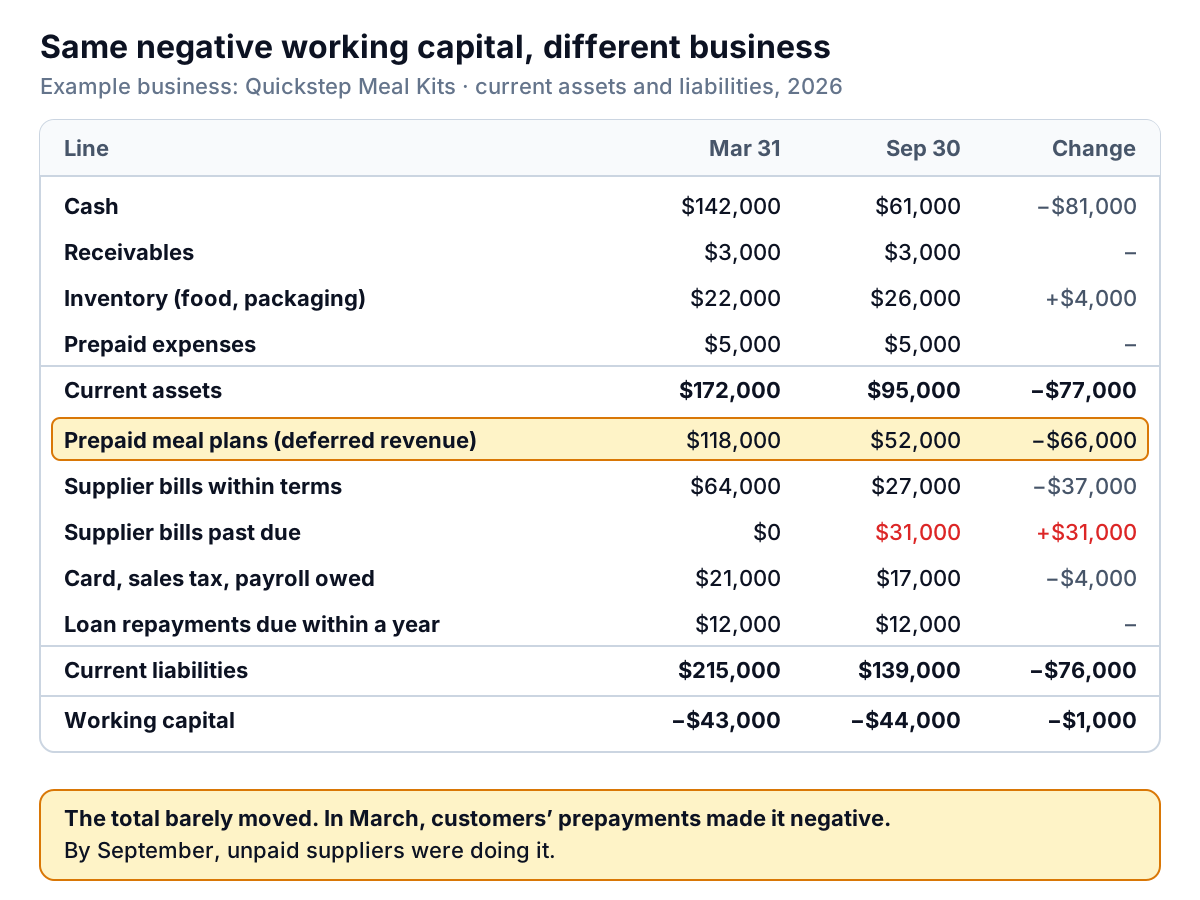
In March, the biggest current liability was $118,000 of prepaid meal plans: money customers had paid for meals Quickstep hadn't delivered yet. Accountants call this deferred revenue or unearned revenue. It sits on the balance sheet as a liability because Quickstep owes the customer something, but what it owes is food in a box, not a cheque. Every supplier bill was within its terms, and there was $142,000 in the bank.
By September, the prepaid plans had shrunk to $52,000. Cash had fallen to $61,000. And $31,000 of supplier bills, more than half of everything owed to suppliers, were past their due date. The working capital figure stayed put because two things moved in opposite directions: a good liability (customer prepayments) shrank, and a bad one (overdue bills) grew to take its place.
That's the main lesson. The total can't tell you anything on its own. You have to read the lines.
Why customer prepayments push working capital below zero
This point trips up even experienced finance teams. When a customer prepays $300 for a 12-week plan, Quickstep's cash goes up by $300 and its deferred revenue goes up by $300. Current assets and current liabilities rise by the same amount, so working capital doesn't change at all.
The US Securities and Exchange Commission made exactly this point to the publisher John Wiley & Sons. Wiley had told investors its negative working capital came from subscription revenue collected in advance. In a 2012 comment letter exchange, SEC staff pointed out that advance cash and the matching deferred revenue rise together, so the prepayment alone doesn't create a deficit. Wiley agreed, and explained that the cash was being used elsewhere in the business: paying down debt, funding operations, paying dividends and buying back shares.
So prepayments make working capital negative only when the cash they bring in is spent on something that isn't a current asset. For a small business that usually means:
- Equipment and fit-out: a van, a blast chiller, a second kitchen.
- Owner draws or distributions.
- Repaying long-term loans.
- Losses, if the business is spending more than it earns.
The first three can be perfectly sensible. Using customers' money as free, interest-free financing is the whole appeal of a prepaid model. It's the same reason a business can have a negative cash conversion cycle: customers pay before suppliers have to be paid. The arrangement works for as long as new prepayments keep arriving to replace the ones you're delivering against. The risk is what happens when they stop.
Four tests: is your negative working capital healthy?
Run these on any balance sheet that shows a negative figure. They take ten minutes once you have the reports in the next section.
Test 1: who is funding the gap?
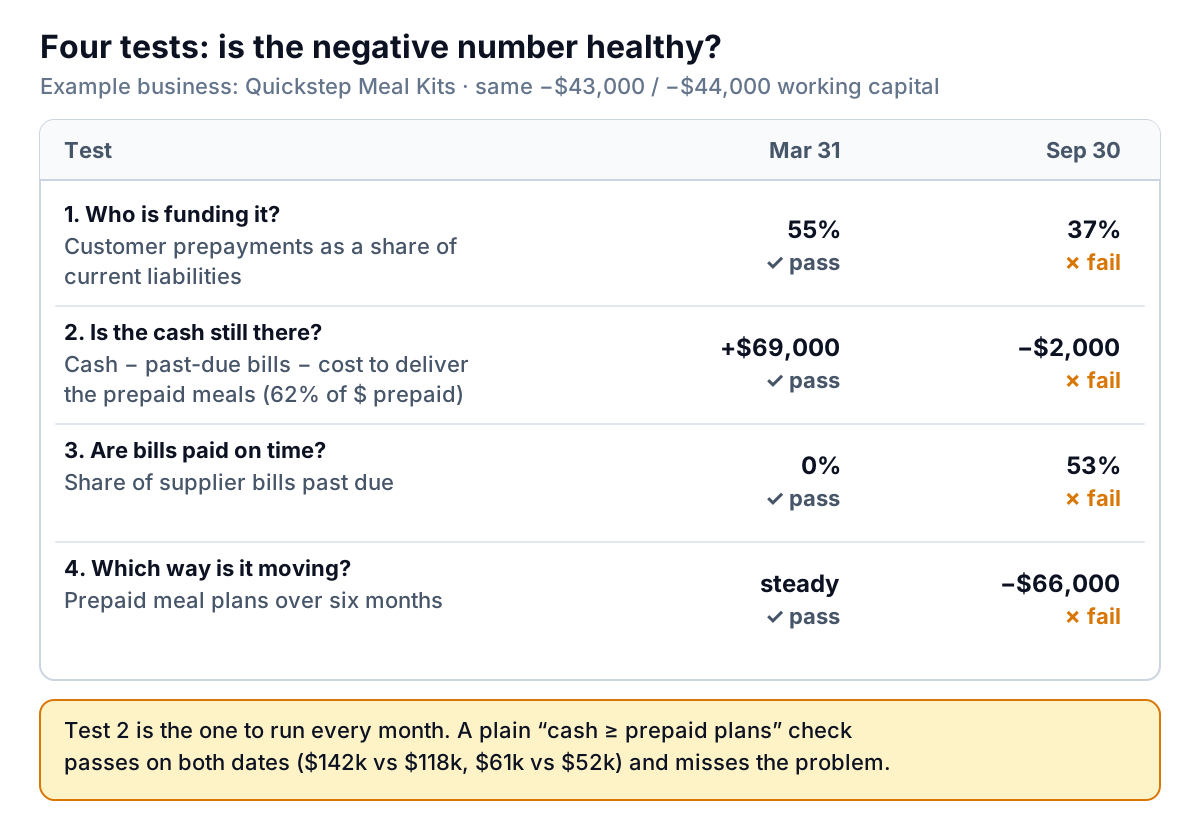
Work out what share of current liabilities is customer money: deferred revenue, customer deposits, gift card balances, prepaid memberships. In March, Quickstep's $118,000 of prepaid plans was 55% of its $215,000 of current liabilities. In September, $52,000 was 37% of $139,000.
A rule of thumb for a business like this example (not an industry standard): when customer prepayments are more than half your current liabilities, the negative figure is mainly customers financing you. When overdue bills, credit cards and short-term loans make up most of it, you're being financed by people who didn't agree to it, or at rates you wouldn't choose.
Test 2: is the cash still there?
This is the one to run every month. Take your cash, subtract any bills that are already past due, then subtract what it will cost you to deliver what customers have prepaid:
Cash − past-due bills − (deferred revenue × your variable cost %)
Quickstep's food, packaging and delivery come to about 62% of the price of a box. In March: $142,000 − $0 − ($118,000 × 62%) = about +$69,000. In September: $61,000 − $31,000 − ($52,000 × 62%) = about −$2,000. In September, the cash isn't enough to clear the overdue bills and cook what customers have already paid for.
Two notes on this test. First, it uses the cost to deliver, not the full prepaid amount, because Quickstep owes meals, not refunds. If your terms let customers cancel for a full refund, use the full amount, since that's your worst case. Second, notice what the simpler "is cash bigger than deferred revenue?" check says: $142,000 against $118,000 in March, $61,000 against $52,000 in September. It passes both times and misses the problem completely.
Test 3: are suppliers being paid on time?
Run an accounts payable aging report and look at the share of bills past their due date. Quickstep went from 0% to 53%. Paying suppliers on the due date rather than early is good cash management. Paying them late is borrowing they didn't agree to, and it tends to end with tighter terms or a demand for cash on delivery, exactly when you can least afford it.
Test 4: which way is the prepaid balance moving?
A stable or growing deferred revenue balance means new prepayments are keeping pace with deliveries. A falling one means you are consuming customer cash faster than it's being replaced. Quickstep's fell $66,000 in six months.
The reverse squeeze: when growth slows
Here is what happened at Quickstep. In February and March it ran a "pay for 12 weeks, get 2 free" offer, which sold a lot of long plans. That's why prepaid plans peaked at $118,000. Over the spring and summer it delivered those meals, and most customers then renewed week by week. Weekly customers pay on Sunday for a Wednesday box, so they hardly add to deferred revenue at all. At the same time, summer sign-ups slowed.
Meanwhile, the March cash had already been partly committed: a $15,000 blast chiller, owner draws and loan repayments. None of those were mistakes on their own. Together, with prepayments no longer refilling the pot, they drained it.
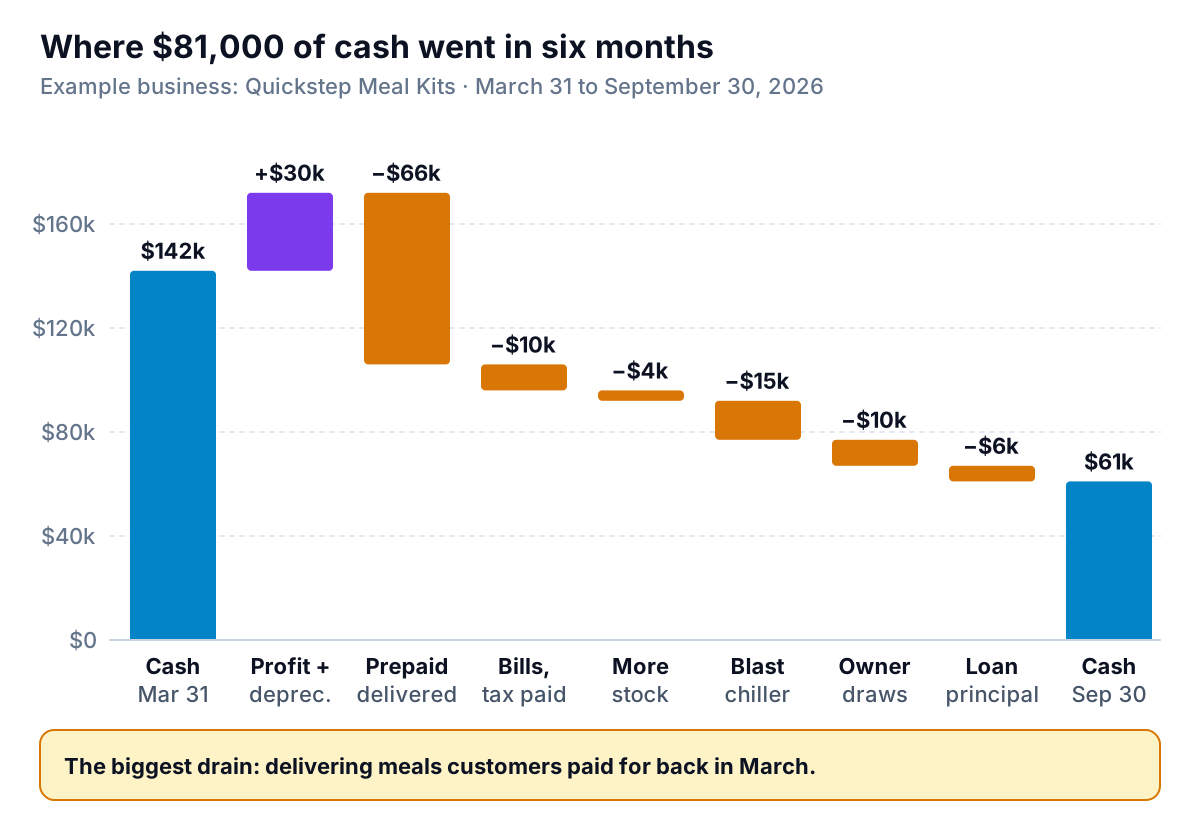
This is the mirror image of the squeeze a wholesaler or a contractor feels. A business with positive working capital needs extra cash to grow, because each extra sale ties up money in stock and receivables first. A business with negative working capital gets cash from growth, and gives it back when growth stops. Quickstep made $24,000 of profit in those six months, plus $6,000 of depreciation added back, and still lost $81,000 of cash, because $66,000 of it was meals it had been paid for in March.
Any business that takes money upfront can feel this: annual memberships, gyms, schools and course providers, event organisers selling early tickets, contractors taking large deposits, and subscription boxes. The warning signs are the same: a promotion that pulled prepayments forward, a seasonal dip in sign-ups, or customers moving from long plans to short ones.
Getting the numbers from QuickBooks, Xero or a spreadsheet
You need three things: a balance sheet, an accounts payable aging report, and your variable cost percentage.
- QuickBooks Online: run the Balance Sheet for the month end. Use the Balance Sheet Comparison report to put two dates side by side, as in the first figure. For payables, Intuit's year-end guide points you to the Accounts payable aging summary through "Find report by name".
- Xero: the Balance Sheet gives the totals, and the Aged Payables Summary report shows what's owed to each supplier by age.
- Spreadsheet: paste in the balance sheet, tag each line as "customer prepayment", "other current liability" or "current asset", and use SUMIF on the tags. Put past-due payables on their own row. Test 2 is then one formula:
=Cash-PastDue-DeferredRevenue*0.62, with your own cost percentage in place of 0.62.
One tax note, which is a question for your accountant rather than something to act on from a blog post. How prepayments are taxed doesn't always follow how they're shown on your balance sheet. IRS Publication 538 describes when an accrual-method business can defer part of an advance payment to the following tax year, and the limits on doing so. If prepayments are a big part of your model, ask your accountant which method you're using.
What to do when the tests turn the wrong way
If your balance sheet passes all four tests, leave it alone. It means customers are financing your business at no cost, which is about as good as financing gets. Keep running Test 2 every month.
If it starts failing, act in this order:
- Stop committing prepayment cash to long-term things. Postpone the equipment purchase, pause or cut owner draws, and check whether a loan repayment can be rescheduled. These are the items that turned Quickstep's prepaid cash into a hole.
- Call suppliers before they call you. Tell them what's overdue and when you'll pay it, and offer a short, specific plan. A supplier who hears it from you first is far more likely to keep your terms open.
- Refill prepayments the right way. Offer a modest discount for 4- or 12-week plans to existing weekly customers rather than a deep one to new customers. A deep discount brings in cash today and obligations that cost more to deliver than they paid.
- Forecast the unwind. Put deferred revenue on its own line in your cash flow forecast, showing how much will be delivered each week and how much new prepayment you expect. If the line falls every week, you know your cash low point in advance.
- Arrange credit while you still pass Test 2. A lender will look at the same balance sheet you do. It's much easier to agree a line of credit when overdue bills are zero.
At Quickstep, the owner put the blast chiller on a lease instead of buying the second unit she'd planned, offered weekly customers 8% off a 12-week plan, and agreed a four-week catch-up schedule with the two wholesalers she owed most. Whether that's enough shows up in one number at the end of October: cash minus past-due bills minus the cost of meals already paid for.
Keeping all four tests on one page
These tests are only useful as a trend. A single month tells you where you are. Twelve months tell you which way prepayments, overdue bills and cash are moving, early enough to act.
Parity can build that page from your books. Connect QuickBooks Online, or upload a balance sheet and payables aging export from Xero or any other tool as a CSV or Excel file. Parity builds a dashboard with the headline numbers and their trends, charts, what explains them and a table of what needs attention, such as suppliers whose bills are past due. Every number is checked against queries on the full dataset before you see it. You can refine it by chat ("show deferred revenue, cash and past-due payables as three lines", "add cash minus past-due bills minus 62% of deferred revenue") and update it with next month's export. If you ask, it writes the month-end report for your lender or business partner from the same data.
Connect QuickBooks or upload your balance sheet and get a checked dashboard of prepayments, overdue bills and cash over time. Build a report from your data free
The question to ask of a negative number is never "how negative?" It's "whose money is it, and do I still have it?" In March, Quickstep's answer was customers' money, and yes. In September, it was suppliers' money, and no. The working capital total was the same both times.