Last spring, Quince Boutique, an example women's clothing shop we'll use throughout this guide, sold out of linen dresses in the second week of April. The supplier had more. Quince had no money to buy them: the owner had placed every spring order at the February trade show, and by April the shop was full of knitwear nobody wanted in the warm weather.
This year she runs an open to buy. Open to buy (OTB) is the amount you can still order for a given month without going over the stock you planned to hold: planned sales + planned markdowns + planned end-of-month stock − stock at the start of the month − stock already on order. It turns "how much should I buy?" into a number per month, and it shows, before the trade show, how much to commit and how much to keep back. This guide builds Quince's six-month plan step by step, converts it to cost correctly, and shows how to update it each month as real sales come in.
The open to buy formula, one month at a time
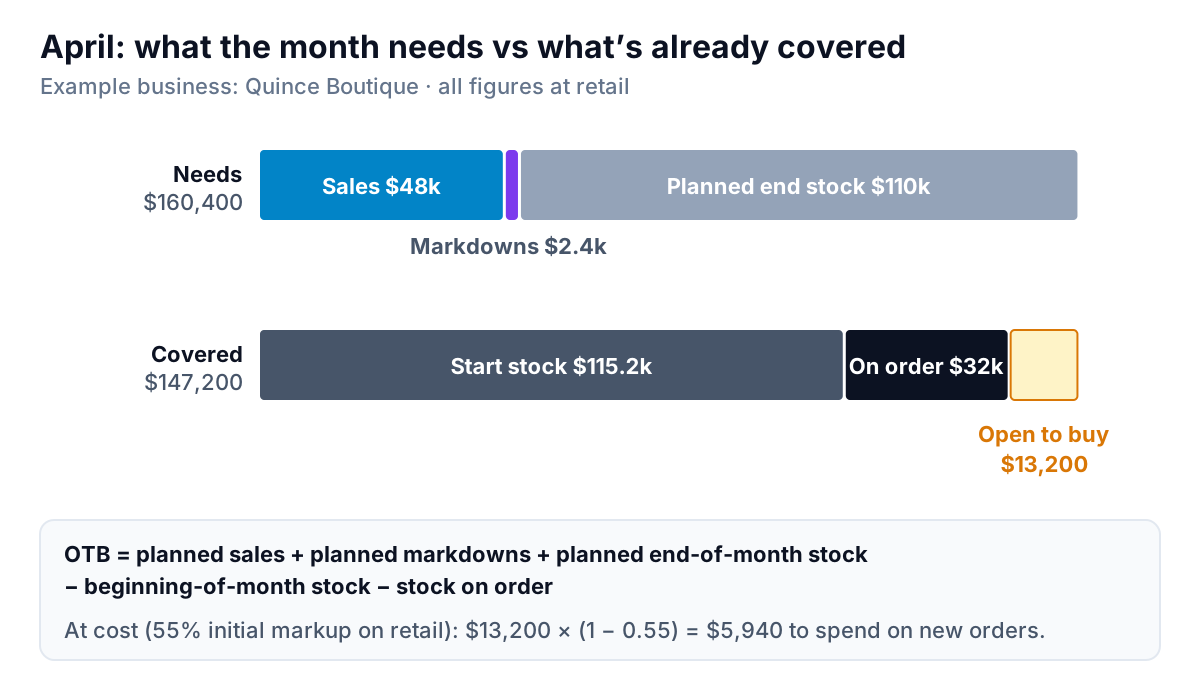
Take April. Quince plans to sell $48,000 at retail, expects $2,400 of markdowns (discounts, staff purchases and shrink, which all reduce the retail value of the stock), and wants to end the month with $110,000 of stock at retail, ready for May. That's what April needs: $160,400 in total.
Some of it is already covered. The shop expects to start April with $115,200 of stock, and $32,000 of April deliveries were ordered at the February show. That's $147,200.
The difference, $160,400 − $147,200 = $13,200, is April's open to buy at retail: what Quince can still order for April delivery and stay on plan.
The same formula appears in vendor guides such as Lightspeed's, which subtracts purchases already scheduled to arrive, and Shopify's, which leaves on-order out of the formula and tells you to reconcile open purchase orders before you calculate. The result is the same if you do it: don't count the same order twice, and don't forget it.
Planned markdowns are in the "needs" column because a markdown removes retail value from the stock without bringing in a sale at that value. If you plan to take $2,400 off prices, you need $2,400 more stock at retail to finish the month where you planned.
Building a six-month open to buy plan
One month is arithmetic. The work is in the inputs, and they chain together: each month's planned end stock is the next month's beginning stock. Quince plans the spring and summer season, February to July, in five steps.
1. Plan sales by month
Start from last year's monthly sales at retail, then adjust for what you know: a price change, a new brand, a closed competitor, a month that was unusual last year. Quince plans 5% growth, with a bigger April and May because last year's were held back by the stockout. Total: $250,000 over six months.
2. Set the stock you want at the start of each month
The usual tool is a stock-to-sales ratio: beginning-of-month stock at retail ÷ that month's sales. Work out last year's from your own records (month-start stock at retail divided by the month's sales) and adjust where last year went wrong. A ratio of 3.0 in February means starting the month with three times February's planned sales on the floor, which makes sense when the new season is arriving and sales are low. By May, at 2.2, the shop runs leaner because it's selling faster.
Beginning stock = planned sales × ratio. February: $30,000 × 3.0 = $90,000. And planned end stock for each month is simply next month's beginning stock. For July, Quince plans August sales of $32,000 at a ratio of 2.8, so July should end at $89,600.
3. Plan markdowns
Use last year's discounts by month as the starting point. Quince's are low in March and April and rise in June and July, when summer stock is cleared before autumn arrives.
4. Calculate planned purchases
Planned purchases = planned sales + planned markdowns + planned end stock − beginning stock. This is the total amount of stock, at retail, that needs to arrive during the month.
5. Subtract what's on order
Whatever is left is open to buy.
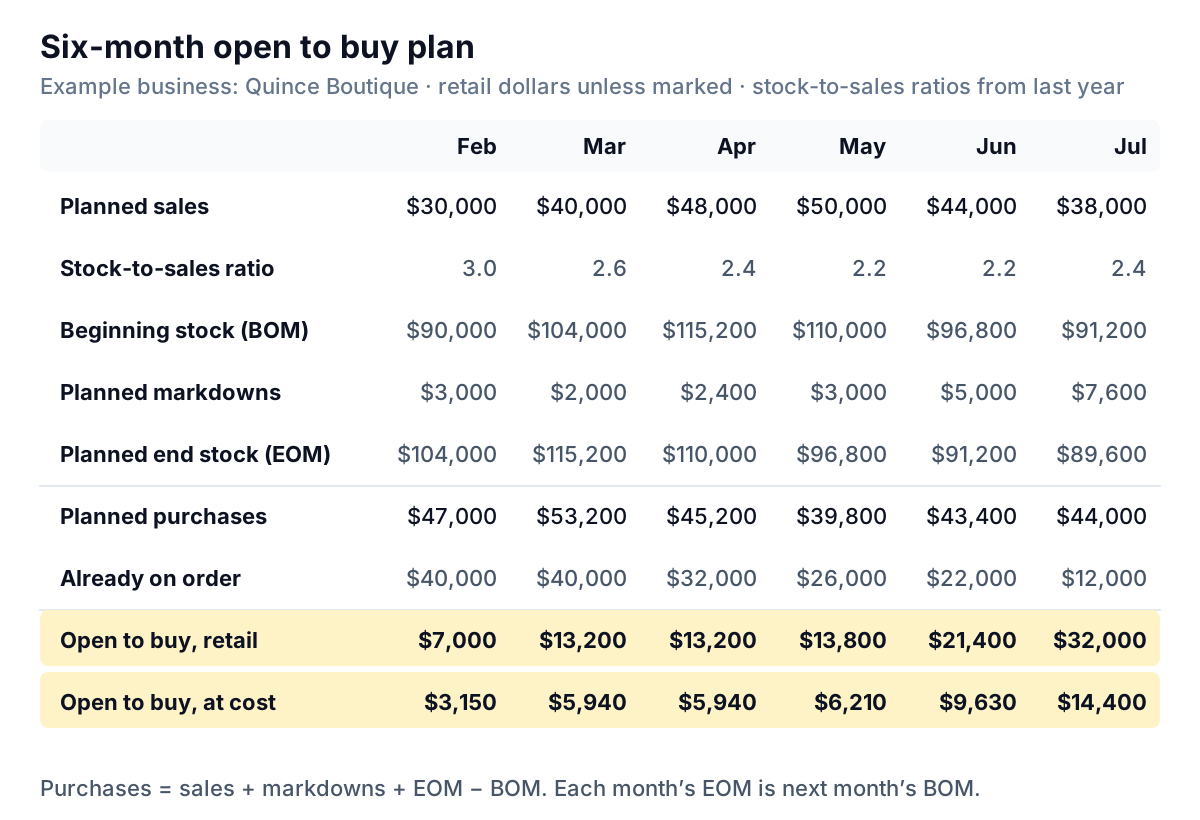
Over the six months, Quince plans $272,600 of purchases at retail. It has committed $172,000 at the show, leaving $100,600 open across the season. In February, with most of the month's goods already landed, only $7,000 is open. By July, $32,000 is still open, because summer reorders are where last year went wrong.
Retail or cost? Converting without the common mistake
The plan above is at retail, because that's how a clothing shop sees its stock and sales. But orders are placed at cost, so the open to buy has to be converted before it's useful at a trade show.
Quince's initial markup is 55% of retail: a dress priced at $100 costs $45. So:
OTB at cost = OTB at retail × (1 − initial markup % on retail)
April: $13,200 × (1 − 0.55) = $13,200 × 0.45 = $5,940. That's what the owner can still spend with suppliers for April delivery.
The mistake to avoid is multiplying by the markup itself. $13,200 × 0.55 = $7,260, which is $1,320 too much, and the error repeats every month. Some published guides blur this, so check the arithmetic against one known product: if a $100 dress costs $45, your cost factor is 0.45, not 0.55. If you think of pricing as a markup on cost instead (Quince's $45 to $100 is a 122% markup on cost), our guide to margin vs markup shows how to convert between the two.
You can also plan everything at cost from the start: sales at cost (cost of goods sold), stock at cost and markdowns ignored, since a discount doesn't change cost. That's simpler if your system reports stock at cost, as many do. Shopify's Month-end inventory value report, for example, multiplies each variant's cost per item by its month-end quantity. What you can't do is mix the two in one calculation. Shopify's guide makes the same point.
How much to commit early, and how much to hold back
The plan tells you how much you can buy in total. It doesn't tell you when to commit. That's a judgment, and it's where Quince's mistake happened last year.
Quince's rule: at the pre-season show, commit no more than about 75% of each month's planned purchases from April onwards, and keep the rest open for reorders of what sells. For February and March, when goods arrive within weeks of the show, it commits nearly everything. The table shows the result: April has 29% open, May 35%, June 49% and July 73%.
There's no standard percentage for this. A shop with suppliers who reorder in two weeks can hold back more. A shop that buys mostly one-off pieces from small makers, who won't have more later, needs to commit more up front. Set your reserve by how much you can actually reorder, and how fast.
Updating open to buy as the season happens
An open to buy plan is only as good as its last update. At the end of each month, replace the plan with what actually happened, then recalculate the months ahead.
April went better than planned. Linen dresses sold through fast, and the month finished at $55,000 of sales against $48,000. With the planned $45,200 of goods arriving and $2,400 of markdowns, April ended with $115,200 + $45,200 − $55,000 − $2,400 = $103,000 of stock, not the $110,000 in the plan. May starts $7,000 lighter.
The owner also raises May's sales forecast from $50,000 to $54,000, keeping May's planned end stock at $96,800. May's planned purchases become $54,000 + $3,000 + $96,800 − $103,000 = $50,800. With $26,000 already on order, May's open to buy goes from $13,800 to $24,800 at retail, or $11,160 at cost.
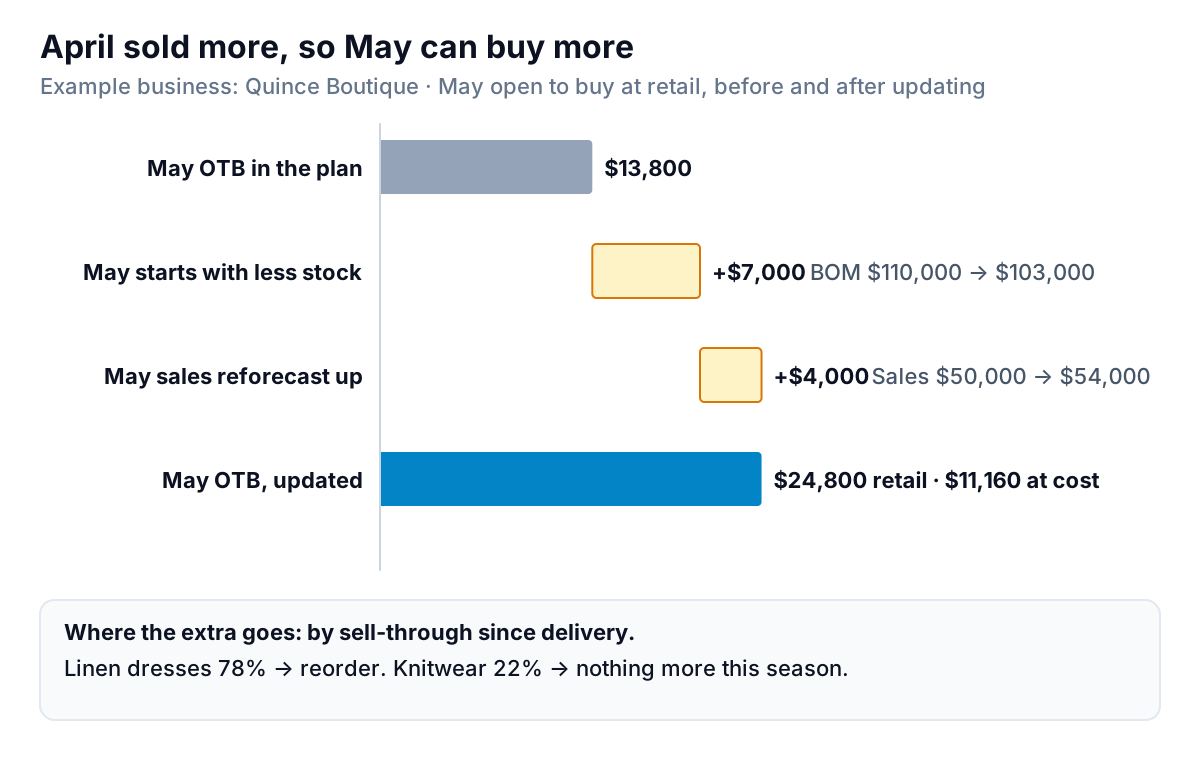
Where should the extra $11,160 go? Not evenly across the shop. Linen dresses have sold 78% of what was delivered; knitwear 22%. Our guide to sell-through rate explains how to measure that consistently and how to project where each line will finish. The open to buy says how much; sell-through says where.
When open to buy goes negative
The update works the other way too. Suppose June sales come in 15% under plan, at $37,400. June then ends with $6,600 more stock than planned, and July's open to buy falls from $32,000 to $25,400 before you even revise July's forecast. If you also cut July's sales forecast, it falls further.
If a month's open to buy goes below zero, you've committed more than the plan supports. The options, in order: push deliveries to a later month, cancel orders that the supplier allows you to cancel, transfer stock between classes where the shop is short, and as a last resort plan an earlier markdown to bring stock back down. Don't simply ignore it. Negative open to buy that nobody acts on becomes the overstock you mark down in August.
Mistakes that break an open to buy plan
- Forgetting orders already placed. Every confirmed order belongs in the on-order line. If you use QuickBooks Online purchase orders, the Open Purchase Order Detail report lists items still on order and how many have been received. If orders live in email and supplier portals, keep a simple on-order sheet by month and class.
- Counting deliveries in the wrong month. On-order goes in the month the goods arrive, not the month you placed the order.
- Using a sales forecast you don't believe. If the plan says 20% growth because you hope for it, the open to buy will tell you to buy for it. Plan sales from last year plus specific reasons.
- Never updating. A plan made in January and never revised is a guess. The monthly update takes half an hour once the inputs are set up.
- Mixing retail and cost. Retail stock with cost-based orders, or the markup used instead of its complement, quietly overstates how much you can spend.
Where the numbers come from, and keeping them current
You need five things each month: sales by class, markdowns, stock by class at the start and end of the month, and open orders. Your POS gives the first three; most systems report sales by category and stock on hand at a date. Orders come from your purchase orders or your own list. Our inventory dashboard guide covers stock value and aged stock, and the retail KPI guide shows where stock-to-sales and sell-through fit with traffic and margin.
If you export monthly sales and stock by class to a spreadsheet, Parity can build a dashboard from it: plan against actual by month and class, current open to buy and the classes running ahead or behind, with every figure checked against queries on the full dataset before you see it. Next month, update it with a newer file.
Upload your sales and stock export and get a dashboard of where you're ahead, behind and still open to buy. Build a report from your data free
This April, Quince's linen dresses sold out again. The difference is that the reorder was placed the same week, out of money the plan had kept open for exactly that.