At the end of June, the owner of Alder Point Electrical, an example business we'll use throughout this guide, was asked by her bank for the business's quick ratio. Her bookkeeper's spreadsheet said 1.57. Her own tally on the back of an envelope said 1.22. Both were using the same balance sheet, and both were using a formula you'll find in any textbook.
The difference came down to which assets each of them counted as "quick". That's the part most explanations skip, and it's the part that decides whether the number means anything. This guide gives the quick ratio formula, then goes through a small contractor's balance sheet line by line, shows how the quick ratio differs from the current ratio, and sets out what to do when it falls.
The quick ratio formula
The quick ratio, also called the acid-test ratio, compares the assets you could turn into cash within weeks with the bills you owe within a year. It leaves out stock and anything else that can't pay a bill soon. There are two common ways to write it:
- By addition: (cash + receivables + short-term investments) ÷ current liabilities
- By subtraction: (current assets − inventory − prepaid expenses) ÷ current liabilities
They give the same answer only when your balance sheet holds nothing else. Most small business balance sheets do hold something else: a loan to the owner, a deposit paid to a supplier, retainage held back by a client. The subtraction version quietly counts all of those as quick. The addition version only counts what you deliberately put in.
Benchmark publishers often use the stricter one. ProSight, whose Statement Studies benchmarks are built from bank borrowers' financial statements, defines the quick ratio as cash and equivalents plus trade receivables, divided by total current liabilities. Use that as your default, and decide each judgment call once, in writing, so next month's number is comparable with this month's.
What counts as a quick asset, line by line
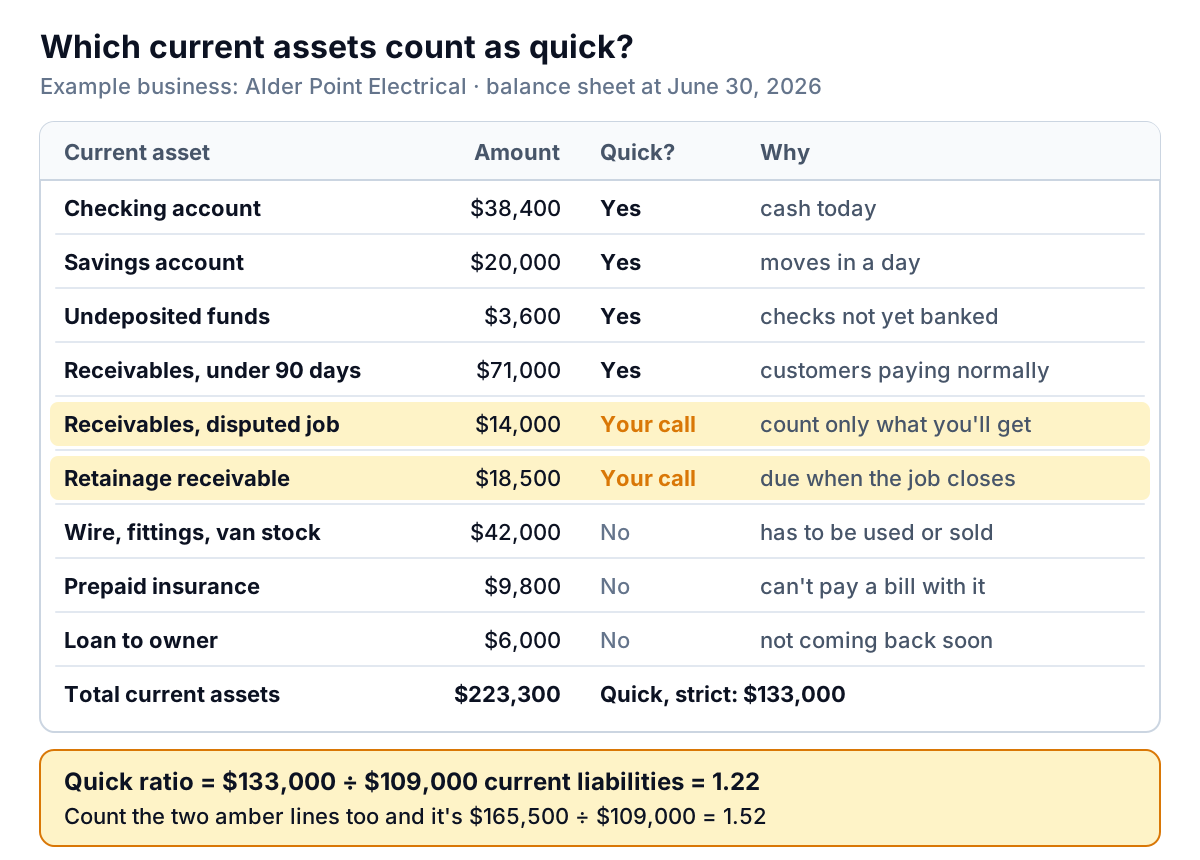
Here's Alder Point's balance sheet at June 30. Current liabilities are $109,000: $41,200 of supplier bills, $8,600 on the credit card, $15,400 of payroll and payroll taxes, $2,300 of sales tax, $12,000 of customer deposits, $20,000 on the line of credit and $9,500 of van loan repayments due within a year.
Always quick
- Bank accounts. Checking and savings. If you hold a term deposit you can't break without a large penalty, leave it out.
- Undeposited funds. Payments received but not yet banked. Check this line against reality: in QuickBooks it often holds old payments that were banked but never matched, which inflates both ratios.
- Receivables from customers who pay normally. Invoices that are current or a little late. Run your accounts receivable aging report at the same date to split them by age.
Your call, decided once
- Old or disputed invoices. Alder Point has $14,000 owed on a job where the customer disputes the final invoice. Count only what you expect to collect within a couple of months. If you don't expect to collect it at all, ask your accountant about writing it off.
- Retainage. On construction jobs, clients often hold back part of each payment until the work is finished and signed off. Alder Point's $18,500 isn't due until a project closes in November. It's a real asset, but not one that pays July's bills.
- Short-term investments. Count money-market funds or treasury bills you could sell in days. Leave out shares you'd be reluctant to sell.
Never quick
- Inventory and materials. Wire, fittings, van stock. They become cash only after a job is done and invoiced and the customer pays.
- Prepaid expenses. Insurance paid a year ahead is used up, not cashed in.
- Loans to the owner or staff. Technically receivables, practically not coming back this quarter.
- Work in progress and unbilled costs. If you use job costing, amounts you've earned but not yet billed need an invoice before they can be collected. Most owners leave them out; your accountant can tell you how your lender treats them.
Alder Point's strict quick ratio: ($38,400 + $20,000 + $3,600 + $71,000) ÷ $109,000 = $133,000 ÷ $109,000 = 1.22. Add the two judgment calls and it's $165,500 ÷ $109,000 = 1.52. The bookkeeper's 1.57 came from the subtraction formula, which also counted the $6,000 owner loan.
Quick ratio vs current ratio
The current ratio divides all current assets by current liabilities. It answers "if everything on the shelf and every invoice turned into cash, would it cover this year's bills?" The quick ratio answers a harder question: "could we cover them without selling any more stock?"
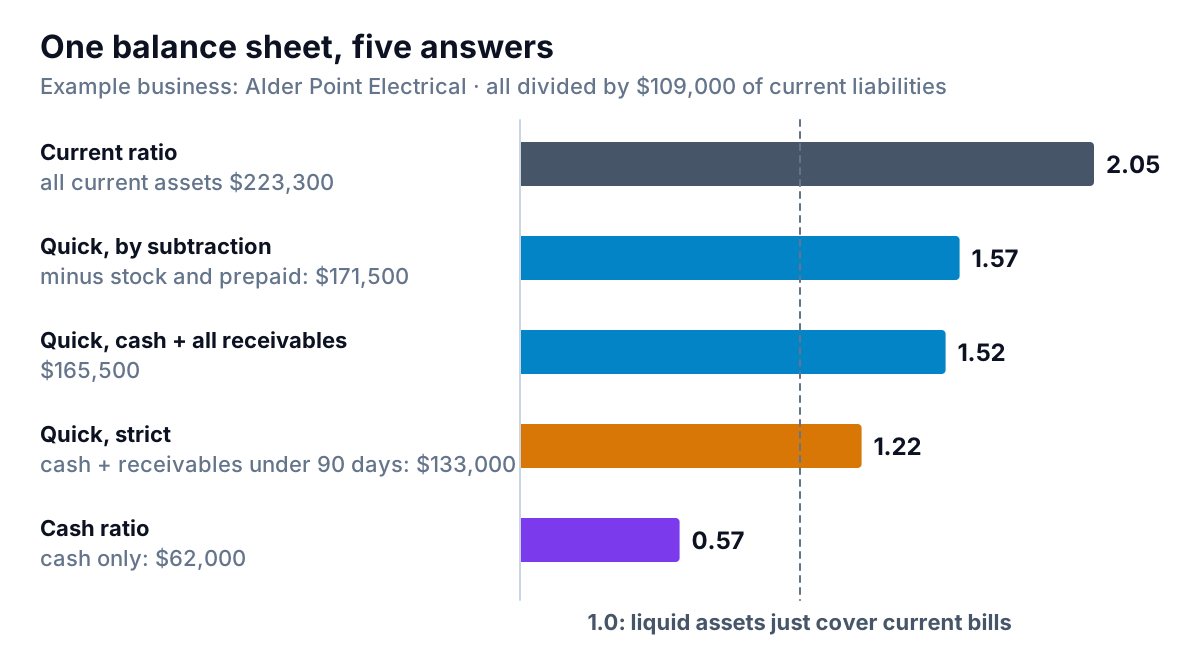
The gap between the two ratios is your dependence on stock. For a business with no inventory, such as a consultancy, they're nearly identical, and the quick ratio adds little. For a contractor, wholesaler or shop, the gap matters more than either number on its own, because it moves when stock builds up.
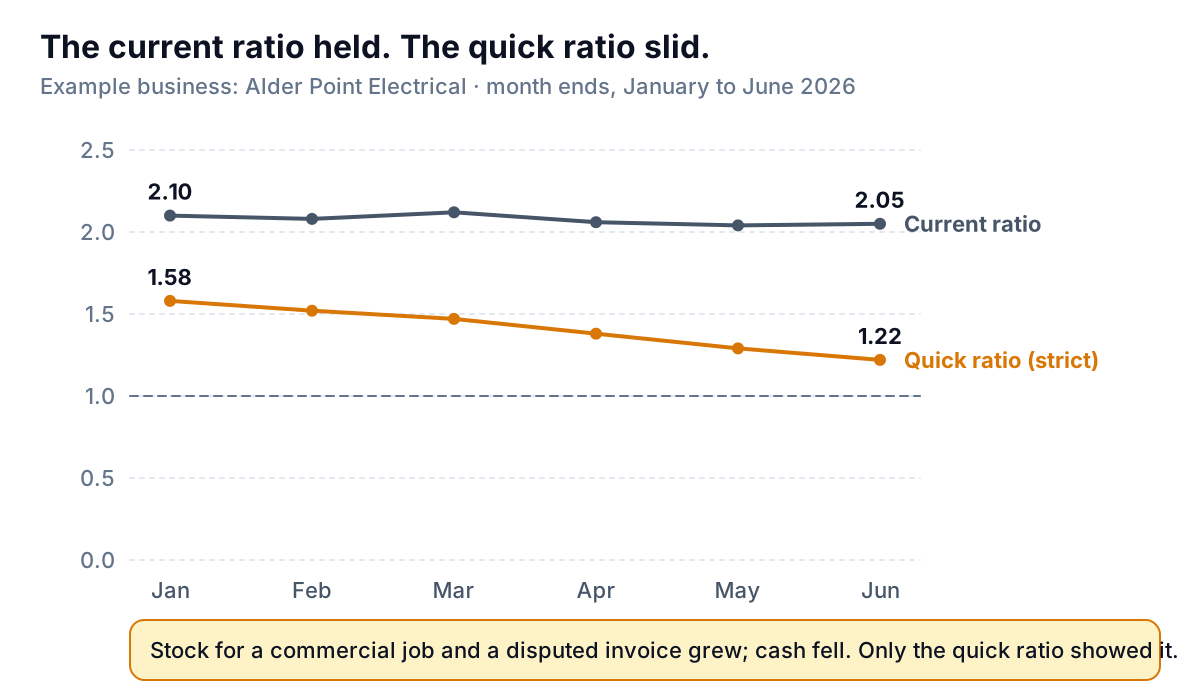
That's what happened at Alder Point over the first half of 2026. The business bought materials early for a large commercial job, and the disputed invoice aged. The current ratio barely moved, because stock replaced cash one for one. The quick ratio fell every month.
Both ratios are snapshots of one day. If you want to know how long cash is tied up between buying materials and getting paid, that's the cash conversion cycle, and if you want the dollar cushion rather than a ratio, that's working capital.
What's a good quick ratio?
The textbook answer is "1.0 or higher", and it has a basis: ProSight's definitions note that a value below 1 to 1 implies a "dependency" on inventory or other less liquid assets to pay short-term debt. Beyond that, there's no single good number. A business paid by card at the counter can run well below 1.0 safely, because cash arrives daily. A contractor with lumpy progress payments needs more headroom.
For a real comparison, look up your industry in ProSight Statement Studies, built from the financial statements of small and medium-sized bank borrowers. Its guide to the ratios explains that each one is shown as a median with upper and lower quartiles, and notes that values outside the quartiles "may begin to approach 'unusual' values." Business libraries often carry it (the University of Wisconsin's guide to industry ratios lists it, for example), so check before you buy, or ask your banker what they compare you with.
Then use simple rules on your own trend:
| What you see | What it usually means | What to do |
|---|---|---|
| Below 1.0 | Next few months' bills depend on finishing jobs, selling stock or borrowing | Build a 13-week cash flow forecast now and line up credit before you need it |
| Falling three months running | Cash is turning into stock or slow receivables | Find which line moved (it's usually one) and act on that line |
| Steady, near your industry median | Normal for your trade | Keep checking monthly |
| Well above your industry's upper quartile for a year | Cash may be sitting idle | Ask whether it should pay down debt or fund growth |
Getting the quick ratio from your books
- QuickBooks Online Advanced can chart it for you: go to Reports, then Performance center, where quick ratio and current ratio are among the metrics you can track (admin users only). On other plans, run the Balance Sheet and work it out yourself. Either way, check which accounts sit in each section, because QuickBooks can't know that your "Loan to owner" account isn't quick.
- Xero's Executive Summary shows "Current assets to liabilities", which is the current ratio, but not a quick ratio. Take the bank and receivables lines from the Balance Sheet instead.
- A spreadsheet: list each current asset with a column marking it Y or N for quick, then
=SUMIF(C2:C20,"Y",B2:B20)/B22, where B22 holds total current liabilities. The Y/N column is your written-down policy for the judgment calls.
Use the same date every month, ideally after bank reconciliation. A ratio worked out from an unreconciled balance sheet tells you about your bookkeeping, not your business.
When the quick ratio drops: what to do
First, find out which side moved. A falling ratio can mean fewer quick assets or more current liabilities, and the fixes are different.
- Receivables are slower. Sort the aging report by balance over 60 days. Call the top three customers this week. For the disputed job, agree a figure: a settled $11,000 is worth more than a disputed $14,000.
- Cash went into stock. Bulk-buying materials for a job can be sensible, but agree with the client to bill for materials on delivery, so the stock is matched by an invoice.
- Liabilities grew. Check whether customer deposits rose. Deposits bring in cash and add a liability, because you owe the work. That's healthy. A growing credit card balance isn't.
Mistakes that make the quick ratio meaningless
- Changing the definition between months. Write down which accounts count, and keep them.
- Counting every receivable at face value. An invoice 200 days old is a collection problem, not a quick asset.
- Using a year-end figure for a seasonal business. An electrician's quick ratio in January and in July can differ a lot. Compare the same month year on year, or watch all twelve.
- Forgetting the loan repayments due within a year. They belong in current liabilities. Leave them out and the ratio flatters you.
- Reading it alone. Pair it with the current ratio to see your dependence on stock, and with cash in the bank to see the next few weeks.
Parity makes the month-by-month view easy to keep. Connect QuickBooks Online, or upload a balance sheet export from Xero or another tool as CSV or Excel, and it builds a dashboard with headline numbers and their trends, charts, what explains them, and a table of what needs attention, such as the receivables that have slipped past 90 days. Every number is checked against queries on the full dataset before you see it. Ask it by chat to "chart the quick ratio counting only cash and receivables under 90 days" and it keeps your definition in the template for next month.
Connect QuickBooks and get a checked dashboard of your quick ratio, current ratio and the receivables behind them. Build a report from your data free
When the bank asks again, Alder Point's owner will send 1.22, with one line explaining what's in it and what isn't. A lender trusts a modest number with a clear definition far more than a flattering one nobody can explain.