Glazeworks Pottery Studio's accountant sent over the 2025 statements in February, and one number made the owner reach for a supplier catalogue: cash flow from operating activities, $70,700. Net income was only $42,000. If the studio's day-to-day business had thrown off $28,700 more cash than it earned, she reasoned, a second $22,000 kiln was affordable. (Glazeworks is an example business we invented for this guide; its numbers add up.) Cash flow from operating activities is the cash a business's normal trading brought in during the period, after paying for that trading: net income adjusted for costs that used no cash and for money tied up in, or released from, receivables, stock, bills and customer prepayments. Most of Glazeworks' extra $28,700 turned out to be money students had paid for classes they hadn't taken yet.
This guide walks through the calculation line by line, the sign rules that make it work, what belongs elsewhere on the statement, and how to tell when operating cash flow is flattering you. If you want the shorter picture of why profit and cash differ in general, our guide to the balance sheet vs the income statement covers it. This one is about the operating section itself.
Glazeworks' cash flow from operating activities, line by line
Almost every small business statement uses the indirect method: start from net income and adjust it. You need the income statement for the year and the balance sheets at the start and end of it.
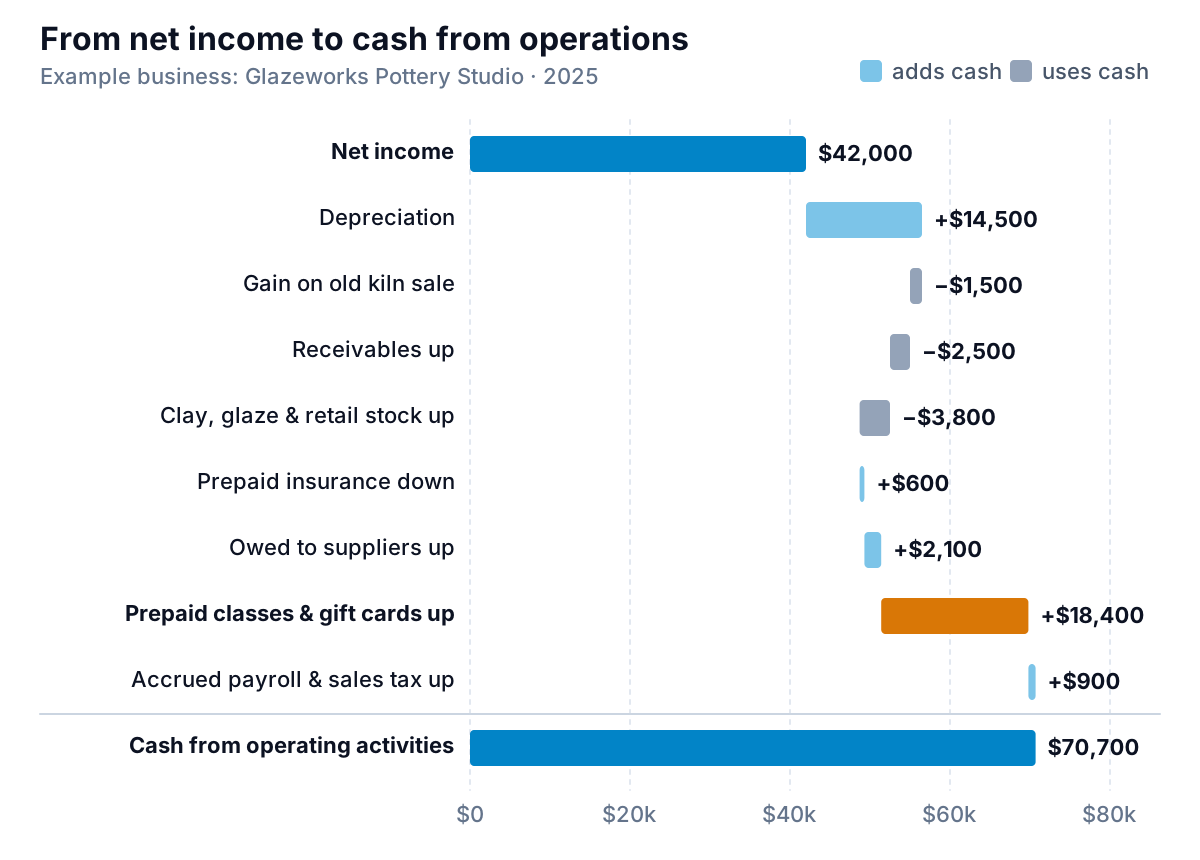
1. Start with net income: $42,000
Take it from the income statement for the same period. Glazeworks is a single-member LLC, which the IRS by default treats as disregarded as separate from its owner for income tax, so its profit is reported on her personal return. That's why there's no owner's salary and no business income tax in this figure. Her draws appear later on the statement, and her personal income tax doesn't appear at all. Ask your accountant how your own entity is set up.
2. Add back expenses that used no cash: +$14,500
Depreciation on the kilns, wheels and studio fit-out reduced profit by $14,500, but no money left the bank for it this year. The cash went out when the equipment was bought, and that purchase shows up in investing activities. Amortization of intangibles, if you have any, is added back the same way.
3. Remove gains and losses that belong elsewhere: −$1,500
Glazeworks sold its oldest kiln for $3,000. Its book value was $1,500, so the income statement shows a $1,500 gain. The whole $3,000 of cash is reported in investing activities, so the gain is taken out here to avoid counting it twice. The standard calls for exactly this: Deloitte's summary of ASC 230's format rules lists gains and losses on sales of property, plant and equipment among the items removed from net income in the reconciliation. A loss would be added back.
4. Adjust for working capital: +$15,700 in total
Compare each operating asset and liability on the two balance sheets:
- Receivables up $2,500 (−$2,500). Corporate team-building events were invoiced in December and paid in January. Revenue counted; cash didn't arrive.
- Stock up $3,800 (−$3,800). Clay, glazes and pieces for the retail shelf bought but not yet used or sold.
- Prepaid insurance down $600 (+$600). Part of a policy paid last year was used up this year, an expense with no cash out.
- Owed to suppliers up $2,100 (+$2,100). Bills received, not yet paid.
- Prepaid classes, memberships and gift cards up $18,400 (+$18,400). The studio sold more eight-week course places for January starts and more holiday gift cards than it did a year earlier. The cash is in the bank; the revenue isn't earned until the classes run, so the balance sheet shows it as a liability, often called unearned or deferred revenue.
- Accrued payroll and sales tax up $900 (+$900). The last week of December's wages and the quarter's sales tax, both owed but unpaid.
Net income $42,000, plus $14,500, minus $1,500, plus $15,700: cash from operating activities, $70,700.
The four sign rules, and why they work
The working capital lines trip people up more than anything else on the statement. There are only four cases.
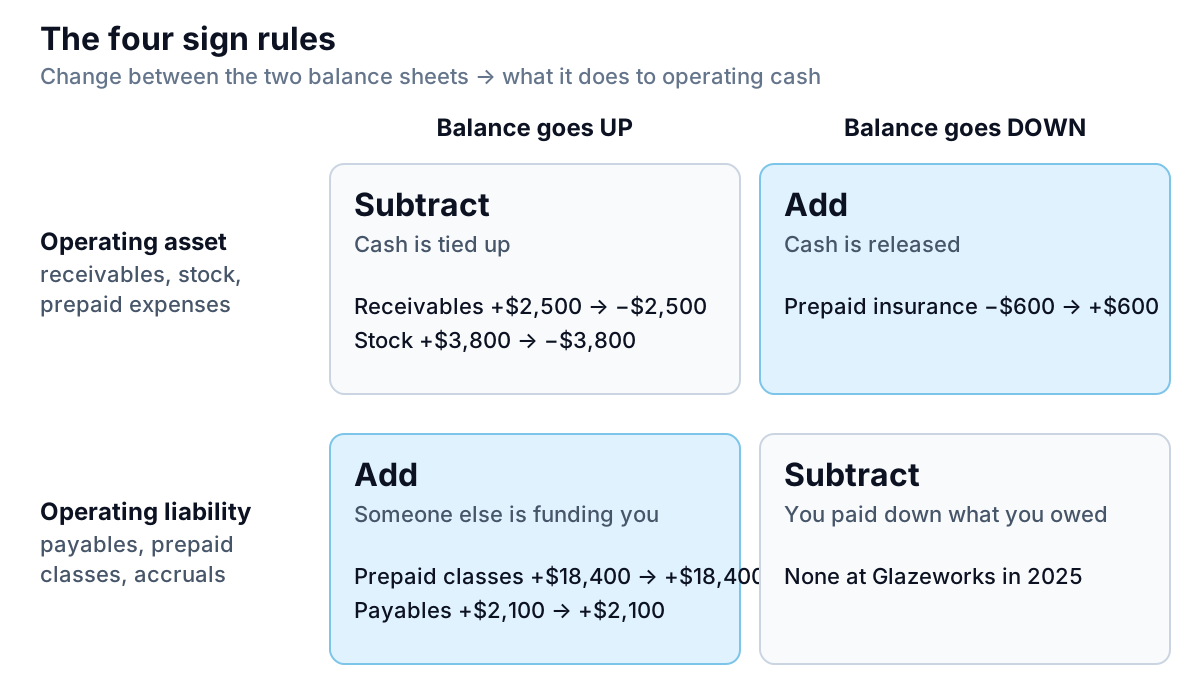
The logic: net income counts revenue when it's earned and expenses when they're incurred, on the accrual basis. Each working capital line is the gap between that timing and when cash moved. More receivables means you counted sales you haven't been paid for, so subtract. More owed to suppliers means you counted costs you haven't paid, so add. If you can remember one rule, remember "assets go the opposite way to cash".
Two practical checks. First, use only operating lines here: the current portion of a loan is a current liability but belongs in financing, and cash itself is the answer, not an input. Second, the standard requires the major classes of reconciling items, such as changes in receivables, inventory and payables, to be reported separately, so don't net them into one "working capital" line on statements you give a lender.
What doesn't belong in operating activities
The other two sections finish the statement. Getting items into the right one matters, because lenders and buyers read the operating total on its own.
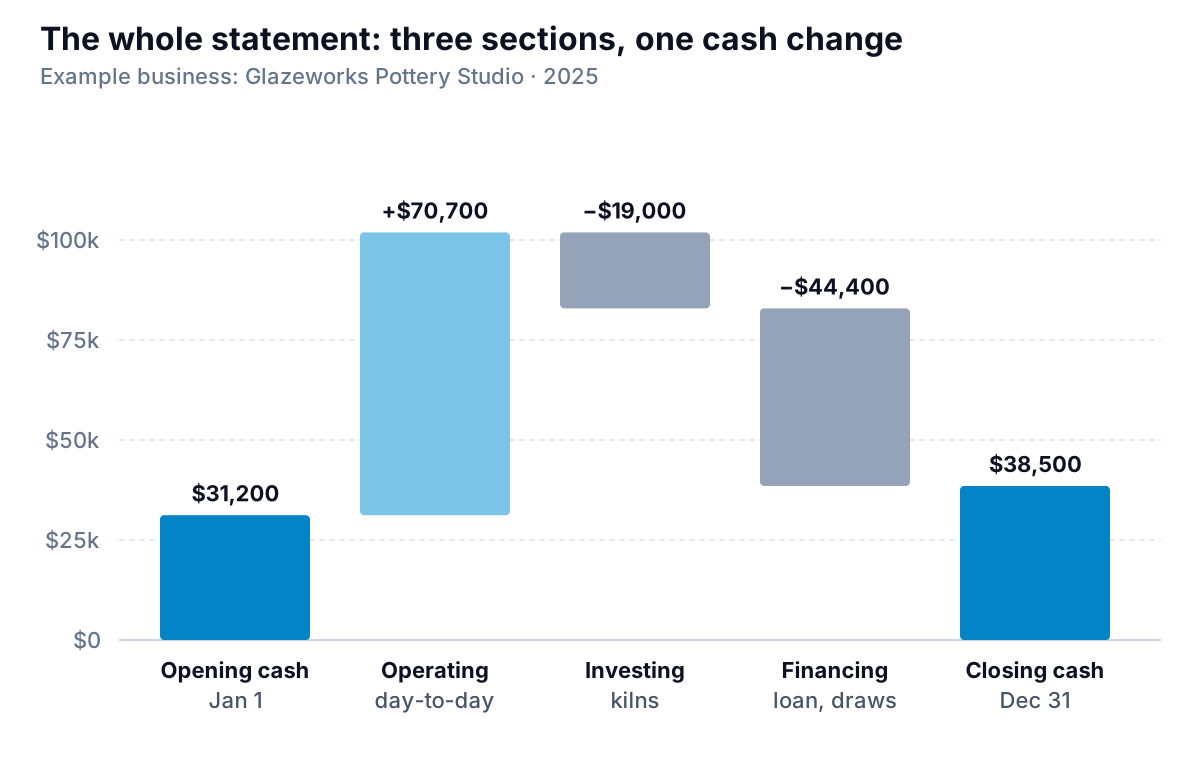
- Investing: −$19,000. A new $22,000 kiln, less the $3,000 from selling the old one. Equipment purchases are investing, not operating, even though the business can't run without them.
- Financing: −$44,400. $8,400 of loan principal and $36,000 of owner's draws. Under US GAAP, Deloitte's summary of the standard lists distributions to owners and repayments of amounts borrowed as financing outflows.
- Interest stays in operating. The $3,100 of loan interest was already deducted in net income and stays there: US GAAP lists cash payments to lenders for interest among operating outflows, along with taxes paid. Only the principal goes to financing.
Opening cash of $31,200, plus $70,700, minus $19,000, minus $44,400, is $38,500: exactly the bank balance on December 31. If your version doesn't land on the closing cash figure, a balance sheet line is missing or in the wrong section.
The direct method, briefly
The direct method reaches the same $70,700 by listing actual receipts and payments: cash from customers, cash paid to suppliers, to employees, for interest and so on. ASC 230 encourages it, but Deloitte notes that many entities use the indirect method, and anyone using the direct method must still show the reconciliation from net income. For a small business, one direct-method line is worth knowing because it tells you about collections:
Cash from customers = revenue − increase in receivables + increase in unearned revenue. Glazeworks: $318,000 − $2,500 + $18,400 = $333,900. The studio collected $15,900 more than it earned this year, almost all of it prepayments.
Is operating cash above profit good news?
Usually it's a healthy sign. A business whose cash flow from operating activities runs well below profit year after year is turning profit into receivables and stock instead of money. But a single year above profit needs a second look, because some of the lines that raise it reverse.
Glazeworks' three years:
| Year | Net income | Cash from operating activities | Operating cash ÷ net income |
|---|---|---|---|
| 2023 | $39,800 | $46,100 | 1.16 |
| 2024 | $44,600 | $47,900 | 1.07 |
| 2025 | $42,000 | $70,700 | 1.68 |
Two years of about 1.1 (depreciation explains most of the gap), then a jump to 1.68 in a year when profit fell. That pattern says "find the one-off". Here it's the $18,400 rise in prepaid classes and gift cards. That cash is real, but it comes with a duty to teach the classes, and it only adds to operating cash once. If prepaid sales next December merely match this December's, that line will be zero next year; if they fall back, it will be negative.
Strip it out and Glazeworks' underlying operating cash was about $52,300. From that, the studio paid $19,000 net for kilns and $8,400 of loan principal, leaving $24,900, against $36,000 of owner's draws. On an ordinary year's cash, the owner drew about $11,100 more than the business produced, and the January students covered it.
So the second kiln waited. The decision rule the owner took from it: never spend an increase in customer prepayments. Treat it as a timing gift, keep it in the bank until the classes run, and plan spending from operating cash with that line removed. The same applies to any business that takes deposits, sells memberships or annual plans, or issues gift cards. Lower-than-usual operating cash deserves the reverse question: is it a temporary build in receivables or stock, or a trend? Our working capital guide covers the levers.
You'll also see "free cash flow", usually defined as operating cash flow minus capital spending ($70,700 − $22,000 = $48,700 for Glazeworks). It's not a GAAP term and people calculate it differently, so if a lender or buyer quotes one, ask for their definition.
Getting it from QuickBooks, Xero or a spreadsheet
QuickBooks Online has a Statement of Cash Flows report under Reports, then Standard reports. Intuit's help article notes that the report runs only on the accrual basis, and Intuit's list of reports by plan includes it in Simple Start, Essentials and Plus. Software decides which section each line goes in from the account's type, so check two things before you trust it: that loans are set up as liabilities rather than expenses, and that owner's draws post to an equity account. A loan repayment booked as an expense understates profit and puts principal in the wrong section.
From two balance sheets and a P&L, which works with any software: put the balance sheets side by side, calculate the change in each line, then apply the steps above. Our guide to the comparative balance sheet shows the side-by-side layout and the sources-and-uses view that leads straight into this statement.
If your books are on the cash basis, most of the working capital lines disappear, because there are no receivables or bills recorded in the first place, and net income is already close to operating cash. That doesn't mean the timing issues have gone; they just aren't visible. Our guide to cash vs accrual accounting explains what you can and can't see on each basis.
Common mistakes to check for:
- Owner's draws in operating activities. They make operating cash look worse than it is.
- Adding back a gain instead of subtracting it, or forgetting it, which double-counts the sale proceeds.
- Sales tax collected counted as the business's money. A rise in sales tax payable adds to operating cash, but it belongs to the state. Read it like the prepaid classes.
- Reading one year alone. The ratio to net income and the trend over three years say more than any single figure.
Watching cash flow from operating activities monthly is easier than finding out in February. Parity connects to QuickBooks Online directly, or takes an Excel or CSV export from any other tool, and builds a dashboard with the headline numbers and their trends, charts, what explains them and a table of what needs attention. Every number is checked against queries on the full dataset before you see it. Ask for operating cash flow by month next to net income, with the change in customer prepayments shown separately, and refine it by chat. To look forward instead of back, pair it with a cash flow forecast.
Connect QuickBooks or upload your statements and get a checked dashboard that shows where profit and cash part ways. Build a report from your data free
The second kiln arrived the following September, after the autumn courses had run and the cash from them was fully earned. Same kiln, same price; the only thing that changed was knowing which part of $70,700 was really the studio's.