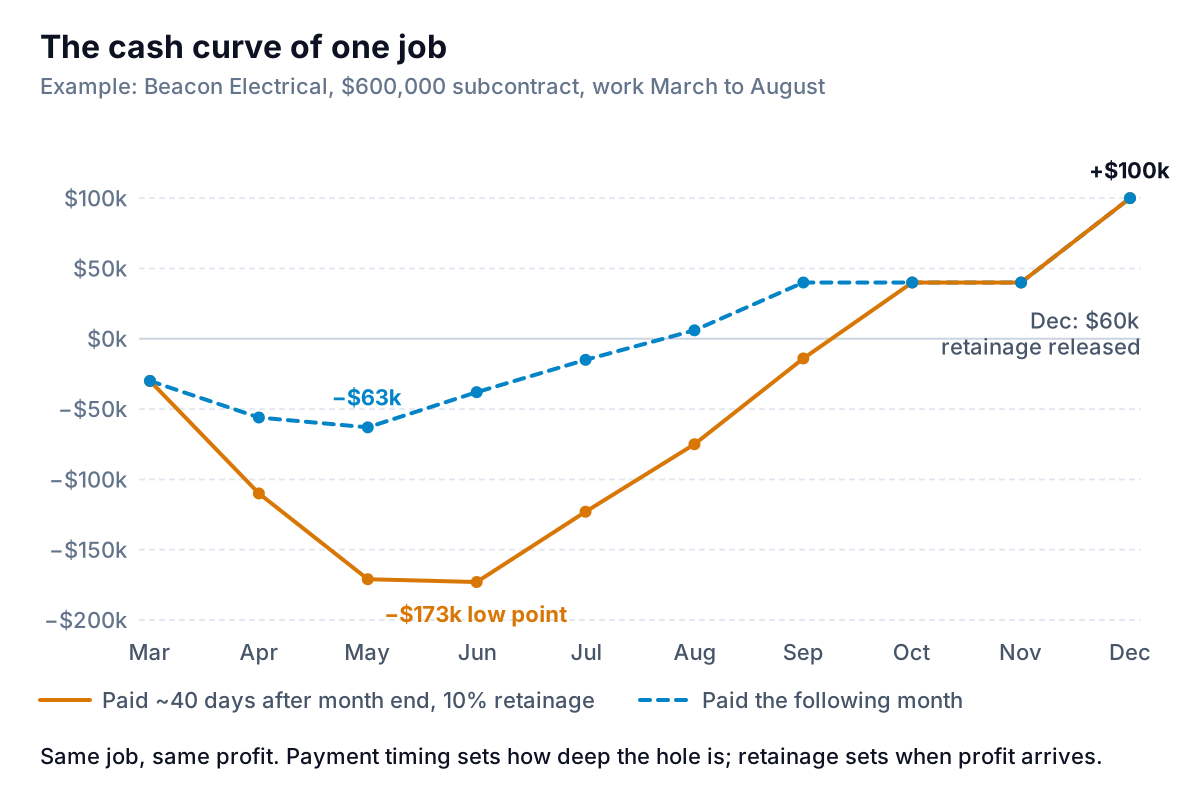
To make $100,000 on a $600,000 subcontract, Beacon Electrical, a made-up electrical subcontractor, first had to find $173,000 of its own money. That was the job's low point, in June, two months before the crew left site. The gap between those two numbers is what construction cash flow is about: the timing of money in and out of each job, with progress payments in, minus retainage and the wait for payment, against labor, materials and subcontractors out. Cumulative job cash = cash received to date − cash paid out to date, and on most jobs it goes deeply negative before it turns positive.
That's why a contractor with a full order book and good margins can still struggle to make payroll. This guide draws the cash curve of Beacon's job, then takes apart the three things that shape it: the pay chain, retainage and the schedule of values. Every number reconciles, so you can rebuild the curve for your own jobs. Contract terms and the law on retainage and payment clauses vary by state and by contract, so treat the legal points as background and check your own with a construction attorney or CPA.
The cash curve of one job
Beacon has a $600,000 subcontract to wire a medical office building, running March to August. It expects $500,000 of cost, so $100,000 of gross profit (16.7%). The terms are typical of many subcontracts: Beacon bills monthly for work done, the general contractor (GC) holds back 10% as retainage, and the GC pays within 10 days of being paid by the owner, which in practice means about 40 days after Beacon's month-end bill.
On Beacon's side, 60% of the cost is crew labor, paid weekly, and 40% is materials from a supplier on 30-day terms. Here's what happens to the bank account:
| Month | Work billed | Cash in | Cash out | Cumulative cash |
|---|---|---|---|---|
| Mar | $60,000 | $0 | $30,000 | −$30,000 |
| Apr | $120,000 | $0 | $80,000 | −$110,000 |
| May | $150,000 | $54,000 | $115,000 | −$171,000 |
| Jun | $120,000 | $108,000 | $110,000 | −$173,000 |
| Jul | $90,000 | $135,000 | $85,000 | −$123,000 |
| Aug | $60,000 | $108,000 | $60,000 | −$75,000 |
| Sep | – | $81,000 | $20,000 | −$14,000 |
| Oct | – | $54,000 | $0 | +$40,000 |
| Nov | – | $0 | $0 | +$40,000 |
| Dec | – | $60,000 retainage | $0 | +$100,000 |
| Total | $600,000 | $600,000 | $500,000 | +$100,000 |
Three things stand out. Beacon has to fund up to $173,000 of this job itself, in June, from cash or a credit line. The job doesn't pay back its costs until October, two months after the crew leaves. And $60,000 of the $100,000 profit, 60% of it, sits with the GC as retainage until December.
Now the dashed line. If the GC paid in the month after each bill instead of about 40 days after month end, the low point would be −$63,000 in May. Payment speed, not price, decides how much cash a job needs. That's the most useful thing a subcontractor can know when negotiating terms.
Why the hole is so deep: the pay chain
The core problem of construction cash flow is two clocks: every dollar Beacon spends goes out faster than the dollar that pays for it comes in.
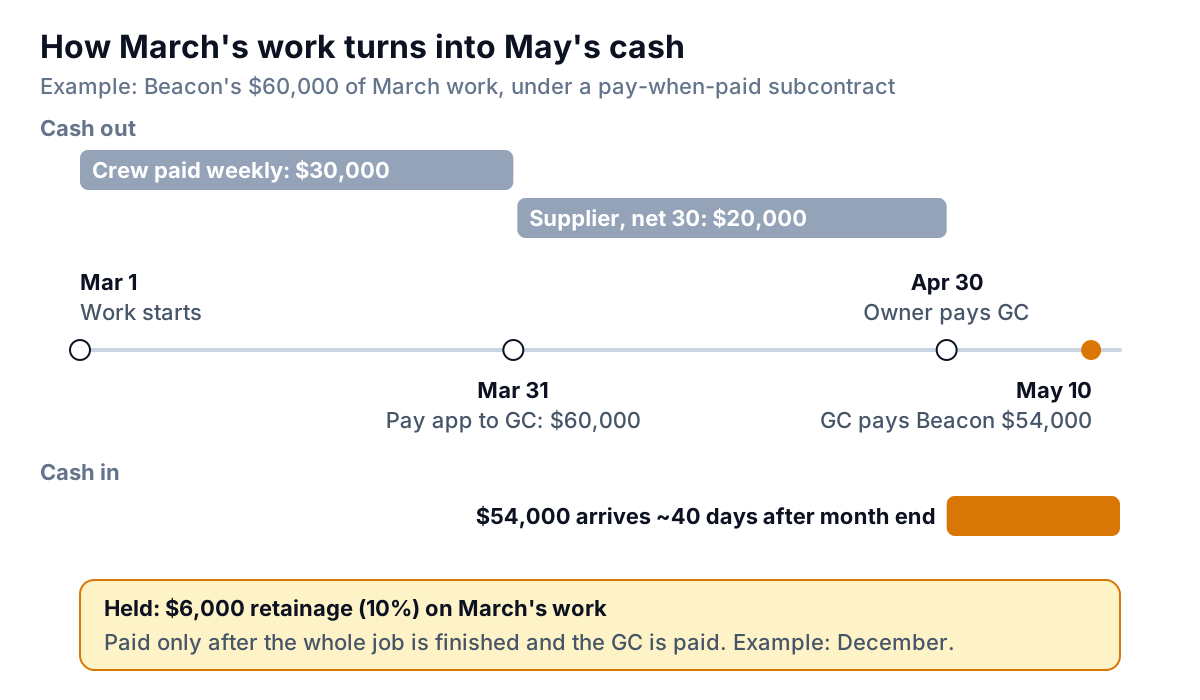
- Payroll is weekly. Crew wages for March leave the account in March.
- Suppliers give 30 days. March's wire, conduit and panels are due at the end of April.
- Billing is monthly, and in arrears. Beacon can only bill March's work on March 31.
- The GC bills the owner, including Beacon's work in its own application. The owner's architect or lender reviews it before the owner pays.
- The GC pays Beacon after it's paid. Under Beacon's pay-when-paid clause, within 10 days of receiving the owner's payment.
The further down the chain you are, the longer the wait. A sub-subcontractor or supplier to Beacon waits for Beacon too.
Pay-when-paid vs pay-if-paid
The clause that links your payment to the owner's matters as much as the price. A pay-when-paid clause is generally read as a timing rule: the GC can wait for the owner's money for a reasonable time, but still owes you. A pay-if-paid clause tries to make the owner's payment a condition, so if the owner never pays, neither does the GC.
States treat these very differently. California's courts held pay-if-paid clauses unenforceable in a 1997 case, as law firm Haight Brown & Bonesteel explains, while in Michigan, Clark Hill wrote in 2023 that courts enforce them if they are clear and carefully worded, and a bill to void them had been introduced. Before you sign, have a construction attorney in your state read the payment clause, and price the job knowing whose credit you're really relying on: the owner's, not the GC's.
Retainage: profit you've earned but can't spend
Retainage (or retention) is the share of each payment held back until the job is finished, as security that the work gets completed and corrected. At 10%, it's $60,000 on Beacon's job: 10% of revenue, but 60% of the profit. On a thin-margin job, retainage can be more than the whole profit.
The rules depend on who the owner is and where the job is:
- Federal contracts. The Federal Acquisition Regulation says retainage shall not exceed 10% of the approved amount, should be decided case by case based on performance, and that retained amounts are paid promptly once the contract is complete.
- Private jobs in California. SB 61 caps retention at 5% on private works of improvement for contracts entered into from January 1, 2026, with exceptions, and subcontracts must mirror the prime contract's retention terms, according to Pillsbury Winthrop Shaw Pittman.
- Other states have been cutting retainage too. EC&M reported in August 2026 on recent changes in New York, Illinois, Iowa and Indiana, and noted that the National Electrical Contractors Association lobbied for California's law.
What would 5% do for Beacon? We ran the same job: the low point barely moves (−$168,000 instead of −$173,000), but the job turns cash-positive in September instead of October and $30,000 of profit arrives in October instead of December. Retainage shapes when profit arrives far more than how deep the hole gets.
To get retainage back faster:
- Negotiate a reduction at 50% complete, or retainage released for your scope when your scope is done, not when the building is.
- Finish the closeout paperwork fast: punch list, as-builts, warranties, operation manuals, lien waivers. Missing paperwork is a common reason retainage sits for months.
- Track retainage by job and age, separately from receivables. Our construction KPI guide treats retainage aging as one of the eight numbers to review monthly.
Pay applications, draw schedules and front-loading
On commercial work, you bill through a pay application. Many projects use the AIA forms: the G702 Application and Certificate for Payment, with a G703 continuation sheet that breaks the contract into lines of the schedule of values. Here's Beacon's June application, the arithmetic every pay app follows:
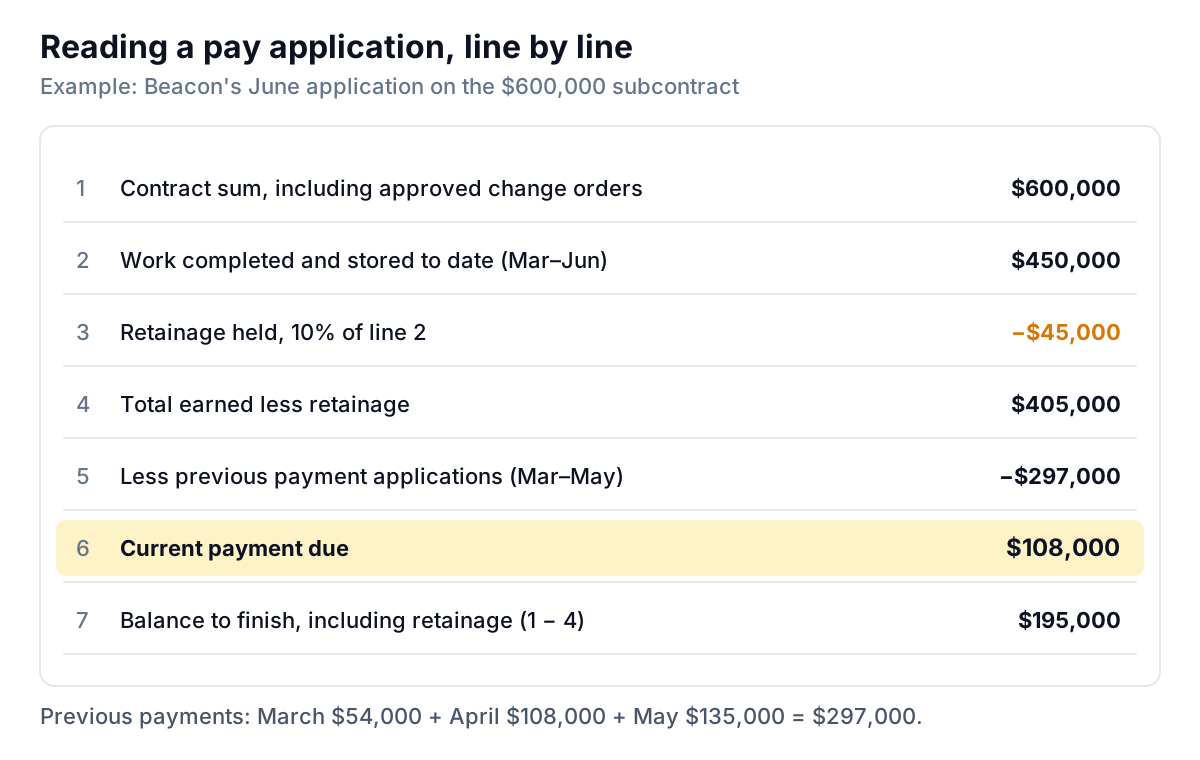
The schedule of values is the list of line items the contract sum is split into, agreed at the start. It decides how much you can bill each month, so it shapes your cash curve before you lift a tool. Two legitimate ways to bring cash forward:
- A mobilization line, for real start-up costs such as setting up the site, submittals and the first material orders, billed in the first month.
- Billing for stored materials. Pay apps such as the G702 include materials stored to date. If your contract allows it, switchgear and fixtures delivered and stored before installation can be billed when they arrive, not when they're installed. Check what proof of delivery, ownership and insurance your contract asks for.
Front-loading is the other route: putting more value on early lines than they're worth, so the early bills run ahead of the work. If Beacon had billed $90,000 for March's $60,000 of work, its cash curve would look better in May, but it would be $30,000 overbilled, and that money belongs to work it hasn't done. The bills at the end of the job are then too thin to cover the cost of finishing it. Owners and GCs can reject a schedule of values that looks front-loaded, and overbillings show up on your work in progress schedule, where lenders and sureties see them. Our construction WIP report guide explains how over and under billing show up, and why overbillings should be matched by cash in the bank.
Residential draw schedules
On homes and remodels financed by a construction loan, the lender usually pays in draws tied to stages, such as foundation, framing, rough-ins, drywall and completion, often after an inspection. The cash rules are the same: map each draw against the cost you'll have paid by then, and make sure no stage leaves you funding a big gap. A deposit and a first draw that cover materials ordered at the start make the biggest difference.
From one job to the whole company
A contractor's construction cash flow is the sum of every job's curve, plus overhead. Two jobs starting in the same month dig two holes at once; a big job finishing while three small ones start can leave the company short even in a record year. That's why a company cash forecast for a contractor works best built job by job:
- For each job, list remaining billings by month, with your real payment lag and retainage.
- List remaining costs by month: labor when the crew works, materials on supplier terms, subs on their terms.
- Add overhead, loan payments, taxes and owner draws.
- Find the lowest week or month, and make sure your cash plus credit line covers it with room to spare.
For the forecasting method itself, see our guides to the cash flow forecast and the weekly 13-week cash flow. Your margins decide how much room you have; our construction profit margin guide covers that side, and the job costing guide shows how to keep each job's costs honest.
Decision rules and common mistakes
| Situation | Rule |
|---|---|
| Bidding a job | Draw its cash curve first. If the low point is more than your free cash plus unused credit line, negotiate terms or pass |
| Choosing what to negotiate | Payment timing first (it sets the hole), retainage second (it sets when profit arrives) |
| A pay app is rejected or cut | Find out which line and why within 48 hours; a month's delay moves the whole curve |
| Retainage unpaid 60 days after your scope is done | Assign one person to finish closeout and chase it weekly |
| Two large jobs starting together | Add their curves; arrange credit before the second one starts, not when payroll is due |
Common mistakes:
- Counting retainage as cash. It's receivable months from now, and sometimes never if the job ends in a dispute.
- Forecasting from contract terms, not history. If a GC's contract says 30 days and it really pays in 55, use 55.
- Billing late. A pay app sent on the 5th instead of the 25th can miss the owner's cycle and add a month to the wait.
- Using overbillings to fund other jobs. It works until the overbilled job needs that cash to finish.
Seeing construction cash flow across every job
Drawing one job's curve by hand is a useful exercise. Keeping fifteen of them current every month is a job in itself, and it's usually the one that slips.
Parity connects to QuickBooks Online directly, or takes a CSV or Excel export from your construction accounting software, such as billings, receivables and retainage by job. Upload them and describe what you need: retainage held by job and age, how long each GC really takes to pay, billings against costs month by month. It builds a dashboard with the headline numbers and their trends, charts, what explains the changes and a table of what needs attention, such as retainage on finished jobs and customers paying slower than their terms. Every number is checked against queries on the full dataset before you see it. Share it with your banker as a read-only link, or export it to PDF before you ask for a larger credit line.
Connect QuickBooks Online or upload your billing exports, and see receivables, retainage and payment speed by job on one checked dashboard. Build a report from your data free
Beacon's job made $100,000. It also needed $173,000 for three months to earn it. Know both numbers before you sign the next subcontract, and negotiate the terms that change the second one.