"Profit and Loss." "Income statement." "Statement of operations." In one week in March, the owner of Hearth & Crumb Bakery, an example business we'll use in this post, was asked for all three: by her accountant, by the bank renewing her equipment loan, and by a landlord's form for a second shop. She assumed she needed three reports. She needed one.
On income statement vs profit and loss, the short answer is that they're the same statement under two names. Both show revenue for a period, the costs of earning it, and what's left: net income or a loss. What does change from one request to the next is the accounting basis, the period and the layout, and those can move the bottom line by thousands of dollars. This post covers the names, the few that mean something slightly different, and the details that matter more than the title.
Income statement vs profit and loss: why two names for one report
"Income statement" is the term you'll find in accounting textbooks, in loan paperwork and in the SEC's beginners' guide to financial statements, which describes it as a report of how much revenue a company earned over a specific period and the costs charged against it. "Profit and loss", or P&L, is what most small businesses say out loud, and it's the name of the report in QuickBooks Online: Intuit's guide to running reports walks through finding Profit and Loss in the standard reports list.
Here is Hearth & Crumb's 2025, which is the same document whichever name goes at the top:
| Hearth & Crumb Bakery (example), year to 31 Dec 2025, accrual basis | Amount |
|---|---|
| Counter sales | $412,000 |
| Wholesale to cafés | $168,000 |
| Custom cakes | $64,000 |
| Total revenue | $644,000 |
| Ingredients and packaging | ($233,800) |
| Gross profit | $410,200 |
| Wages, rent, utilities and other operating costs | ($361,500) |
| Operating income | $48,700 |
| Interest on the equipment loan | ($4,200) |
| Net income | $44,500 |
Some articles claim an income statement is more formal or more detailed than a P&L. That's a habit, not a rule. A P&L your bookkeeper prints with forty expense lines is more detailed than a five-line income statement in a loan summary. The level of detail depends on who prepared it and for whom, not on the name. If you want to read each of these lines properly, our guide to the profit and loss statement goes through them, and our income statement examples show three layouts side by side.
Other names you'll meet, and the two that aren't quite the same
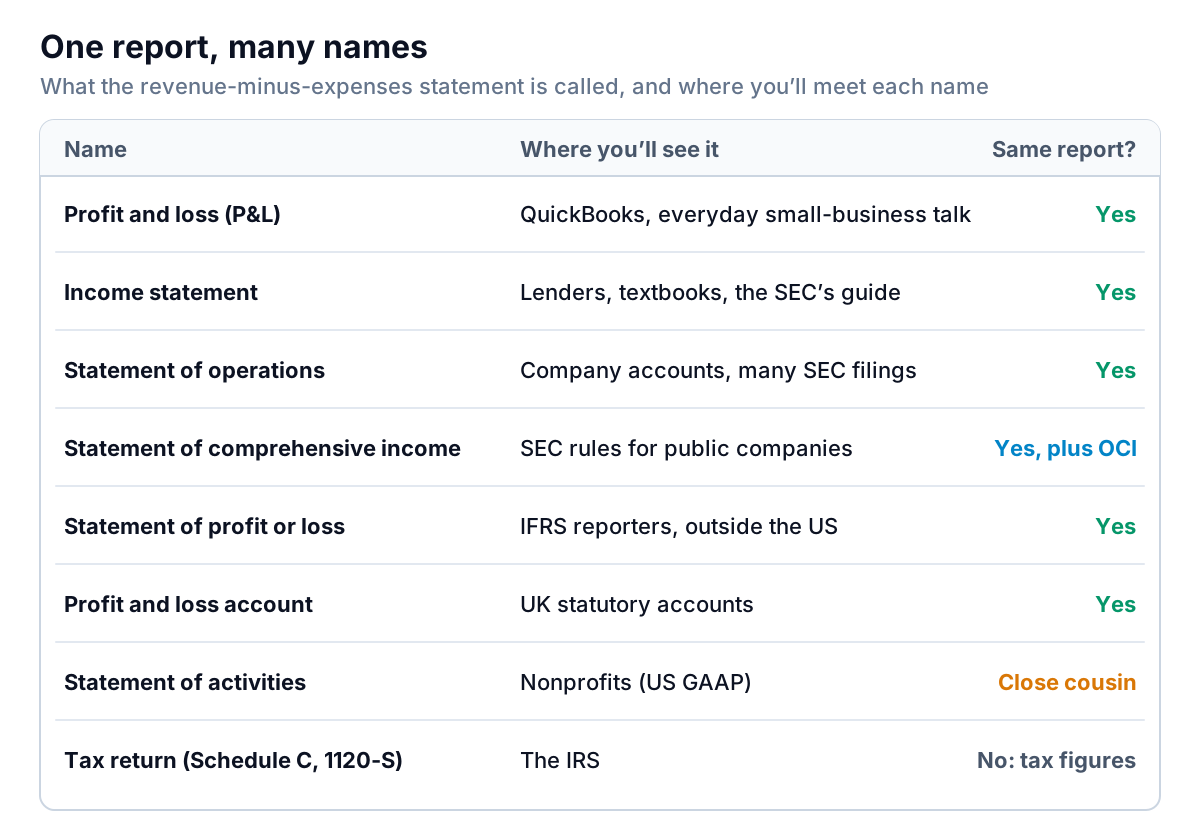
- Statement of operations. A title you'll see on company financial statements, including many public filings. Same content.
- Statement of comprehensive income. The SEC's rules for public companies set out line items for statements of comprehensive income (Regulation S-X, Rule 5-03). "Comprehensive" adds a second section, other comprehensive income, for things like certain unrealised investment gains and currency translation. A small business with none of those items has nothing to add, so for you it's the income statement under a longer name.
- Statement of profit or loss. The term used under IFRS, the international standards. The IASB's new standard, IFRS 18, applies to annual periods beginning on or after 1 January 2027 and adds two required subtotals to this statement: operating profit, and profit before financing and income taxes. That matters if you sell to or report to a parent company abroad; it doesn't change US small-business books.
- Profit and loss account. The UK name. GOV.UK says a private limited company's annual accounts include a profit and loss account showing sales, running costs and the profit or loss. In bookkeeping, "profit and loss account" can also mean the ledger account that income and expenses are closed into at year-end, which is where some of the "they're different" claims online come from.
- Statement of activities. The nonprofit version under US GAAP. It reports revenue and expenses too, but it ends in the change in net assets rather than profit, split between net assets with and without donor restrictions, as the Journal of Accountancy's summary of the not-for-profit reporting standard explains. If you sit on a charity's board, this is the report you'll be reading.
- Your tax return. Schedule C, or page 1 of Form 1120-S for an S corporation, looks like an income statement but uses tax rules. The IRS form for S corporations even has a section titled Schedule M-1, Reconciliation of Income (Loss) per Books With Income (Loss) per Return, because the two numbers are expected to differ. Depreciation methods and partly deductible expenses such as business meals are frequent reasons.
Where the difference matters: basis, period and layout
When the bank asked for Hearth & Crumb's "income statement for 2025", the owner nearly sent the version her bookkeeper runs for her month-end cash review. Same report name in QuickBooks. Different number.
The accounting basis
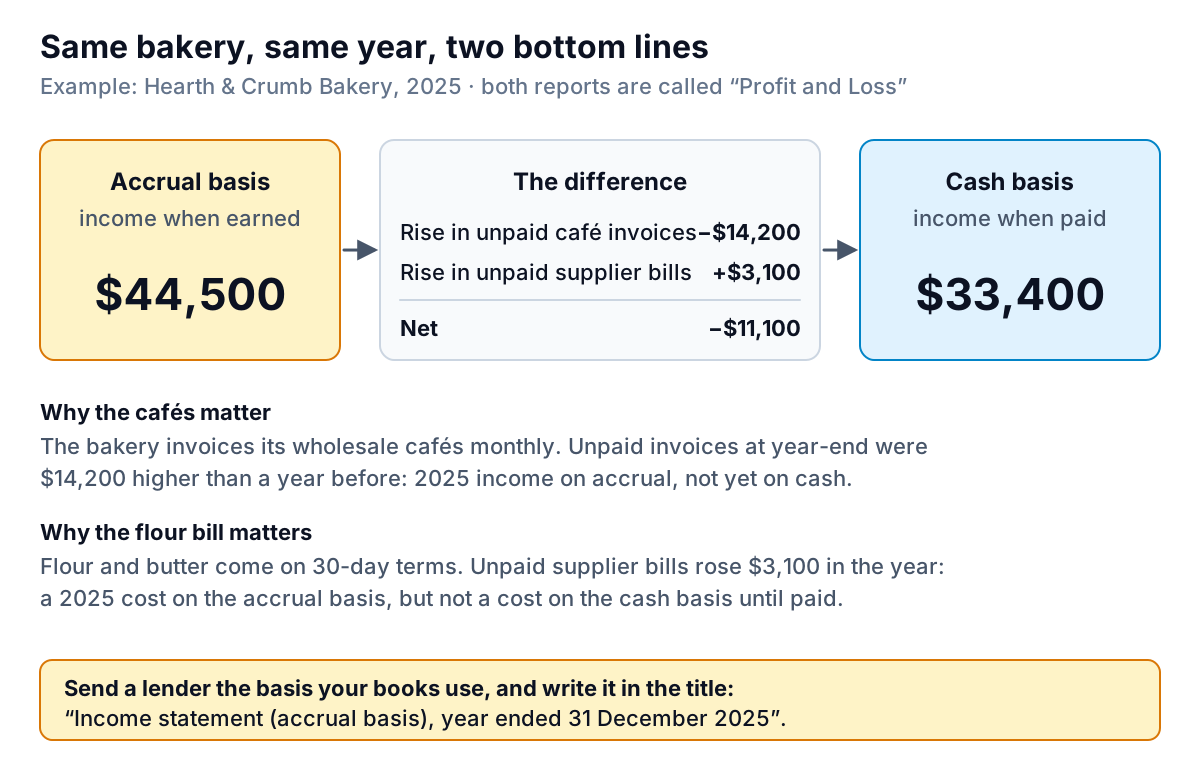
On the accrual basis, income counts when it's earned and costs when they're incurred. On the cash basis, both count when money moves. The IRS explains the two methods, and the rules on who may use which, in Publication 538. Hearth & Crumb's wholesale cafés pay monthly invoices a few weeks late, and at the end of 2025 they owed $14,200 more than a year earlier. That's 2025 income on the accrual basis and not yet income on the cash basis. Unpaid flour and butter bills rose $3,100, which works the other way. Net: $44,500 on accrual, $33,400 on cash. Our guide to cash vs accrual accounting covers the choice itself.
The rule for anyone asking: send the basis your books are kept on, and say which it is. Don't switch basis for one reader because the number looks better.
The period
"Last year" can mean the calendar year, your fiscal year or the last twelve months. A lender reviewing a renewal in March may want both the full prior year and the year to date. Put the exact dates in the title.
The layout, and management P&Ls
Inside a business, "P&L" often means something narrower than the financial statement: a P&L for one location, one product line or one client. Hearth & Crumb's owner keeps a wholesale P&L that charges the delivery van and the early-morning baker to the café accounts. It's useful for deciding whether wholesale is worth it, but it isn't the income statement, because its costs are allocated by her judgment and it covers only part of the business. If you share one outside the business, label it as a management report.
The definitions in a contract
The one place a name can carry real weight is a signed agreement. A loan agreement might require you to send "annual financial statements prepared in accordance with GAAP" within 120 days of year-end, or keep "net income" above a set level. A shop lease with a percentage-rent clause might define "gross sales" in a way that excludes some of what your P&L calls revenue, such as gift card sales or delivery fees. In each case the definition written in the agreement decides what counts, not the title on your report.
So when a contract mentions your income statement, read the definitions section before you send anything. Check three things: which accounting basis it expects, whether it names a standard (GAAP, or "consistently applied" methods), and whether it adjusts any line, for example by excluding one-off gains or adding back owner pay. Hearth & Crumb's equipment loan, in this example, asks for year-end statements on the same basis as the year before, which is one more reason not to switch from accrual to cash for a single reader. If the wording isn't clear, ask the lender in writing, and have your accountant or lawyer look at anything that could put you in breach.
What to send when someone asks for one
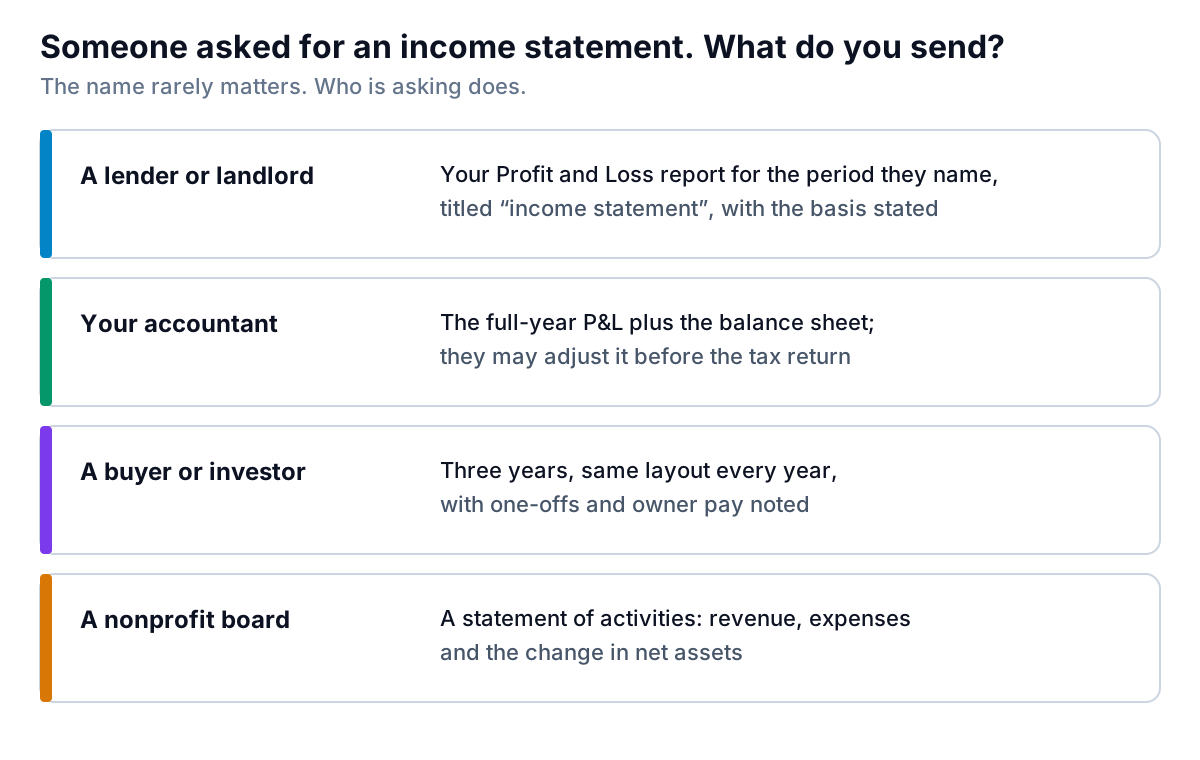
Whatever they call it, five details make the statement usable for the person receiving it:
- A title that says what it is: "Hearth & Crumb Bakery LLC, income statement (accrual basis), year ended 31 December 2025".
- Who prepared it. "Prepared by management from the company's books" is honest and normal for a small business. If an accountant compiled or reviewed it, they'll put their own report on it; don't describe internally prepared figures as reviewed.
- A comparison column. Last year beside this year answers the reader's first question before they ask it.
- Notes on one-offs. An insurance payout, a one-time equipment repair, a month the shop was closed. One line each.
- The balance sheet for the same end date, if they're lending. The two statements are read together; our guide to the balance sheet vs income statement shows how they connect. If you need all three statements in one tied-out workbook, our financial statement template has them.
Pick one name and use it everywhere
For your own business, choose a name and stick to it in your folders, your monthly pack and your emails. "P&L" is fine. What causes trouble is three files called "income statement", "P&L final" and "profit loss v2" that were run on different dates with different settings. Keep one set of report settings (basis, grouping of accounts, comparison columns), save it in your accounting software as a custom report, and export from that every time.
Three checks before any version leaves the building:
- Does net income match the figure in equity on the balance sheet for the same date (or the year-to-date net income line, if your software shows one)?
- Is the basis the same as last time you sent it?
- Are this year's lines grouped the same way as last year's, so the comparison column means something?
If you send the same statement every month, to a partner, an investor or a lender, Parity can take that work over. Connect QuickBooks Online, or upload the Profit and Loss export from any other system, and it builds a dashboard with headline numbers, trends, what explains the changes and what needs attention. Ask for a report and it writes one from the same data, ready to share by read-only link or export to PDF or Excel, with every number checked against queries on the full dataset first. Call it whatever your reader calls it.
Connect QuickBooks Online or upload your Profit and Loss export, and get a report your reader can follow. Build a report from your data free