The year-end count at Bergamot Gift Shop, an example shop we'll follow in this guide, finished at 9:40 on a January Sunday night. The point-of-sale system said the shop held $68,400 of stock at cost. The shelves and back room held $65,200. The owner's first thought was shoplifting. When she traced the $3,200 gap item by item over the next two weeks, theft explained about $500 of it. The rest came from a loading dock, a till key and a broom.
That's the useful way to think about retail inventory management in a small shop: a handful of habits that keep the stock record true and the money in stock moving. Receive carefully, keep item records clean, count a little every week, buy with a rule, and clear what doesn't sell on a calendar. This guide covers each one with Bergamot's numbers. It doesn't repeat the dashboard side (turnover, aged-stock buckets, reorder formulas), which our inventory dashboard guide already covers.
Measure the gap before you fix it
Shrink is the difference between the stock your records say you should have and the stock you actually have, usually shown as a percentage of sales for the same period. Bergamot sold $410,000 in 2025, so its shrink was $3,200 ÷ $410,000 = 0.78%.
For a rough outside reference, the National Retail Federation's 2023 National Retail Security Survey put average shrink at 1.6% of sales in fiscal 2022, up from 1.4% the year before. Treat that with care: it's a survey of mostly large retailers' loss prevention teams, and it's the last one NRF published with a shrink rate. Retail Dive reported in October 2024 that NRF would not publish its annual shrink report that year. Your own trend from one count to the next is the number that matters.
The figure matters less than the breakdown. Bergamot's owner pulled every item with a variance over $20 and asked one question of each: what's the most likely reason?
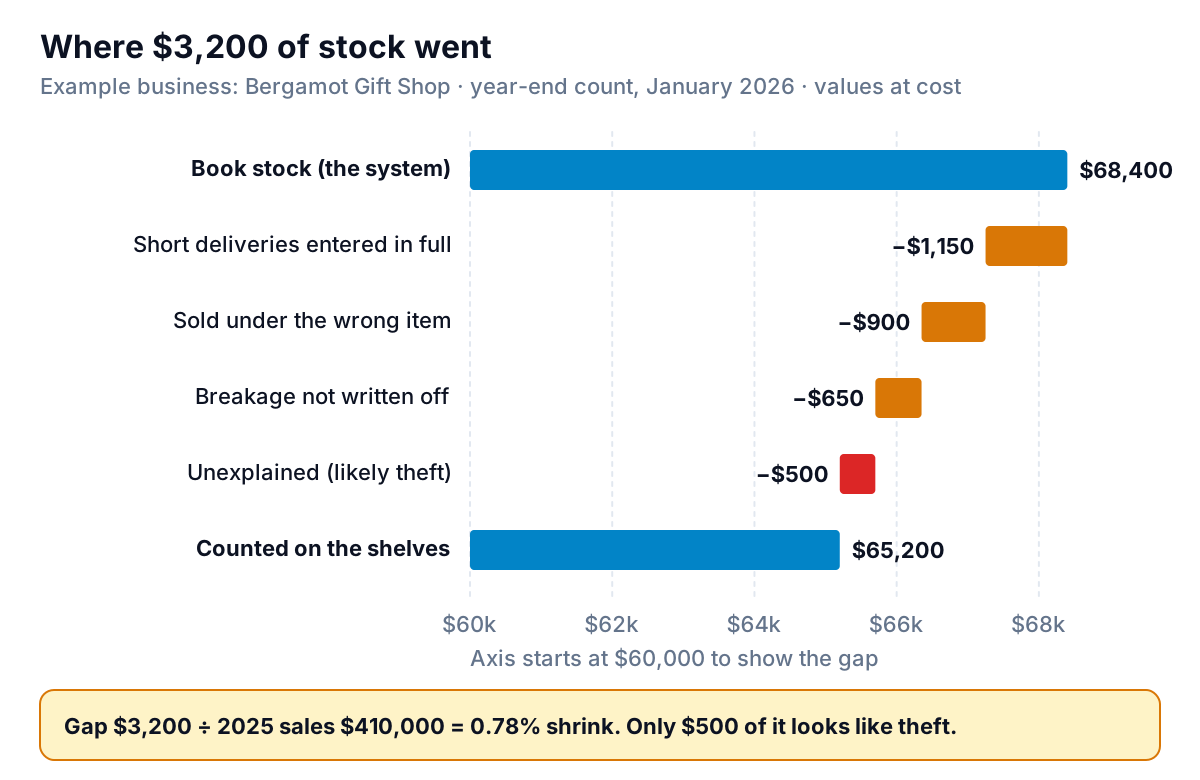
Three of the four causes are paperwork, not crime. That's good news, because paperwork is cheap to fix. The sections below take them in the order they cost Bergamot money.
Receiving: where most small-shop stock goes missing
$1,150 of Bergamot's gap came from deliveries that arrived short but were entered in full. A carton of 24 candles held 18. A case of greeting cards was missing a whole pack of six designs. Nobody opened the boxes against the packing slip; someone received the purchase order in the system with one tap, and the system believed it.
Shopify, for example, describes receiving a transfer as checking each item and choosing to accept or reject it, and only accepted items add to your available stock. Most systems work the same way. The software can only be as accurate as the person doing the tapping.
A receiving routine that fits a shop with one or two people:
- Count before you sign. If the driver waits, count the cartons against the delivery note. A missing carton is easy to claim on the doorstep and hard to claim a week later.
- Open and count inside the same day. Check every line against the packing slip, not the purchase order. The slip is what the supplier says it sent.
- Receive only what you counted. Short lines get received short, with a note, and a message to the supplier for credit.
- Check the invoice against what you received before it's paid. Bergamot found two invoices billed for the full order after a short delivery.
- Price and shelve after receiving. Stock sitting in the back room unreceived is invisible to the system and easy to sell under the wrong code.
Clean item records make retail inventory management possible
$900 of Bergamot's gap came from the till. Staff rang up items under the wrong code when a barcode wouldn't scan: a $34 candle under the $22 candle's button, a set of earrings under a generic "Jewelry" key. Each sale took the wrong item out of stock. The candle that sold still showed on hand; the one that didn't sell went negative, or would have, if the generic key had tracked stock at all.
The fixes are boring and they work:
- One SKU per thing you'd reorder separately. If you'd ever reorder the lavender candle without the cedar one, they need separate SKUs. Variants (size, colour, scent) count.
- Remove or lock the open-price keys. A "Misc gift" button is how stock leaves the shop without leaving the system. If staff need it, require a note and review its sales weekly.
- Label everything on receipt. Items without a scannable label are where wrong-code sales start.
- Use adjustment reasons. When you change a quantity by hand, record why. Shopify's adjustment history, for instance, offers reasons such as correction, count, received, damaged, and theft or loss. A year of reasons is a breakdown like Bergamot's, without the two weeks of detective work.
The last $650 was breakage: chipped mugs and cracked frames put in a bin under the counter and never written off. The fix is the same: a damaged-goods log by the bin (date, item, quantity), entered as an adjustment at the end of each week.
Count a little, every week
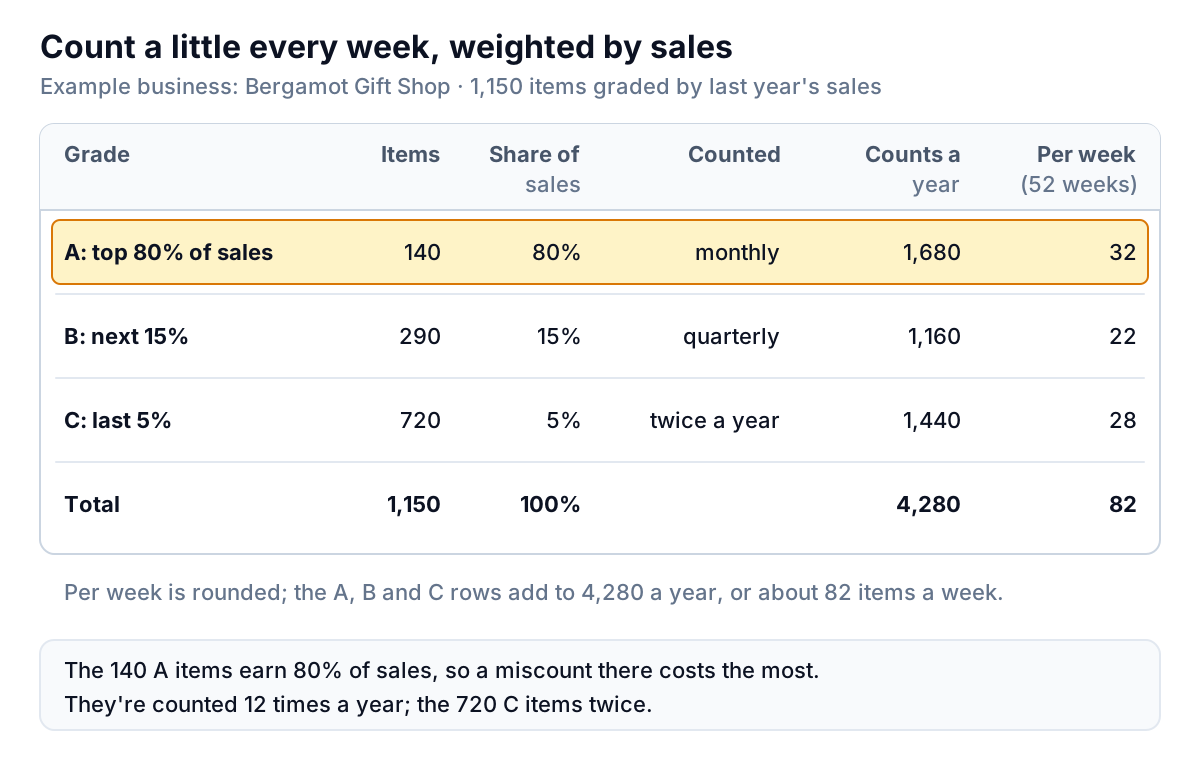
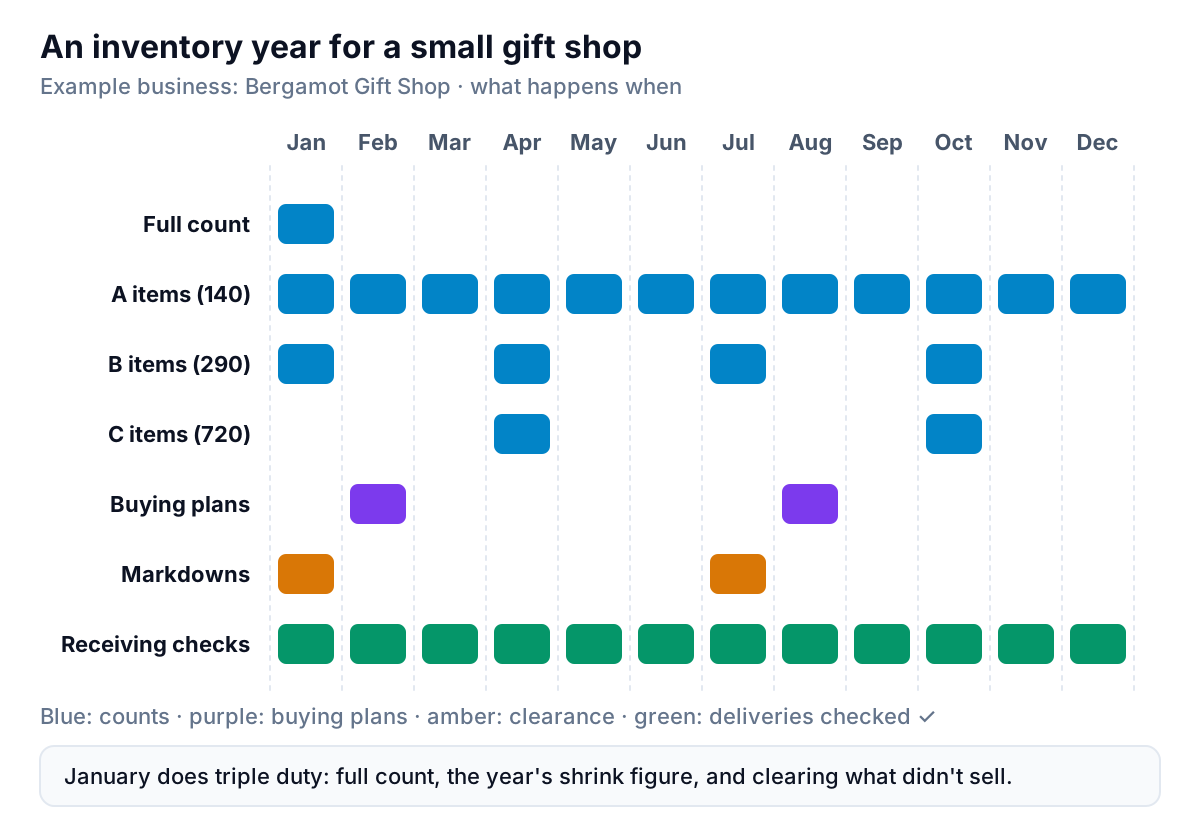
An annual count tells you the gap once a year, months after the mistakes that caused it. A cycle count, where you count a slice of the shop on a schedule, finds problems while you can still trace them. It also makes the January count faster, because most of the stock record is already right.
Not every item deserves the same attention. Bergamot grades its 1,150 items by last year's sales, the same 80/15/5 split our Pareto analysis guide explains, and counts the A items most often.
How to run it without disrupting the shop:
- Count by location, not by list. Do one shelf or fixture at a time, top to bottom, so nothing is counted twice or skipped.
- Count before opening, when nothing is being sold, or freeze sales of that section for ten minutes.
- Investigate before you adjust. If the count is off by more than one or two units, check for unreceived deliveries and recent wrong-code sales before posting the adjustment. Then post it with a reason.
- Know what your system does with uncounted items. Square's retail counting, for instance, distinguishes cycle counts from full counts, and in a full count any item you didn't count is set to zero when the count is approved. Square also recommends counting each item variation at least once every 90 days.
Keep the annual full count too. Your accountant needs a year-end stock figure, and the IRS says in Publication 538 that businesses keeping inventories must take a physical inventory at reasonable intervals and adjust the books to match. Some small businesses can use simpler methods, so ask your accountant what applies to you.
Buy with a rule, not a feeling
Shrink is the visible leak. Over-buying is the bigger, quieter one, because it doesn't show up as missing stock. It shows up as stock that's all there and won't sell.
Split your range into two kinds of buying and give each its own rule:
- Replenishment items sell steadily all year: Bergamot's cards, its core candle scents, gift wrap. These get a reorder point and an order-up-to level, and the stock system or a weekly report tells you when to order. The inventory dashboard guide shows how to set both; if you run the shop from a spreadsheet, the inventory spreadsheet template flags them for you.
- Seasonal and one-time buys are bought once for a season: holiday ornaments, summer tableware, a designer's limited run. A reorder point is meaningless here. These need a budget for the season, set before you visit a trade show, and a check partway through on how fast they're selling. That budget is an open-to-buy plan, and the mid-season check is sell-through rate.
A useful rule at Bergamot: no seasonal order is placed without a number next to it for what the shop expects to have sold by a set date. If the line has sold less than half that by mid-season, it gets moved to a better spot and the next order is cut. The rule turns a buying decision into a forecast you can check.
Clear what doesn't sell, on a calendar
Every gift shop has a shelf of things that seemed like a good idea. The cost of keeping them isn't just the cash: it's the space a better seller could have used. Bergamot marks down on a schedule rather than when someone notices:
- Seasonal items get marked down the week after the season ends, starting at 30% off and dropping in two-week steps. Holiday stock left after mid-January goes to a clearance table.
- Year-round items that haven't sold in 120 days get moved first, then marked down at the January or July clearance.
- Anything still there after the clearance is bundled, returned to the supplier for credit if the terms allow, or donated. If you donate or write down stock, ask your accountant how to record it.
Two measures help decide which lines deserve shelf space at all. GMROI shows how much gross margin each dollar of stock earns, and days inventory outstanding shows how long money sits on the shelf before it comes back. Neither needs to be calculated weekly; once a quarter by category is plenty.
What to watch, and when the numbers move
Put a few inventory numbers next to your sales numbers and check them on the same rhythm. The retail KPI guide covers the full set; for inventory management specifically, three are enough:
| Number | Check | If it moves the wrong way |
|---|---|---|
| Cycle count variance (value of adjustments ÷ value counted) | Monthly | Sort adjustments by reason. Mostly "count"? Look at receiving. Concentrated in one fixture? Look at that fixture's labels and till keys. |
| Stock at cost vs the same month last year, against the change in sales | Monthly | Stock growing faster than sales means buying ran ahead. Cut the next seasonal budget before adding more replenishment. |
| Value of stock with no sale in 120+ days | Monthly | Rising? The markdown calendar is slipping. Bring the next clearance forward. |
For Bergamot, the first number tells the story of the year. The owner changed the receiving routine in February and locked the generic till keys in March. If the monthly A-item counts show variance falling from spring onward, next January's gap should be smaller, and she'll know which change did it.
Connect Shopify or Square, or upload a stock and sales export, and Parity builds a checked inventory dashboard with what needs attention. Build a report from your data free
None of these habits needs new software. They need a routine that's written down and done the same way each week. Start with receiving, because it's where Bergamot's biggest leak was and the fix costs nothing but ten minutes per delivery. Then add the weekly count. By next January, the count should hold fewer surprises.